Old casings in a Lemon Grove ranch, or a sticky front door in North Park, often have more than one coating on them. Putting alkyd on existing latex trim is a job-by-job call, not a rule you copy from a forum. A licensed local painter inspects the wood, tests a small area, and only then names a primer and finish.
Identify the existing trim coating
About 49.6% of housing units in the City of San Diego were built before 1978. In La Mesa that share is 68.7%. In Lemon Grove it is 69%. In National City it is 66.2%. In El Cajon it is 62.5%. Those houses still carry decades of paint on doors, baseboards, window stools, and casing.
You usually cannot name that stack by looking. Sheen is a hint, not a lab result. A glossy door in Hillcrest might be old alkyd, a later latex enamel, or both stacked. Leftover gallons in the garage help when the labels still match the room. If the cans are gone, the painter is working from chips, edges, and feel.
Ask them to say what they think is on the wood, and how they decided. Some will look at a chip under a stair. Some will check a hidden edge behind a door. Some will compare a scrape to films they know. What you want on the quote is that finding in plain words, not a hallway guess.
This page stays on trim, doors, and baseboards. Kitchen boxes take a different beating, and they use different enamel systems. If cabinets are the real question, use our latex versus alkyd cabinet enamel guide instead.
If the house predates 1978, paid work that disturbs paint can fall under the EPA Renovation, Repair and Painting program. The rule applies in general to paid renovation in pre-1978 housing and child-occupied facilities. Testing is not required by the RRP rule. Without records showing the affected paint is not lead-based, applicable requirements remain. Color and sheen do not settle it. A painter who will sand or scrape old trim should say whether the job is in scope, how signs and containment will work, and how dust stays in the work area.
Newer inland stock is a different mix. San Marcos is about 23.8% pre-1978. Carlsbad is about 27.5%. Encinitas sits near 45%. Those homes still need a coating ID. They just have less lead-era trim in the mix than Lemon Grove or National City.
Check adhesion and surface damage first
Alkyd over a loose latex film fails at the old layer, not the new one. Before anyone talks sheen, the painter should press, pick, and look.
Start with high-touch wood. Door edges that hit the jamb. Baseboards by the entry in Imperial Beach, where sand comes in on shoes. Window stools that take condensation in a coastal bedroom. Stair railings in two-story tracts in Santee and Poway, where about 47.8% and 49.2% of housing units predate 1978.
Failed film looks like peeling in sheets at edges and miters. Fine cracking that follows the paint instead of the grain. Soft spots from leaks around tubs and sliders. Chips that go down to primer or bare wood. A harder topcoat will not glue down paint that is already letting go. The honest scope is to remove the failed film, then prime what is left. If a whole run of baseboard is loose, new wood can be the cleaner path. That is a trim call, not a can of paint talking.
Coastal interiors stay damper than inland ones. Average relative humidity at San Diego International Airport is 79%, peaking near 91% before dawn and falling to about 67% in the early afternoon. Inland rooms in Escondido or El Cajon usually sit drier. Humidity does not prove latex versus alkyd. It does help explain why a bathroom door may have a weaker film than a hall casing.
Tell the painter if doors already bind after an old repaint. That belongs in the same visit as the adhesion check. Closing enamel too soon is a common reason painted doors stick after repainting.
Compare cleaning, sanding, and primer scopes
Quotes for trim, doors, and baseboards should split prep from color. Cleaning, sanding, and primer are three different amounts of time.
Cleaning comes first. Hand oil around knobs, cooking film on kitchen casing, and sunscreen on a west-facing slider all sit on latex. Sanding that dirt into the film is a bad start. The painter should name the cleaner and the rinse, then wait until the wood is dry.
Sanding depends on the house. On pre-1978 trim, federal RRP work practices apply to covered jobs. Power sanding, grinding, or similar work on painted surfaces is prohibited unless the machine has a shroud or containment system with a HEPA vacuum collecting dust at the source. Heat guns stay under 1,100°F. Signs go up before work starts. The work area is isolated so dust and debris do not leave it. Furniture, rugs, and window coverings come out or go under taped sheeting. Waste stays contained and gets secured at the end of every work day.
On newer trim, the painter still needs a dull, clean surface. How far they cut is a scope line: a light scuff, or back to a sound layer. Ask which, room by room.
Primer is not a slogan. The data sheet for the finish the painter intends to use decides. Stain-blocking primers such as Zinsser Cover Stain or Zinsser B-I-N appear on trim specs when tannin, smoke, or marker is in play. Naming them is a fact about products for sale. It is not a promise that every latex baseboard needs a full prime. If the quote says spot prime versus full prime, walk the rooms and mark the difference on the wood.
EPA guidance on indoor VOCs is narrow: increase ventilation, meet or beat the label, and follow the label. That source does not give a universal safe occupancy time, and this page will not invent one. Ask what the can says, and how the painter will vent a tight Coronado cottage versus a more open plan inland.
A California C-33 painting contractor classification covers surface preparation and the application of paints, primers, varnishes, and similar coatings. For work at or above $1,000 in labor and materials, California law as of 2026 requires a licensed contractor. Check the number on the CSLB license lookup before you sign.
Review the proposed finish with the painter
After the old film is named and the failed bits are in the scope, talk about the new coat. People who search “alkyd paint over latex” usually want a smoother, harder trim finish than what is on the wood now. That is a fair goal. It is still not a product pick by itself.
Have the painter write the system: cleaner, sanding, primer if any, finish, sheen, and method. Brush and roll versus spray changes masking. Doors often come off the hinges. Baseboards usually stay put. Window sash needs a sequence so the units still open.
Named interior trim enamels you may see on a spec include Sherwin-Williams Emerald Urethane Trim Enamel, Sherwin-Williams ProClassic, and Benjamin Moore ADVANCE. Those are current architectural coatings. Do not attach a lifespan, a warranty term, or a dollar figure to any of them. Ask why that can belongs on this wood, in this house, over this existing film.
Cleanup and odor are household issues as much as film issues. If the painter proposes a solvent-borne alkyd, ask how they will ventilate, store rags, and keep pets off wet sills. If they propose a waterborne alkyd, ask the same questions against that label. San Diego County architectural coatings are governed by Air Pollution Control District Rule 67.0.1. The exact grams-per-liter table in that rule could not be confirmed from the primary document for this page. Treat the current can and the painter’s product list as the authority, not a blog chart.
Sheen is feel and cleaning. Higher sheen on old mitered casing shows every ding. Lower sheen hides more and can look flat on a front door. View a sample in the real light: a north room in Point Loma versus a bright east kitchen in Chula Vista.
Keep the rest of the interior in view. Fresh trim against tired walls looks unfinished. If walls are in the same visit, that is interior painting, sequenced so enamel on doors does not pick up wall spatter.
For more on how local trim jobs are scoped, read trim and baseboard painting in San Diego.
Confirm a test area before wider repainting
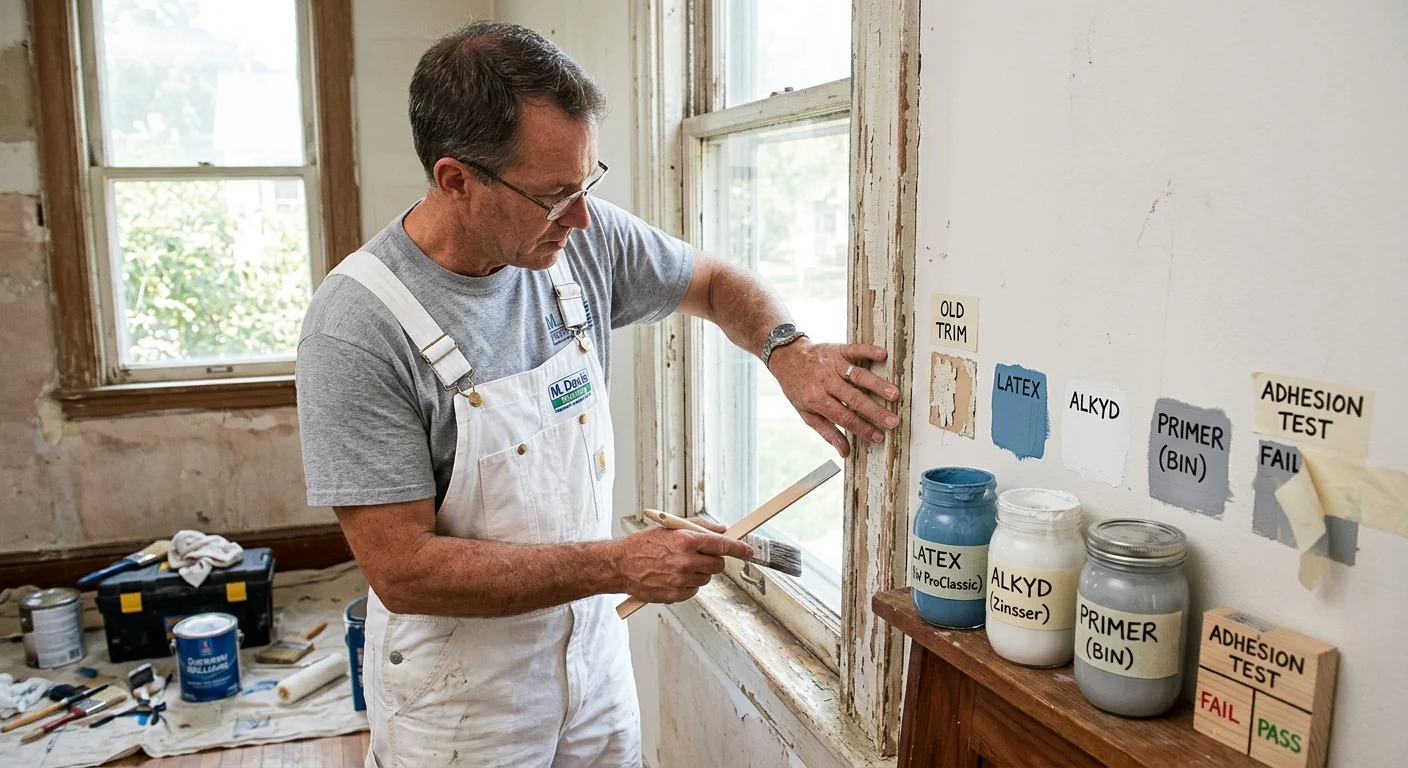
A test area is how you find out whether alkyd paint over latex will hold on your trim. Pick a low-visibility piece: the back of a closet door, a baseboard behind a dresser, or a casing edge the painter can coat again.
The test has to repeat the real system. Same clean. Same sanding. Same primer. Same finish. Same coat count. A dab of alkyd on unwashed latex tells you nothing.
Then wait. Follow the recoat notes on the label in use. Coastal humidity can slow a film. Inland heat in Ramona or Alpine can hurry another. There is no county-wide dry-time number to publish here. The can, the room, and the painter’s check are the record.
After that wait, the painter should try to fail the patch. Thumb the film. Check the edges. If it peels, wrinkles, or stays gummy, stop. Change the prep, the primer, or the finish. Do not carry a failed patch down a whole hallway of baseboard.
If the test holds, the wider job still needs the same prep. Skipping the scuff in the “easy” rooms is how you get a good closet door and a peeling dining-room casing.
What will stick to latex on trim is the system that passed that test, not a brand line. An alkyd enamel over latex can look fine, or it can pull, depending on the old film and the prep. Alkyd over an older oil-type enamel is still not a free pass. Adhesion of the coat that is already there comes first. Primer is whatever that tested system required, not an automatic yes on every door.
When the test is done, you should have three things in writing: the existing coating as identified, the prep and primer scope, and the finish product and sheen. That is the job you are buying.
When to call us
Call when trim is chipping, doors pick up every fingerprint, or you want alkyd over an unknown latex and need a painter to test it rather than guess. Paint Pros San Diego is a referral service. We match you with licensed, independent local painters who inspect and do the work. Call us at (858) 400-6422 and we’ll connect you with a licensed local painter.