Here is the short answer. Modern waterborne urethane-modified alkyds, like Benjamin Moore Advance, Sherwin-Williams Emerald Urethane Trim Enamel, and INSL-X Cabinet Coat, give you the rock-hard durability of traditional oil-based alkyd with the soap-and-water cleanup, low odor, and low VOC compliance of latex. Pure latex enamels are fine for low-traffic accent cabinets or a quick DIY refresh. Traditional oil-based alkyd is mostly obsolete in San Diego because of California’s air quality rules and the yellow-shifting it does over time. To get matched with a painter for your kitchen, call (858) 400-6422.
What is the difference between latex vs alkyd paint?
Latex vs alkyd paint on cabinets is not a two-way tie anymore. Traditional oil alkyd is mostly gone in San Diego because of air-quality rules and yellowing. Pure latex enamel is the DIY-easy option and the weaker kitchen finish. The product class the painters we match actually spray is a waterborne urethane-modified alkyd, which is why the rest of this guide compares three families, not two.
The 3 paint families compared
There are really three families homeowners are weighing when they look at cabinet enamel in 2026. Knowing what each one is, before getting lost in brand names, saves a lot of confusion.
Pure latex or acrylic enamel uses a 100% acrylic resin in a water carrier. It dries fast, cleans up with water, and has very low VOCs. The trade-off is hardness. Pure acrylics never get as hard as alkyds. They block (stick to themselves) more easily and ding under fingernails. Good examples are Behr Premium Plus Cabinet, Door, and Trim Enamel, and Sherwin-Williams ProClassic Acrylic.
Traditional oil-based alkyd uses a petroleum-derived alkyd resin in a mineral-spirits carrier. It self-levels beautifully, cures to a glass-hard finish, and lasts a long time mechanically. The downsides are real. It off-gases for days, requires solvent cleanup, recoats only after 16 to 24 hours, and yellows noticeably under any cabinet that does not get UV. Sherwin-Williams ProClassic Alkyd and Benjamin Moore Satin Impervo (now mostly discontinued) are the historical references.
Modern waterborne urethane-modified alkyd is the hybrid revolution. Chemists grafted urethane and alkyd resins into a water-dispersible emulsion. You get the leveling and hardness of alkyd with the cleanup, odor profile, and recoat speed of latex. Benjamin Moore Advance, Sherwin-Williams Emerald Urethane Trim Enamel, and INSL-X Cabinet Coat all live in this family. PPG Breakthrough is in this family too, along with Cabinet Coat from Insl-X (an ICI/PPG brand).
Here is a quick spec comparison, drawn from each manufacturer’s published tech data sheet.
| Property | Pure latex/acrylic | Traditional alkyd | Hybrid urethane alkyd |
|---|---|---|---|
| Recoat window | 4 hours | 16 to 24 hours | 6 to 16 hours |
| Full cure | 14 to 21 days | 21 to 30 days | 21 to 30 days |
| Hardness (pencil) | 2H to 3H | 4H to 5H | 3H to 5H |
| Yellowing risk | Very low | High in dark areas | Low to none |
| Cleanup | Soap and water | Mineral spirits | Soap and water |
| VOC content | 50 to 100 g/L | 350 to 550 g/L | 100 to 250 g/L |
| AQMD Rule 1113 compliant | Yes | No (most formulas) | Yes |
| What ends the finish’s useful life | Wear at high-touch points | Color shift from yellowing, not mechanical failure | Wear at high-touch points, no significant yellowing |
That table is the whole post in one screen. The rest of this guide is why.
What alkyd used to mean (and why pros abandoned it)
Up through the early 2010s, oil-based alkyd was the unquestioned king of cabinet and trim work. The resin chemistry is great at flowing out brush and roller marks, self-leveling into a mirror-smooth film, and curing into a finish that resists fingernails and grease. Old-school painters loved it for a reason.
The problems were never the durability. They were everything else.
Traditional alkyd recoats only after 16 to 24 hours, which means a typical 30-door kitchen takes a full week longer than a modern hybrid job. The mineral-spirits solvent puts off heavy fumes that you, your family, and your pets can smell for days. It requires solvent cleanup, which is a hazardous-waste headache. And the resin itself is unstable in low UV. Open up a cabinet door that has been closed for a year and the inside is creamy yellow next to the still-white outside. The Kitchen Cabinet Manufacturers Association documents this yellowing as one of the top consumer complaints with oil-based finishes on light cabinets (KCMA Cabinet Finish Standards).
Most San Diego cabinet pros stopped buying it around 2013 to 2015 once the first wave of hybrid alkyds matured. By 2020, the California Air Resources Board and South Coast Air Quality Management District had effectively legislated traditional alkyd out of the residential market in our region. We will get to those rules in a minute.
The modern hybrid revolution
Waterborne urethane-modified alkyd is the most important advance in cabinet finishing in 30 years. The chemistry took roughly a decade to refine. Early hybrids in the late 2000s had pot-life problems and flash-rusted over steel hardware. By the mid-2010s the formulations had stabilized, and by 2020 they were the default for any pro cabinet shop in California.
What you are getting is a paint that thins with water, cleans up with soap, off-gasses minimally, and dries to the touch in about 4 hours. But the resin film, once cured, is harder than pure acrylic and approaches the hardness of traditional alkyd. The cure is slow (3 to 4 weeks for full block resistance), which is the one real limitation. You cannot reinstall doors on day 2 and expect them not to stick to each other. We will cover cure time in detail below.
Fine Homebuilding ran a blind durability test in 2024 comparing Advance, Emerald Urethane, and Cabinet Coat against traditional ProClassic Alkyd on identical white-painted maple panels (Fine Homebuilding cabinet paint comparison). After accelerated wear testing, all three hybrids came close to matching the traditional alkyd’s hardness, with zero yellowing. The traditional alkyd shifted noticeably warm. None of the pure acrylics in their test came close on hardness.
That is the story. Hybrid alkyds are now the right answer for almost every residential cabinet job in San Diego.
Hardness and durability in a real kitchen
Pencil hardness, ASTM D3363, is the standard industry test. The scale runs from 6B (very soft) up through HB and into 9H (very hard). For cabinets you want at least 2H, and pro shops target 3H to 4H. Anything softer dings under a thumbnail.
Pure latex enamels generally test in the 2H to 3H range after full cure. Benjamin Moore Advance, Sherwin-Williams Emerald Urethane, and INSL-X Cabinet Coat all test in the 3H to 5H range per their published data sheets. Traditional alkyd lands at 4H to 5H but takes longer to get there.
Real-world lifespan is different from a lab test. In a working San Diego kitchen with two kids, a dog, and a family that actually cooks, we see the following pattern:
- Pure latex enamel: visible wear shows first at high-touch points (top edge of doors, around handles, the cabinet by the trash pull-out). Repaint gets triggered by mechanical wear.
- Traditional alkyd: the wear surface itself holds up well, but yellowing on light colors shows up well before the finish mechanically fails. Repaint gets triggered by color shift, not failure.
- Hybrid urethane alkyd: wear shows at the same high-touch points as pure latex, but with no significant yellowing. Repaint gets triggered by color preference or a kitchen remodel, not finish failure.
The hybrid wins on total useful life because it does not yellow. A traditional alkyd that’s mechanically sound can still be worth repainting early because the white cabinets now look like dirty cream. ASTM D4587 (accelerated UV testing) shows the hybrid resins hold color stability substantially better than traditional alkyds (ASTM D4587 standard).
California AQMD Rule 1113 implications
This is the part most homeowners do not realize. Most traditional oil-based alkyd cabinet paints cannot legally be sold to homeowners in San Diego County in 2026.
South Coast Air Quality Management District Rule 1113 governs VOC content in architectural coatings sold in our region. Cabinet enamels are classified as “industrial maintenance” or “interior wood coatings” depending on the formula, with VOC caps in the 100 to 275 g/L range depending on category (SCAQMD Rule 1113). Most traditional alkyd enamels run 350 to 550 g/L. They simply do not comply.
What this means in practice. If you walk into a Sherwin-Williams or Benjamin Moore store in San Diego today and ask for an oil-based cabinet paint, you will usually be redirected to the hybrid. The traditional ProClassic Alkyd is still made for select industrial and out-of-state markets, but the stores here mostly do not stock the cabinet-relevant sheens. Specialty mail-order is technically available but not for residential application.
The hybrids were engineered specifically to hit Rule 1113 compliance while maintaining performance. That is why they exist. California, more than any technical breakthrough, drove the chemistry forward.
SW Emerald Urethane vs BM Advance vs INSL-X Cabinet Coat
These are the three hybrid enamels we actually buy week to week. They are not identical. Each has a specific personality.
Benjamin Moore Advance. Priced at the higher end of the hybrid category retail in San Diego. The longest open time of the three (slowest dry), which means it self-levels beautifully out of a sprayer. The trade-off is it stays soft longer (full cure at 30 days). On a doors-off spray job it is our default for white shaker cabinets where the customer wants a glass-smooth finish. Available in matte, satin, semi-gloss, and high-gloss. Tint base is limited in deep saturated colors.
Sherwin-Williams Emerald Urethane Trim Enamel. Priced at the top of the hybrid category retail, though it’s regularly discounted on contractor sale. Faster dry than Advance (recoat in 4 to 6 hours vs. Advance’s 16). The faster cure means harder finish sooner, useful if doors need to go back on quickly. Slightly less forgiving on brush and roll because it sets up fast. Sprays clean. Check the current Sherwin-Williams Emerald product data sheet for film properties and any published warranty terms.
INSL-X Cabinet Coat. Priced at the low end of the hybrid category retail. The budget hybrid. Made by Benjamin Moore’s INSL-X specialty brand and engineered specifically for cabinets. Excellent adhesion to laminate and thermofoil, which is its real edge. Slightly less hard at full cure than Advance or Emerald Urethane, but plenty hard for residential. We use this on laminate refinishing jobs and tight-budget projects.
If a customer asks us which to spec, the honest answer depends on the cabinet substrate and timeline. Maple shaker doors with a generous timeline: Advance. Maple or oak doors that need to reinstall fast: Emerald Urethane. Laminate or thermofoil: INSL-X Cabinet Coat. There is no wrong answer in this group.
When to still use traditional alkyd
There are still narrow cases where traditional oil-based alkyd makes sense, even in 2026.
Extreme-traffic commercial kitchens that are exempt from residential VOC rules sometimes still spec it. Antique furniture restoration where the customer wants the natural yellowing to match an aged piece is another. Some marine and high-humidity industrial applications still favor traditional alkyd resin.
For a San Diego residential kitchen, the answer is essentially never. Bob Vila’s product roundup in 2025 came to the same conclusion (Bob Vila cabinet paint reviews). The hybrids do the same job better in our climate and under our regulations.
When to use pure latex
Pure latex or acrylic enamels still have a legitimate place. They are not bad paints. They are just outclassed for high-wear cabinet work.
Use pure latex when you are repainting interior trim that does not get heavy hand contact (chair rail, baseboard, crown molding). Use it on a powder-room vanity that gets used twice a day, not a family kitchen island. Use it on a guest-room closet door. Use it when the budget is tight and the customer accepts a shorter repaint cycle.
Use it also when the DIY learning curve matters. Pure acrylic latex is the most forgiving paint a beginner can put on a cabinet door. It recoats fast, sands easy if you make a mistake, and is genuinely soap-and-water cleanup. Beginners often struggle with hybrid alkyd because the long cure feels like the paint is “not done” for weeks. It is just normal.
Use pure latex when the budget favors a shorter repaint cycle over the long haul, or when the DIY learning curve matters more than maximum durability.
For our own kitchen, we would not use pure latex. We use a hybrid.
Application differences per type
The three families spray and brush differently. Knowing this before you buy a gallon saves a botched first coat.
Pure latex enamel sprays through a 310 or 312 fine-finish tip at typical thinning. It dries dust-free in 30 to 45 minutes and recoats in 4 hours. Brush and roll is fine with a high-quality synthetic-bristle brush (Wooster Silver Tip, Purdy Nylox) and a 4-inch microfiber mini-roller. Lap marks are forgiving because the resin levels reasonably well, though not as well as alkyd.
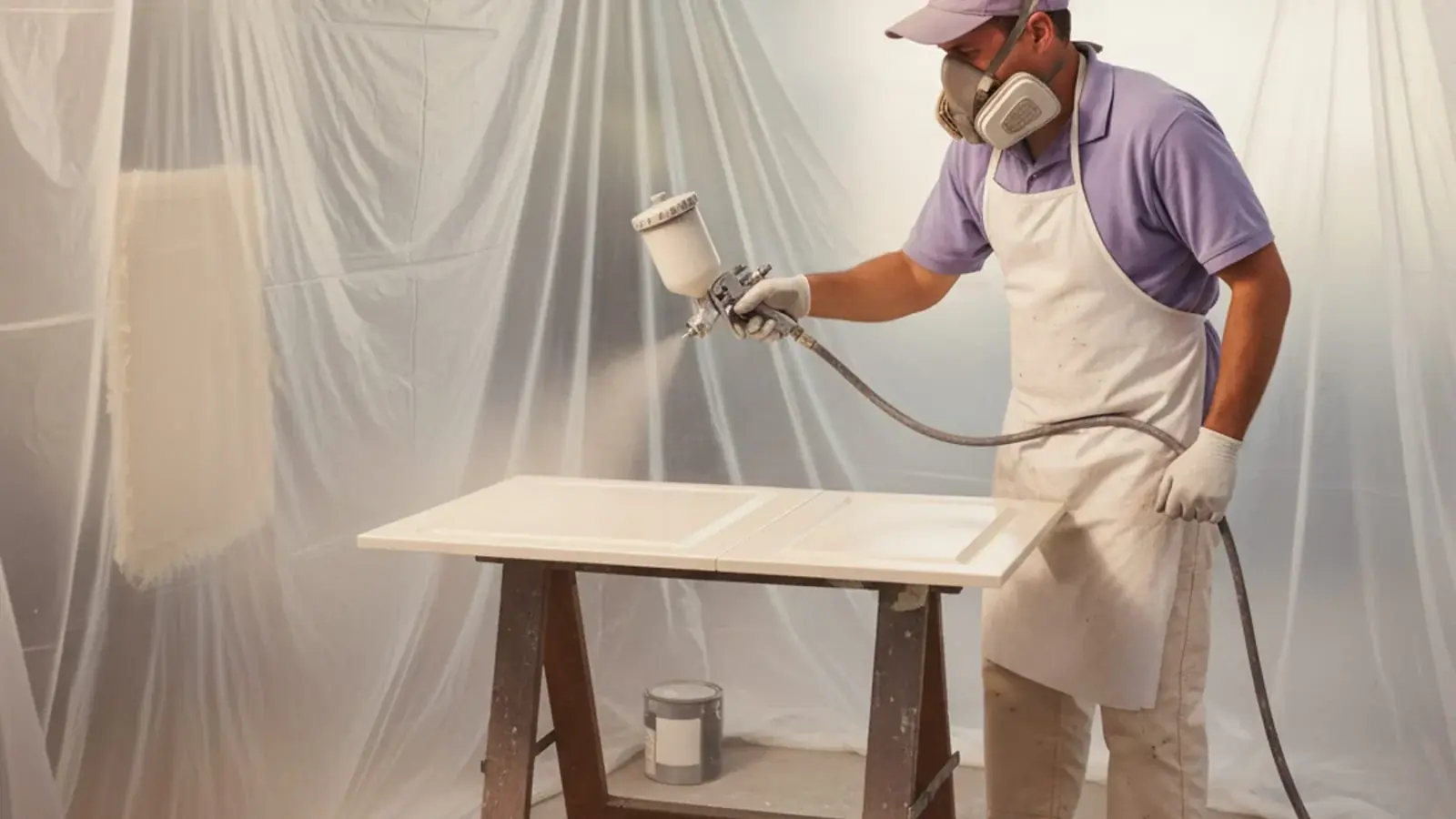
Hybrid urethane alkyd sprays beautifully through a 410 or 412 tip at 0 to 5 percent water thinning. Long open time means slower dust-free (60 to 90 minutes) but excellent leveling. Brush and roll requires technique. Advance especially can be over-brushed and leave drag marks because the resin sets up gradually. Use a soft synthetic brush, do not overwork the paint, and accept that the second coat will look better than the first. Recoat at 6 to 16 hours depending on product. Some pros add a post-catalyst (cross-linker) for harder cure on extreme-use kitchens. Optional and not always available.
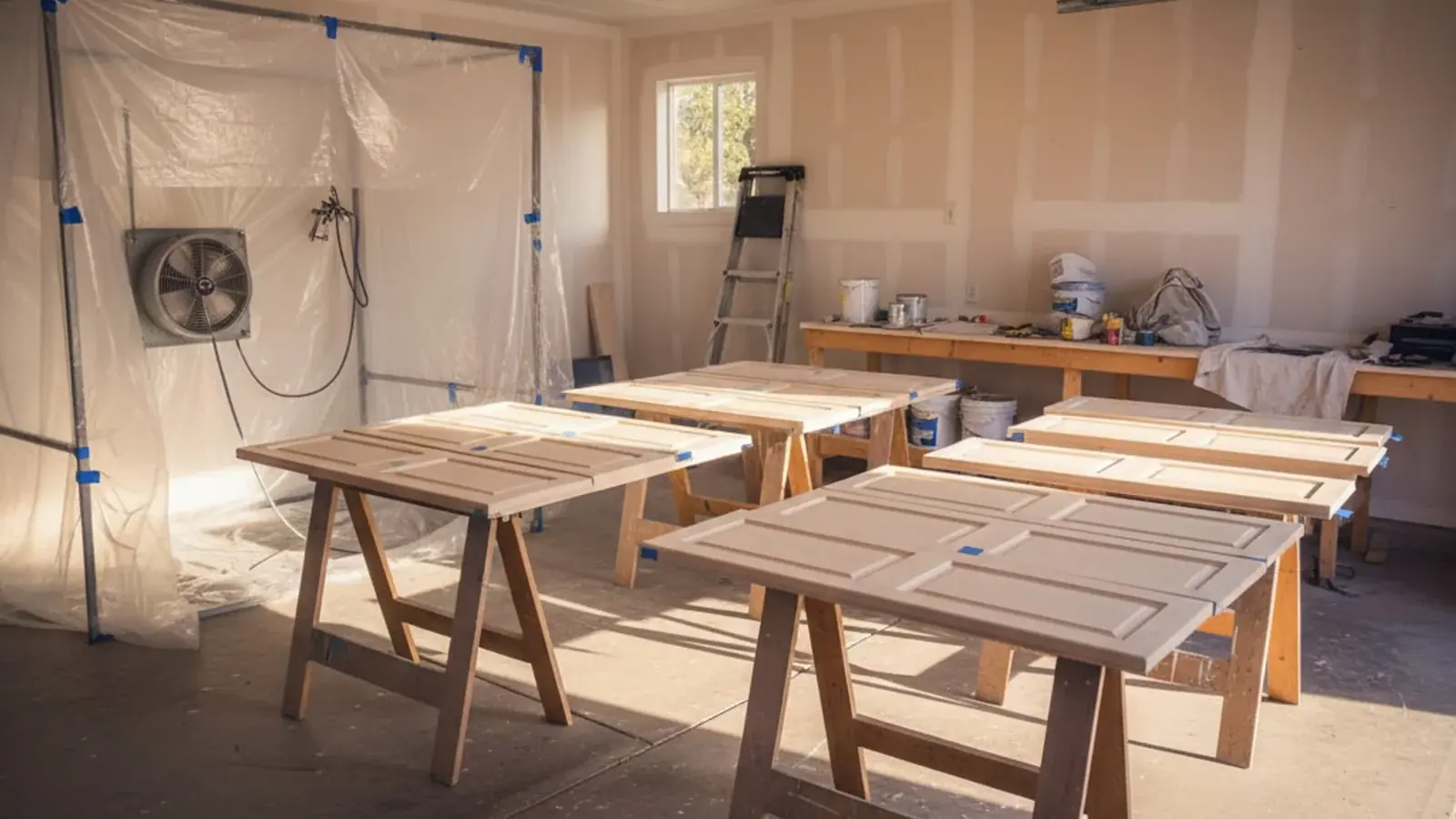
Traditional alkyd sprays through an air-assisted airless or fine HVLP at 5 to 10 percent mineral-spirits thinning. Dries dust-free in 4 to 6 hours. Recoats in 16 to 24 hours, sometimes longer in cool weather. Requires solvent cleanup of every brush, roller, and gun part. Requires real ventilation during application. Not a job to do over a weekend with the family home.
For a deeper walk-through of how we actually spray a kitchen, see our professional cabinet refinishing process and the broader cabinet painting San Diego: what to expect guide.
What drives paint cost per gallon across the three families
A standard 30-door kitchen takes roughly 2 to 3 gallons of finish enamel plus 1 gallon of primer, after the typical contractor discount where applicable.
- Pure latex enamel (SW ProClassic Acrylic, Behr Premium Plus Cabinet): priced at the low end of the category
- Traditional alkyd (where still available, special order): priced in the middle, and harder to source
- Hybrid urethane alkyd (Advance, Emerald Urethane, Cabinet Coat): priced across a wider band depending on brand, generally the highest of the three
The hybrid premium over pure latex is real but small next to the total job cost. Labor, not material, is the budget driver, and labor runs roughly identical across all three finish families.
For the full cost breakdown on a typical San Diego cabinet repaint, see our cabinet painting cost in San Diego guide. For the larger cabinet-vs-replace question, see cabinet painting vs. replacing in San Diego.
What we actually use
In 2026 our default cabinet enamel is Benjamin Moore Advance Satin for shaker doors on a doors-off spray job with a generous timeline. We switch to Sherwin-Williams Emerald Urethane when the customer needs doors reinstalled in under two weeks. We use INSL-X Cabinet Coat on laminate, thermofoil, and tight-budget jobs. Primer is almost always INSL-X STIX or BIN shellac depending on substrate.
We do not buy traditional oil-based alkyd for residential cabinet work anymore. The yellowing alone takes it out of the running on every white or off-white kitchen, which is the majority of the local work.
If you are weighing brands more broadly, see our Sherwin-Williams vs. Behr for stucco guide for our general thoughts on those two lines, and our paint sheen guide for San Diego for sheen selection on cabinets versus walls. For the full kitchen project overview, see our kitchen cabinet painting San Diego guide.
Frequently asked questions
Can you recoat over old oil-based alkyd with a new hybrid?
Yes, but you need to clean, lightly scuff-sand the old finish (220 grit), and prime with a bonding primer like INSL-X STIX. Hybrid waterborne enamels do not always grip cured alkyd directly. The primer step is what makes it work. Skipping it leads to peeling at edges within a year.
Which yellows least over time?
Modern hybrid waterborne urethane alkyds yellow the least. ASTM D4587 testing shows substantially better color stability than traditional alkyd. Pure acrylic latex also yellows very little. Traditional oil-based alkyd yellows the most, showing visibly on light colors and in low-UV cabinet interiors well before the finish itself fails.
Can a homeowner DIY any of these?
Pure latex is the easiest to DIY. Hybrid urethane alkyd is doable but requires patience with the long cure and care with brush technique. Traditional alkyd is hard to DIY because of fume management, solvent cleanup, and the long recoat window that ties up your kitchen for two weeks. Most DIYers should pick pure latex or a homeowner-friendly hybrid like INSL-X Cabinet Coat.
What is the cure time before I can reinstall doors?
Light handling is fine at 24 hours for any of these paints. Full block resistance (doors that will not stick to each other or to the frames) takes 14 days for pure latex, 21 to 30 days for hybrid alkyd, and 21 to 30 days for traditional alkyd. Most pros reinstall doors at 7 days and tell the customer to be gentle for the first three weeks.
Which scrubs cleanest in a working kitchen?
Hybrid urethane alkyds scrub the cleanest because the hardened resin film resists oil, food splash, and fingerprints best. Pure latex is acceptable but tends to mark with magic-eraser scrubbing. Traditional alkyd scrubs well but the yellow tone makes “clean” look creamy regardless.
Do painters in your network offer estimates on cabinet refinishing in San Diego?
Yes. Painters in our network typically offer an in-home walkthrough, quoted in writing, anywhere in San Diego County. Call (858) 400-6422 or visit our page for cabinet painting in San Diego County to schedule.
The bottom line
For a 2026 San Diego kitchen, the right cabinet enamel is a modern waterborne urethane-modified alkyd. Benjamin Moore Advance, Sherwin-Williams Emerald Urethane Trim Enamel, and INSL-X Cabinet Coat all qualify. Pure latex is acceptable for low-traffic accents or DIY-friendly projects. Traditional oil-based alkyd is effectively obsolete in California for residential cabinet work, both because of yellowing and because of CARB and SCAQMD VOC rules.
Want our recommendation for your specific kitchen? Call (858) 400-6422 for a San Diego cabinet-painting walkthrough. We will walk your kitchen, recommend the right product for your cabinets and your timeline, and quote the job in writing.