Kitchen cabinet painting in San Diego is priced per door and drawer front, not per room. A standard kitchen runs 25 to 35 fronts, and the count is the first number any honest quote starts from. After the count, the price moves on four things: the condition of the existing finish, whether the doors get sprayed off-site or in place, the grade of enamel, and how big a color change you’re making. Painting costs a fraction of replacing the boxes, which is why it’s the most common kitchen refresh in the county. For a full walkthrough of the process, see our complete guide to kitchen cabinet painting in San Diego, browse our roundup of cabinet painters near you, or check the broader 2026 house painting cost guide for budget context.
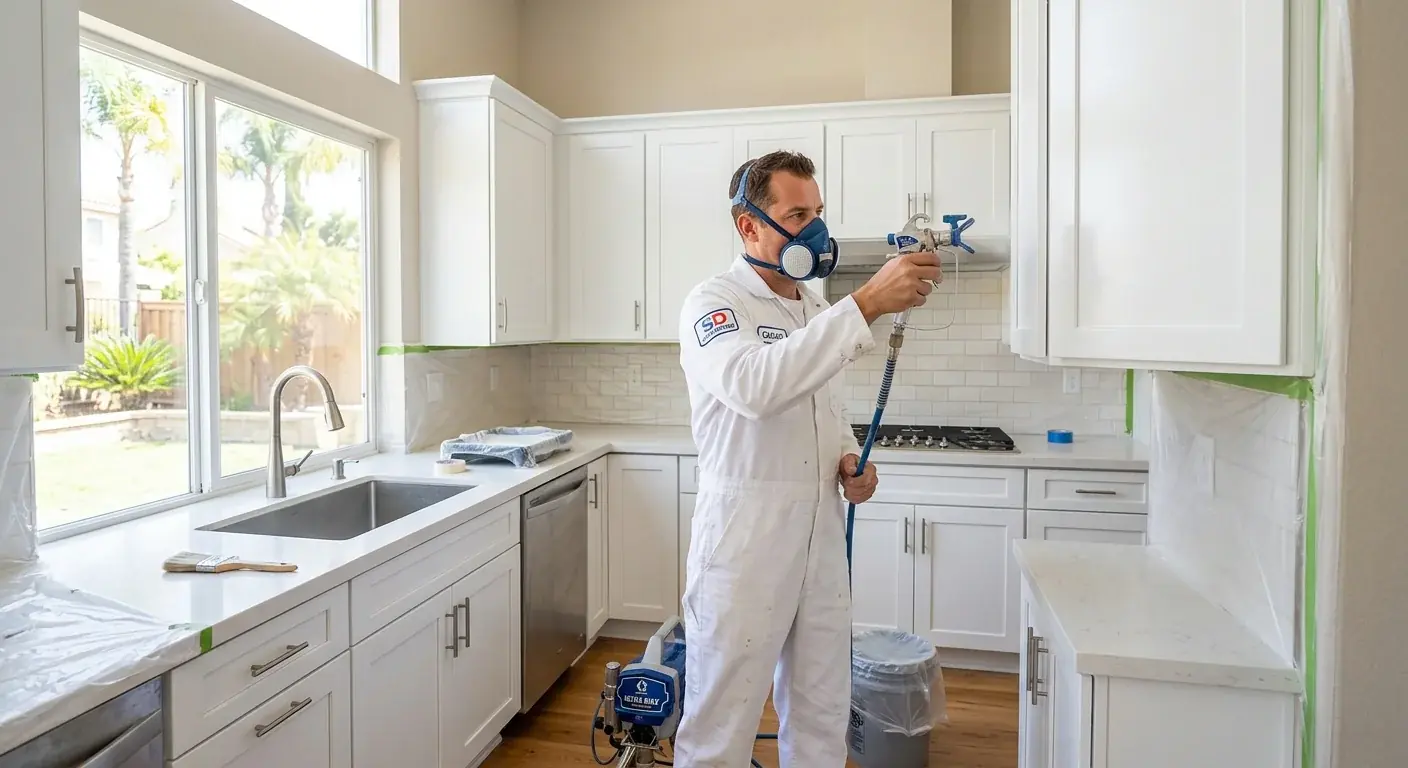
How is kitchen cabinet painting priced in San Diego?
Cabinet painting is priced per door and drawer front, not per room and not per square foot. That single fact explains most of the spread between two quotes on the same kitchen. A painter counts every door, every drawer front, and every exposed end panel, then prices the boxes separately because those get brushed and rolled in place rather than sprayed.
A standard San Diego kitchen runs 25 to 35 doors and drawer fronts. A galley or condo kitchen sits below that. A kitchen with an island, a pantry, and an appliance garage can pass 50. When you compare two bids, compare the counts first. If one painter counted 30 fronts and the other counted 22, you’re not looking at the same job.
Four things move the number after the count:
- Condition of the existing finish. Sound factory laminate needs a bonding primer. Cabinets with a failing finish, grease film, or water swelling near the sink need stripping or replacement of individual doors, and that’s labor, not materials.
- Where the doors get sprayed. Off-site spraying in a booth costs more in handling and transport than masking your kitchen and spraying in place. It also produces the finish most people are actually paying for.
- The enamel. A cabinet-grade waterborne enamel costs several times what wall paint costs per gallon, and it’s the difference between a finish that survives fingernails and one that prints them.
- Color change depth. Going from dark stain to white takes more coats than going white to grey, and every extra coat is another handling and cure cycle.
Paint Pros San Diego is a referral service, so we don’t set the price. The painter we match you with quotes your kitchen after counting it in person, in writing. What we can tell you is what a real quote itemizes, which is the fastest way to spot a bid that’s too good to be true.
What licensed San Diego painters publish as planning ranges
We do not quote cabinets. Two licensed San Diego painting companies do publish planning ranges, and those numbers are the honest market picture as of 2026.
Chism Brothers (updated March 2, 2026) lists three process tiers for a standard kitchen: brush-and-roll in place around $1,800 to $2,500, doors sprayed and boxes brushed around $3,000 to $5,000, and a full spray of doors, drawers, and boxes around $5,000 to $7,500, or $8,500 to $15,000-plus on a large island kitchen.
J Brown Painting publishes a different cut of the same job: about $4,500 to $6,250 for a small-to-standard kitchen (roughly 10 to 20 doors plus drawers) and $6,250 to $9,000 for a large kitchen with 40-plus doors. Their process is doors off, degreased, BIN shellac primer, and sprayed enamel.
Treat those as one contractor’s planning ranges, not our price. The spread is the process: in-place brush-and-roll versus doors-off spray. If a bid comes in at $800 for a working kitchen, you are not buying the sprayed job those pages describe. Ask for the door count, the primer, and whether the doors leave the house.
What drives the price: cabinet count, material, finish, prep
The overall cost of your cabinet painting project is a puzzle made up of several pieces, each contributing significantly to the final price. The cabinet count is often the most straightforward driver. More doors, drawer fronts, and exposed cabinet boxes mean more surface area to prep, paint, and finish. Most painters price based on a per-door/drawer front unit, which simplifies estimating. A large kitchen with 40+ pieces will naturally cost more than a small kitchen with 20 pieces.
The material of your current cabinets also plays a role. Laminate or thermofoil cabinets, while paintable, require specialized primers and extra adhesion promoters, which can add to labor and material costs. Solid wood cabinets are generally easier to prep and paint, but their condition (grease buildup, deep scratches, previous poorly applied finishes) will dictate the amount of prep work needed. Older cabinets might need minor repairs or degreasing.
Next, the finish quality and type you select directly impacts the cost. High-quality, durable enamel paints designed for cabinets, like Sherwin-Williams Emerald Urethane Trim Enamel or Benjamin Moore Advance, are more expensive than standard wall paints but offer superior adhesion, hardness, and washability. Specialty finishes, like glazes, distressed looks, or two-tone schemes, involve additional labor and materials. Finally, prep work is arguably the most important and time-consuming part of any professional cabinet painting job, and it’s a significant cost driver. This includes thoroughly cleaning, degreasing, sanding, repairing minor imperfections, and priming every surface. Skipping these steps leads to a finish that won’t last, which is why experienced San Diego painters dedicate considerable time to proper preparation. You can learn more about the full process on our page for cabinet painting in San Diego.
Spray finish vs brush-and-roll: cost and durability tradeoffs
When it comes to cabinet painting, the application method significantly impacts both the final look and the overall cost. The two primary approaches are spray finishing and brush-and-roll. A spray finish typically delivers the smoothest, most factory-like appearance, free of brush strokes. This method requires specialized equipment, extensive masking to protect your home from overspray, and a skilled technician to apply the paint evenly. The labor involved in setup, masking, and meticulous spray application often makes this option more expensive upfront. However, the durability can be excellent, as spray application allows for multiple thin coats that cure into a hard, resilient surface. Many homeowners prefer this for a truly high-end, flawless look.
Brush-and-roll, on the other hand, is generally a more cost-effective option. It requires less equipment and masking, which can reduce labor time and material costs. While a skilled painter can achieve a very good finish with brushes and rollers, there will inevitably be some minor texture or brush marks visible upon close inspection. The durability can still be very good, especially with high-quality cabinet paints, but it might not match the rock-hard surface achieved with professional spraying. For those on a tighter budget or in kitchens where a slightly less perfect finish is acceptable, brush-and-roll can be a perfectly viable option. Ultimately, the choice often comes down to your budget, aesthetic preference, and how much you value that perfectly smooth finish. A painter can walk you through both options and recommend the best fit for your San Diego kitchen during the estimate. Our professional cabinet refinishing process details the steps that go into quality, regardless of the application method.
Cabinet painting vs refacing vs replacing, the real numbers
When considering a kitchen refresh in your San Diego home, cabinet painting is just one of three main options, each with vastly different costs and outcomes. Understanding these real numbers helps you make an informed decision that aligns with your budget and vision.
Cabinet Painting: As discussed, professional cabinet painting in San Diego is the most budget-friendly of the three options, providing a dramatic aesthetic change by updating the color and finish of your existing cabinet boxes, doors, and drawer fronts. It’s ideal if your cabinet boxes are structurally sound, you’re happy with your current layout, and you primarily want a fresh new look. It’s a quick transformation, with most of the calendar time being off-site door prep and cure.
Cabinet Refacing: This option involves keeping your existing cabinet boxes but replacing all the doors, drawer fronts, and applying new veneer to the exposed cabinet frames. This allows for a change in door style (e.g., from raised panel to shaker) and material. It costs meaningfully more than painting because every door and drawer front is fabricated new rather than refinished, and it still relies on the integrity of your existing cabinet boxes and layout.
Cabinet Replacing: This is the most extensive and expensive option, involving the complete demolition and removal of your old cabinets, followed by the installation of brand-new cabinetry. This allows for a complete redesign of your kitchen layout, new materials, and custom features. Cost tracks the scope of new cabinetry plus installation, and often countertops, sinks, and plumbing work, since these frequently need to be removed or replaced during a full renovation. It’s a major undertaking with the highest price tag and longest project timeline of the three. If you’re weighing the pros and cons, our blog post on cabinet painting vs. replacing in San Diego offers a deeper walk through these comparisons.
How to read a cabinet painting quote and avoid lowball bids
Receiving quotes for your San Diego cabinet painting project can sometimes feel overwhelming, but knowing what to look for helps you compare accurately and avoid potential pitfalls. A detailed, professional quote should be more than just a single bottom-line number. It should itemize key components, providing transparency about what you’re paying for.
Look for a breakdown that includes:
- Number of doors and drawer fronts: This confirms the scope.
- Prep work details: Specifics on cleaning, sanding, filling imperfections, and priming.
- Paint type and brand: High-quality cabinet enamels ensure durability.
- Application method: Spray, brush-and-roll, or a combination.
- Number of coats: Typically two topcoats after primer.
- Hardware removal/reinstallation: Confirmation that pulls/knobs will be handled.
- Protection of surrounding areas: Masking, drop cloths, and ventilation.
- Warranty: What’s covered and for how long.
- Timeline: Expected start and completion dates.
Be wary of lowball bids. While an attractive price might seem appealing, it often signals cut corners. These could include skipping essential prep steps, using cheaper, less durable paints, or not removing doors for proper spraying. These shortcuts lead to finishes that chip, peel, or show brush marks prematurely, ultimately costing you more in the long run for repairs or re-painting. Always check that the company is licensed and insured in California. You can verify their license number on the CSLB website. A reputable painter will provide a clear, full quote, explain their process, and stand behind their work. When a quote seems too good to be true, it almost always is.
Red flags in a cabinet painting quote
A cheap cabinet quote is almost always a short one. These are the things worth reading a bid for before you compare the number at the bottom.
It promises the whole kitchen in a day. Spraying is fast, but degreasing, sanding, priming, and curing are not. A one-day cabinet job means the prep got skipped, and the finish will tell you within a year.
It has no door and drawer count in it. The count is the unit this work is priced in. A bid without one is a guess, and it is the reason two quotes on the same kitchen can be thousands apart.
It does not name the enamel. Cabinet-grade waterborne enamel costs several times what wall paint costs per gallon, and it is the difference between a finish that survives fingernails and one that prints them. If the product line is not written down, assume the cheaper can.
It is silent on where the doors get sprayed. Off-site spraying in a booth and masking your kitchen to spray in place are different amounts of work and different finishes. Both are legitimate. Not saying which one you are buying is not.
It leaves the boxes vague. Doors and drawer fronts get sprayed. The face frames and boxes are usually brushed and rolled in place, and they are the surfaces you touch every day. A quote should say how they are being finished.
It has no hardware plan. Every door and drawer front comes off, and the hinges and pulls have to be labelled to go back in the same holes. Bids that skip this are the ones where doors come back on the wrong openings.
It cannot show you a cured sample. Wet enamel looks flawless. Ask to see cabinet work that has been in a working kitchen for a year, because that is when spray defects, thin edges, and the wrong sheen show up.
When professional cabinet painting pays off in a San Diego home
Investing in professional cabinet painting truly pays off in several key scenarios for San Diego homeowners. First, it’s an excellent choice if your cabinets are structurally sound but aesthetically outdated. If the layout of your kitchen still works for your lifestyle and the boxes are in good condition, a fresh coat of paint can completely transform the space for a fraction of the cost of replacement. This allows you to achieve a modern, bright, or elegant new look without the disruption and expense of a full demolition.
Secondly, professional painting is a smart move if you’re looking for a high return on investment (ROI) for a home sale. Updated kitchens are a major selling point in the competitive San Diego real estate market. A beautifully painted kitchen appears fresh and well-maintained to potential buyers, increasing your home’s appeal and value without overcapitalizing. Buyers often prefer move-in ready homes, and new-looking cabinets are a big part of that.
Finally, it pays off when you value durability and a flawless finish. DIY cabinet painting is incredibly challenging to do well, particularly with the spray-quality finishes that many homeowners desire. Professional painters have the specialized equipment, experience, and techniques to deliver a smooth, hard, and long-lasting finish that resists chipping, fading, and daily wear. They understand the specific challenges of different cabinet materials and how to properly prepare them for optimal paint adhesion, important for longevity in San Diego’s varying humidity. You’ll enjoy a beautiful, like-new kitchen that truly lasts, making the investment worthwhile.
Frequently asked questions
How much does it cost to paint kitchen cabinets in San Diego?
Your price is built from the door and drawer count, so ask for that count in writing before you compare bids. A standard San Diego kitchen is 25 to 35 fronts. From there the finish condition, off-site spraying, enamel grade, and depth of color change decide where you land. Paint Pros San Diego is a referral service and sets no prices, so the painter we match you with quotes the kitchen after counting it in person.
Is professional cabinet painting worth it?
Yes, in most cases. Professional cabinet painting gives you a factory-smooth, durable finish for a fraction of the cost of refacing or replacing, and it holds up well over the years when done with real prep and a cabinet-grade enamel. DIY rarely matches a sprayed finish and often peels within a year or two.
Is it cheaper to paint or replace kitchen cabinets?
Painting is far cheaper than refacing or full replacement. If your cabinet boxes are solid and you like your layout, painting delivers the biggest visual change for the lowest cost.
How long does cabinet painting last?
Professionally painted cabinets hold up for years before they need a refresh, often longer with gentle cleaning. The key is prep and product: degreasing, sanding, priming, and a hard cabinet enamel like Sherwin-Williams Emerald Urethane or Benjamin Moore Advance.
How long does it take to paint kitchen cabinets?
Timeline for a standard San Diego kitchen tracks door count and cure time for the finish. Doors and drawer fronts come off for off-site spraying, while the boxes are painted in place. You keep limited use of the kitchen through most of the project.
What does cabinet painting in San Diego include?
Cabinet painting in San Diego, as the painters we match spec it, means doors and drawer fronts off, degreased, sanded, primed, and sprayed, with boxes finished in place. Hardware comes off and goes back on. It is not a brush-and-hope weekend, and it is not cabinet replacement. Kitchen cabinet painting is the same job under a more specific name.
When to call us
When you’re ready to explore how professional cabinet painting can transform your San Diego kitchen with a stunning, durable finish, it’s time to reach out. Painters in our network specialize in bringing kitchens back to life with expert preparation and premium paint application. Call us at (858) 400-6422 and we’ll connect you with a vetted local painter for an in-home walkthrough, quoted in writing.