The boxes still hold. The doors look tired. Grease, chips, and a dated stain sit between you and a kitchen you still like. Cabinet painting in Chula Vista is the check that decides whether a licensed painter can refinish what you have, or whether those doors need more than a new coat.
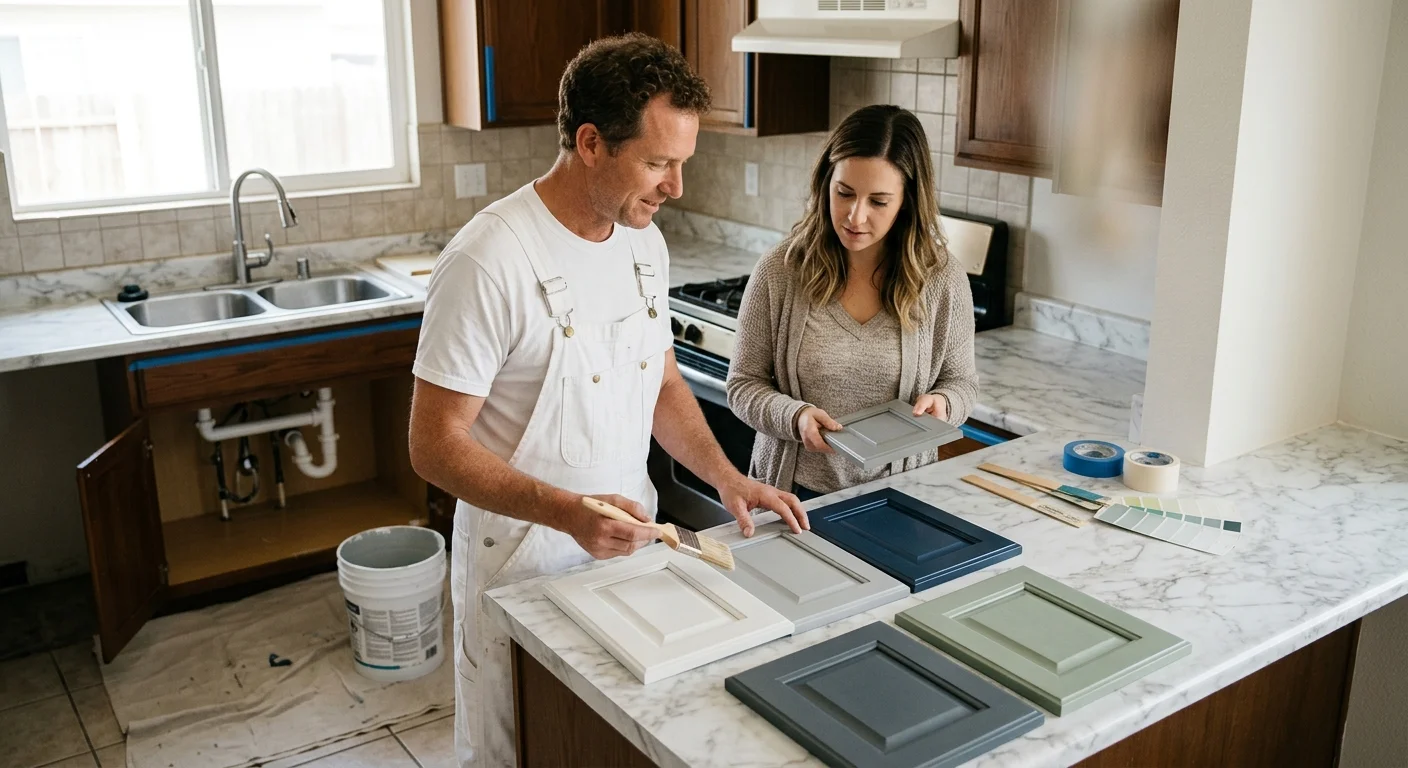
Paint Pros San Diego is a referral service. We match you with licensed, independent painters. We do not paint cabinets, own a spray booth, or set a price. The pro you hire does the work and you pay that pro directly. Use this page to walk the kitchen or bath the way a careful painter will, then compare written scopes.
Map the kitchen or bath cabinets in scope
Start with a room list, not a color chip. Walk the kitchen first, then any bath vanities you want in the same job. Count every door, drawer front, and exposed box. Include the island if you have one. Include the range hood panel, the sink-base, and the tray above the fridge. Those pieces get left off a verbal walkthrough and show up later as extras.
Chula Vista is not one kitchen type. It is the second-largest city in San Diego County, with about 275,000 residents and roughly 90,500 housing units. About 41 percent of those units were built before 1978 citywide. East of the freeway, Otay Ranch, Eastlake, and Rancho del Rey kitchens are often still on the original factory finish: raised-panel maple or oak, a lot of doors, and an island that doubles the spray list.
West-side kitchens tend to carry more cooking film and more years of cleaner on the doors. East-side kitchens tend to carry more linear feet of cabinet and more glass or mullion doors. Neither is automatically a better candidate. Both need a scope that names every piece.
Bath vanities are a separate climate. A Telegraph Canyon hall bath sees steam. A powder room off the foyer does not. If you want cabinet painting in both rooms, say so up front. A painter who prices only the kitchen will not guess the vanity.
Mark what stays closed during the job. Pantry doors that cannot come off. A desk built into the island. A TV niche with cabinet doors. Write those down. Access changes prep, and prep changes the quote.
If you are also thinking about walls, trim, or the rest of the house, keep that as a second conversation. A house painter in Chula Vista is a different scope than a cabinet refinish. Mixing them on one vague request is how doors get rolled with wall paint.
Stand in the room and take photos with the lights you actually use. Overhead cans, under-cabinet strips, and afternoon sun off a west window all shift white. The painter cannot color-match a phone photo taken at noon if you cook at 6 p.m.
Check doors, drawers, and damaged edges
Open every door. Pull every drawer. You are looking for three things: the substrate, the wear, and the hardware holes.
Wood and wood veneer take paint differently than thermofoil, laminate, or melamine. A painter should name the material on the quote. If the doors are peeling film, bubbling near the dishwasher, or delaminating at the bottom rail, paint will not glue that film back down. Ask whether those doors get repaired, replaced, or excluded. Guessing here is how a cheap number turns into a change order.
Run a hand along the edges that take hits: the dishwasher door, the trash pull-out, the corner of the island where backpacks land. Chipped corners and rounded veneer need filler or a new edge before enamel. A painter who skips that step can still make the centers look new. The edges will telegraph in a month.
Look at the grain. Heavy oak grain in western Chula Vista kitchens will show through a thin coat. If you want a smoother look, the quote should say how the painter will fill or sand that grain. If you like the grain, say you want it to remain. Silence on grain is a mismatch waiting to happen.
Hinge cups and drawer slides matter. Soft-close hardware from a later remodel may not like a thick build on the door edge. Older overlay doors may have worn screw holes. Ask whether the painter will re-bore, use longer screws, or leave hardware as-is. Door sag after a refinish is usually a hardware and hole problem, not a paint problem.
Take one door off and look at the back. Factory backs are often a different sheen. If you want both faces finished, the quote must say so. Many scopes finish only the faces you see with the doors closed.
Compare this house to a South Bay neighbor only with care. Cabinet refinishing in National City serves a smaller, older housing mix. Chula Vista’s stock splits along I-805. Your door count, island, and finish age will not match a bungalow kitchen a few miles west just because both sit in the South Bay.
Compare preparation and finish options
Prep is the job. Finish is what you see. A useful quote names both.
Degreasing comes first in a working kitchen. South Bay cooking film sits in the grain and around the handles. If it stays, enamel crawls. Ask what cleaner the painter uses and whether doors come off and get washed in a shop or in place. In-place work is quieter for a family in Eastlake. Shop work can give more control on spray. Neither is automatically better. The quote should say which one you are buying.
Sanding and bonding primer come next. Named primers you can ask about include Zinsser Cover Stain and Zinsser B-I-N. Named cabinet finishes you can ask about include INSL-X Cabinet Coat, PPG BREAK-THROUGH, Sherwin-Williams Emerald Urethane Trim Enamel, and Benjamin Moore ADVANCE. Those names are product examples, not a promise that any one painter stocks them, and not a lifespan claim. Ask which product, which sheen, and how many coats. Ask whether the painter will spray, brush, or roll, and on which parts.
A sprayed door and a brushed box can look like two different kitchens if sheen is not matched. If you want a full spray, the quote should say full spray. If boxes stay in place and only doors leave the house, write that down. The professional cabinet refinishing process is worth reading before you sit through a walkthrough, so you can tell a complete prep list from a wash-and-roll.
Lead-safe work is not optional on the older half of this city. About 41 percent of Chula Vista’s housing units predate 1978. Paid work that disturbs paint in pre-1978 housing is generally covered by the EPA Renovation, Repair, and Painting program. Testing is not required by that rule. Without documentation that the paint is not lead-based, the requirements stay in place. Ask whether the firm is EPA-certified for RRP, whether doors will be sanded with HEPA-shrouded tools, and how dust stays in the work area. Do not treat a visual “it looks like latex” as a test.
A California C-33 painting license covers surface prep and the application of paints, varnishes, and similar coatings. Cabinet refinishing of this kind is painting work, not a new kitchen. If the contract will run $1,000 or more in labor and materials, California law requires a licensed contractor. Verify the number on the CSLB license check before you sign.
Color is last, and it is local. A warm oak kitchen off Broadway wants a different white than a gray-and-stainless Otay Ranch kitchen under cool LEDs. Pull samples from Sherwin-Williams color collections or Benjamin Moore color trends, then tape them on the actual door, not the wall. Look at them at night with the under-cabinet lights on.
Review hardware, access, and exclusions
Hardware is where scopes quietly shrink. Decide whether knobs and pulls come off, get painted, get reused, or get replaced. Painting over existing pulls looks fast and usually looks wrong. If you are ordering new pulls, confirm hole spacing before doors are finished. A painter is not a cabinet shop. Moving from a single knob to a long pull means new holes and filler on the old ones.
Ask who bags and labels hinges. A 40-door Eastlake kitchen can have more than 80 hinges. Mix them up and doors stop closing. A careful painter numbers doors to a map of the boxes. If that map is not in the quote, ask for it.
Access is the other silent cost. A townhome garage that cannot take a spray tent is not the same job as a detached house with a side yard. A third-floor condo on Third Avenue may restrict hallway use and work hours. We do not publish hours or arrival windows, and a referral does not include building-rule research. You should still hand the painter the HOA or building packet if you have one. Interior cabinets are usually a homeowner choice. Shared hallways and parking are not.
Exclusions need to be in writing. Typical ones: interiors of boxes, undersides of upper cabinets, matching a laminate pantry, glass inserts, appliance panels, and damaged doors beyond repair. Crown that is integral to the boxes may be in. Crown that is a separate trim run may be out. If you want the open shelving next to the range in the same enamel, say so.
Kitchen use during the job is an exclusion too. Some painters need doors off for several days. Some work in phases so you keep one run of cabinets. Neither timeline is a promise from Paint Pros San Diego. Ask the quoting painter what you can still use, and write the answer on the scope.
If the job includes new doors, new boxes, or a layout change, you have left painting and entered cabinetry. That is a different trade. Keep the painting quote honest by keeping the carpentry off it, or by naming a separate line.
Compare written quotes before you hire
A verbal number from a walkthrough is not a quote. Ask for a written scope that lists rooms, door and drawer counts, substrate, prep steps, primer, topcoat, sheen, spray versus brush, hardware handling, lead-safe practices if the house may predate 1978, and what is excluded.
Paint Pros San Diego does not set prices. For planning only, two San Diego painters have published kitchen ranges you can read against a Chula Vista bid. Chism Brothers, in a post updated March 2, 2026, listed about $1,800 to $2,500 for brush-and-roll in place, $3,000 to $5,000 for sprayed doors and brushed boxes, $5,000 to $7,500 for a full spray, and $8,500 to $15,000-plus for a large island kitchen. J Brown Painting has listed about $4,500 to $6,250 for a small-to-standard kitchen and $6,250 to $9,000 for a large kitchen with 40-plus doors. Those are their published planning ranges, dated to those pages. They are not a Paint Pros San Diego quote, and they are not a Chula Vista city rate. Door count, repair, access, and finish choice will move the number. Confirm the current figure with the painter who is actually bidding. For more context on how those ranges get built, see cabinet painting cost in San Diego.
Compare like with like. A low bid that skips box interiors, skips backs, and rolls doors in place is not cheaper than a spray-and-prime scope. It is a different product. Line up door counts. Line up sheen. Line up whether caulk, filler, and hardware reinstall are included.
If the contract is signed at your house, California’s home-solicitation rules give you a cancellation window: until midnight of the third business day after you sign, or the fifth business day if you are a senior. The contract should include that notice in the language used for the sale. Read it before you sign, not after doors are in a shop.
Ask for the CSLB license number and check it yourself. Ask who is on site: the licensed painter, a sub, or a helper. Ask who you call if a door chips in the first week. Warranties, if any, come from the painter you hire, not from Paint Pros San Diego. We do not warrant work we do not perform.
Get two written scopes when the kitchen is large or the substrate is mixed. One painter who lives in spray and one who prefers brush-and-roll will describe the same Eastlake island in different words. Your job is to make those words match the room you walked.
When to call us
Call when the boxes are sound, the doors are worn, and you want a licensed local painter to refinish a Chula Vista kitchen or bath instead of replacing it. Call before you buy gallons of enamel and find out the film is thermofoil, the edges are failing, or the house west of I-805 needs lead-safe prep. Call us at (858) 400-6422 and we’ll connect you with a local painter.