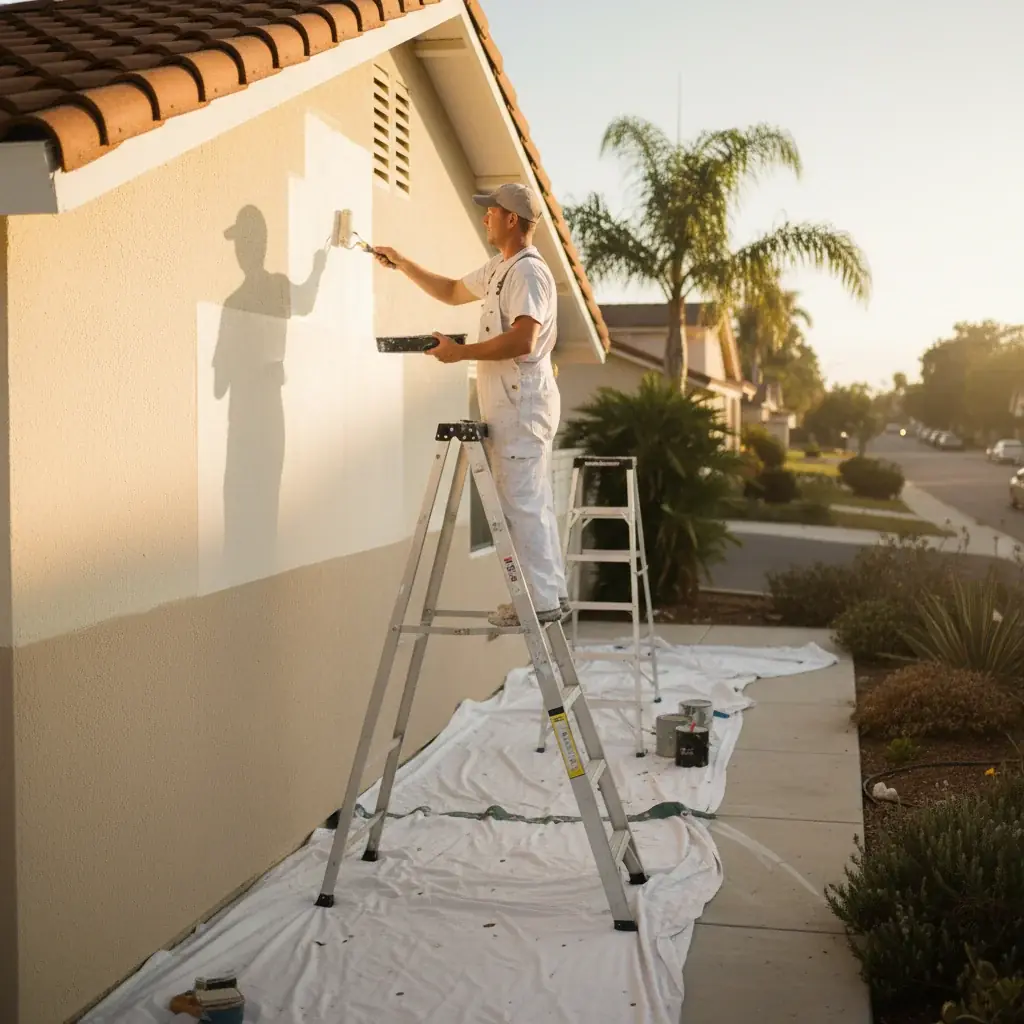
House painting cost tracks scope, square footage, and prep condition before anything else, for both interior and exterior work. San Diego runs above the national average because of higher labor rates, stricter prep standards on stucco, and stronger coastal UV exposure. This guide is updated periodically using real San Diego quotes plus national survey data from Angi, HomeAdvisor, and NerdWallet.
What drives house painting cost: national vs San Diego
The comparisons most homeowners want, side by side.
| Project type | What drives it nationally | SD coastal driver | SD inland driver |
|---|---|---|---|
| Whole-home interior (1,800-2,200 sqft) | Square footage, room count, prep | Same, plus higher regional labor rates | Same, moderate labor premium |
| Whole-home exterior (1,800-2,200 sqft, stucco) | Paintable surface area, story count | Salt-air prep and premium UV-resistant paint | Standard stucco prep, less salt exposure |
| Painter labor rate | Regional wage level | Highest regional wage tier | Moderate regional wage tier |
National figures come from the NerdWallet cost-to-paint summary, the Angi exterior cost report, HomeAdvisor’s interior painting cost guide, and BLS painter wage data. San Diego coastal figures are pulled from quotes booked in 92037, 92107, 92109, 92118, 92014, 92024, and 92011. Inland figures come from 92020, 92021, 92027, 92064, 92078, and 92019.
Why the SD premium exists. Three reasons. Labor runs more expensive here than the national wage figure published by BLS. Stucco prep is more involved than the drywall-heavy mix found in most US markets, so crews spend more hours patching, caulking, and elastomeric-sealing before paint goes on. Coastal UV plus salt air means premium paint lines (Dunn-Edwards Evershield, Sherwin-Williams Emerald, Behr Marquee) get specced as standard rather than as upgrades. The combination pushes a typical SD repaint meaningfully above the same job in Phoenix or Dallas.
What drives interior painting cost
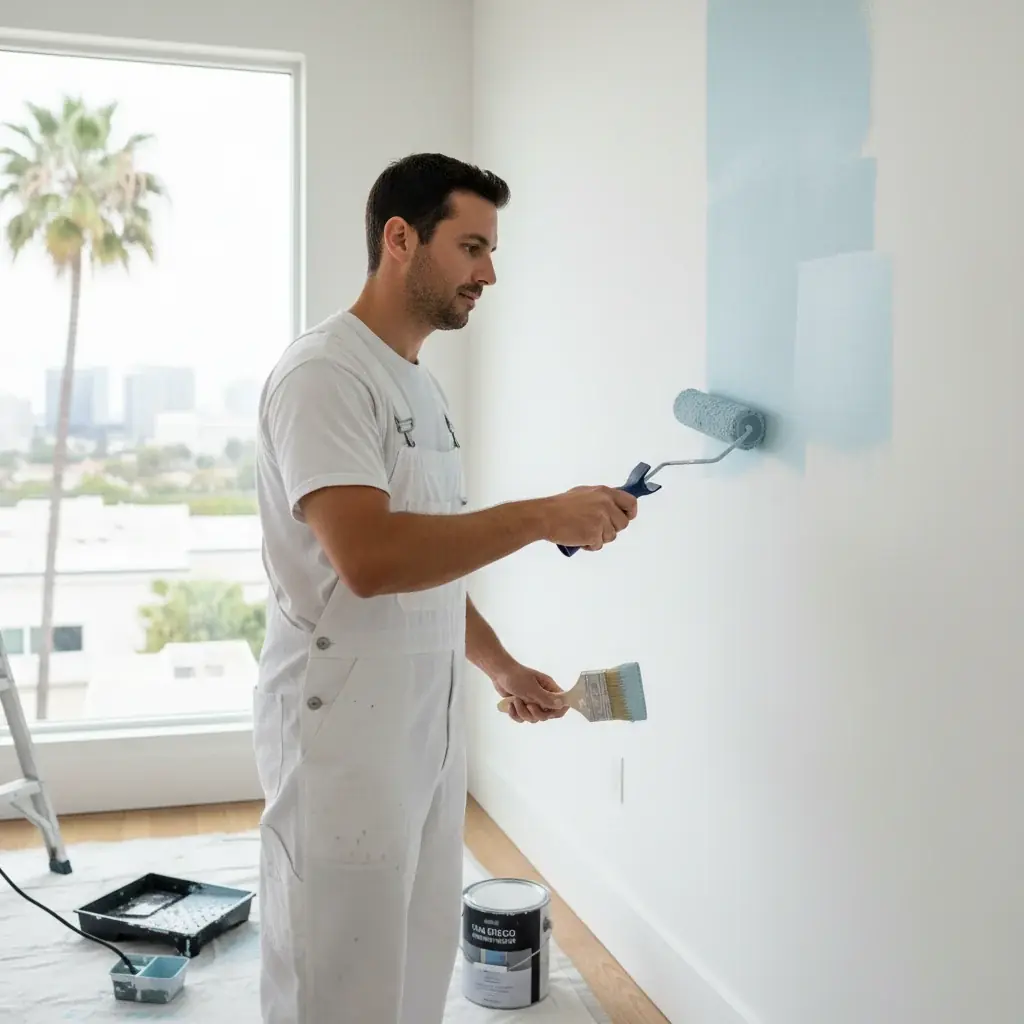
Interior paint is typically quoted per square foot of wall surface or per room. Most professional crews use a flat per-room number once they walk the home, because square-foot pricing breaks down once you add cathedral ceilings, accent walls, or color changes.
What moves the number nationally:
- Wall surface area
- Room count and room size
- Whole-home scope for a 2,000 sqft home vs. single rooms
What moves the number in San Diego:
- The same drivers as above, plus prep depth and paint grade
- Two-coat work with proper prep costs more than single-coat, low-prep work
- Whole-home interior scope
Multi-market driver comparison for a 2,000 sqft whole-home interior repaint:
| Market | What sets the baseline | Notes |
|---|---|---|
| National | Square footage and room count | Baseline |
| San Diego (inland) | Same, plus a moderate regional labor premium | Above national |
| San Diego (coastal) | Same, plus the highest regional labor tier | Above inland SD |
| Los Angeles | Similar labor mix to inland SD | Comparable driver set |
| SF Bay Area | Highest regional labor tier in California | Highest in CA |
| Phoenix | Lower labor cost, similar climate stress | Below national |
| Dallas | Lower labor, drywall-heavy prep | Below national |
For the SD-specific deep dive including room-by-room pricing and ceiling-height considerations, see our San Diego interior painting cost guide and the room-by-room cost breakdown.
What drives exterior painting cost
Exterior cost scales with square footage of paintable surface, not floor area. A single-story 2,000 sqft home has less paintable surface than a two-story 2,000 sqft home with the same footprint, because the two-story has more wall area for the same roof.
What sets exterior cost, one coat plus touch-up, basic prep, mid-grade paint:
| Home size (floor area) | What drives the national number | SD coastal driver | SD inland driver | SF Bay Area driver |
|---|---|---|---|---|
| 1,000 sqft single story | Baseline surface area | Salt-air prep, premium paint | Standard prep | Highest regional labor tier |
| 1,500 sqft single story | Baseline surface area | Salt-air prep, premium paint | Standard prep | Highest regional labor tier |
| 2,000 sqft single story | Baseline surface area | Salt-air prep, premium paint | Standard prep | Highest regional labor tier |
| 2,500 sqft (two-story) | Added story doubles wall area for the roof size | Salt-air prep, premium paint | Standard prep | Highest regional labor tier |
| 3,000+ sqft (two-story) | Largest surface area in this set | Salt-air prep, premium paint | Standard prep | Highest regional labor tier |
Figures in the table assume stucco. Wood siding adds cost because of sanding, scraping, and any rot repair. Fiber cement is roughly stucco-equivalent. Vinyl siding is the cheapest surface to paint but the rarest in San Diego.
For full SD exterior pricing see our exterior painting cost guide for San Diego and the Chula Vista exterior cost breakdown. The long dry window matters too, covered in our best time to paint exterior in San Diego guide.
What drives cabinet painting cost
Kitchen cabinets are the highest-impact paint job in the home. National guidance from Angi’s cabinet painting cost report and HomeAdvisor prices cabinet refinishing per linear foot or per cabinet door, with whole-kitchen jobs scaling with door and drawer count.
San Diego cabinet painting runs above national because most jobs spec a sprayed conversion-varnish or post-cat lacquer finish rather than rolled latex.
| Project | What drives the national number | What drives it in San Diego |
|---|---|---|
| Per door (sprayed, 2-coat) | Door size and finish type | Same, plus higher regional labor and sprayed-finish standard |
| Per linear foot | Cabinet run length | Same, plus higher regional labor |
| Whole kitchen (average) | Door and drawer count | Same, plus higher regional labor |
| Whole kitchen (large, two-tone) | Door and drawer count, plus color-change complexity | Same, plus higher regional labor |
The math gets specific in our San Diego cabinet painting cost guide, which includes per-door driver detail for 23 SD County ZIPs.
What drives the price
Ten factors move a quote up or down. In rough order of impact:
- Prep work needed. Old paint failure, peeling, stucco cracks, dry rot, and previous bad paint jobs all add hours. Prep is a substantial share of total labor on most exteriors. According to Angi’s labor breakdown, labor accounts for the large majority of total cost on a professional interior project.
- Square footage of paintable surface. Wall surface, not floor area. A two-story roughly doubles surface area without doubling floor area.
- Stories and accessibility. Two-story homes need ladders or scaffolding. Three-story or steep-grade lots may need a lift, which adds a daily equipment cost.
- Paint grade. Builder-grade flat costs meaningfully less per gallon than premium acrylic-urethane like Sherwin-Williams Emerald or Dunn-Edwards Evershield. Premium paint costs more upfront but tends to hold up on stucco noticeably longer than budget paint, per Sherwin-Williams’ Emerald product page and the Dunn-Edwards Evershield spec.
- Color count and color change. Single-color same-color repaints are cheapest. Adding accent colors, two-tone schemes, or moving from a dark color to a light one (which needs an extra coat or a tinted primer) adds cost.
- Primer requirements. Bare stucco, stucco patches, raw wood, stains, and dark-to-light color changes all need primer. Skipping primer is the single most common shortcut on cheap quotes.
- Trim, doors, and accents. Each interior door painted adds a labor line. Window trim, shutters, and porch ceilings all add per-piece line items.
- Repair work. Stucco crack repair, drywall patching, fascia replacement, or sash window repair before paint. Specialized repair can add meaningfully to the scope depending on extent.
- Coastal location. Homes within a couple miles of the ocean (per NOAA coastal exposure data) need premium UV and salt-resistant paint, which adds to material cost.
- HOA compliance. HOA-managed neighborhoods often require approved colors, certified contractors, and proof of insurance. That paperwork adds time but no real material cost.
How to save without sacrificing quality
Five tactics that actually move the price.
Schedule in the off-season. San Diego painters are busiest May through September. October through February gets you a discount off list pricing because crews want to fill the gap. The weather still cooperates; SD stays paintable most days in winter, per NOAA San Diego climate normals. The off-season discount is the single biggest legitimate saving available without compromising quality.
Do the easy prep yourself. Clearing furniture, removing outlet covers, taking down curtains, mowing the lawn back from the wall, and pressure-washing the exterior the day before saves crews real setup hours. Many homeowners undervalue how much non-skilled prep time is built into a professional quote. Ask the painter what prep they’d skip if you handled it yourself.
Choose the right finish. Flat costs less than satin, which costs less than semi-gloss. For walls in low-traffic rooms, flat is fine and cheaper. Reserve scrubbable finishes for kitchens, baths, and kids’ rooms. Our paint sheen guide for San Diego walks through where to use each.
Buy the paint yourself when the painter agrees. This only works if the painter is okay with it. Pros usually get contractor pricing through Sherwin-Williams or Dunn-Edwards that beats retail, so this saves you nothing on premium paint. On big jobs with builder-grade paint from Behr at Home Depot or Valspar at Lowe’s, sales and rebates can add up to a real savings.
Get multiple quotes from painters willing to walk the home. Three quotes is the floor. Skip painters who won’t quote without a deposit up front. Skip painters who quote without walking the home. The price spread across a few honest quotes is usually real; pick the middle one if the lowest looks like a corner-cutter.
Cost calculator inputs: what to give a painter for an accurate quote
A painter can’t quote accurately without these eight inputs. The more you can answer before the walk-through, the tighter your quote.
- Square footage of the home (and number of stories).
- Surface type. Stucco, wood siding, fiber cement, brick, vinyl, or mixed.
- Current condition. When was it last painted, any peeling, any visible damage.
- Paint brand and product preference, or budget vs premium guidance.
- Color count. One color, two-tone, accent trim, multiple accents.
- Color change direction. Staying the same, going darker, going lighter (the lighter direction is more expensive).
- Prep scope. Full pressure wash, scrape and sand, stucco crack repair, full primer coat.
- Access. Single story, two story, lift needed, gated yard, parking constraints.
For exterior quotes, also note HOA requirements, any solar panels (which need detach-and-reset coordination), and any landscaping that needs protection. A good estimator will ask all of these in the first ten minutes of a walk-through. If they don’t, get another quote.
Should you DIY or hire a pro?
Honest framework.
| Factor | DIY | Hire a pro |
|---|---|---|
| Cost driver (whole-home interior, 2,000 sqft) | Paint and supplies only | Labor plus materials plus prep |
| Time | A weekend-heavy project spread over weeks | A few working days with a crew |
| Skill needed | Beginner-friendly for one room. Two-story exterior is high-risk. | Years of trade experience |
| Quality ceiling | Decent if you have patience | Sharp lines, even sheen, no roller marks |
| Best for | Single room, accent wall, simple touch-ups | Whole home, exteriors, cabinets, ceilings, anything with prep complexity |
| Worst for | Exteriors above one story, cabinets, ceilings, large color changes | Truly tiny one-wall jobs, which most pros treat as below their minimum scope |
Rule of thumb. If it’s interior and one room with simple prep, DIY makes sense. If it’s a whole-home exterior, cabinets, or anything two-story, hire it out. The cost gap is real but the risk gap (falls, paint failure, do-over costs) is wider than people think. The Bureau of Labor Statistics injury data for painters shows residential painting carries one of the higher fall-injury rates among construction trades, and most of those falls are above the 8-foot mark.
Frequently asked questions
Is it cheaper to repaint or to change siding or stucco color?
Repainting is dramatically cheaper than re-siding or re-stuccoing. Removing and replacing stucco costs considerably more than a repaint just for the stucco work, before paint. Repaint unless the underlying surface is failing.
When’s the best time of year to paint a house in San Diego?
Late April through early November is the long answer. The short answer is whenever a contractor has a stretch of dry days of moderate temperature on the forecast. SD’s mild climate means there’s almost always a paintable window. See our best time to paint exterior in San Diego guide for month-by-month detail.
How do I compare painting quotes apples to apples?
Look at four things. Number of coats (two should be the floor on most surfaces). Paint brand and product line (premium vs builder-grade matters). Prep scope in writing (vague prep is where cheap quotes hide). Warranty terms spelled out in writing rather than a vague promise. If two quotes are far apart on price, one of those four is the reason.
Do painters in San Diego cost more than other cities?
Yes, on average. SD coastal labor rates are among the higher tier nationally. SD painters also default to premium paint and full-prep stucco protocols that drive cost up but extend how long the paint holds up.
Why are San Diego painting prices higher than the national average?
Three reasons. Labor. SD painter wages run well above the national BLS average. Materials. Premium UV and salt-resistant paint is the standard, not an upgrade. Prep. Stucco prep is more hours than drywall or vinyl-siding prep. Net result is a real premium over the national median.
Is a painter’s license required in California?
Yes. The California Contractors State License Board is where you verify the license classification that matches the actual scope. Always check license status at cslb.ca.gov before signing a contract. Paint Pros is a referral service and does not hold a trade license. Unlicensed work voids most homeowner insurance claims if something goes wrong.
Get a quote tied to real San Diego pricing
The drivers in this guide explain the range, not your exact quote. Your actual price depends on your home, your surfaces, your timeline, and the prep work the home actually needs. The fastest way to get a tight number is a walk-through.
Call us at (858) 400-6422 and we’ll connect you with a vetted local painter. A painter will walk the home, give you a written scope, and quote off real conditions instead of square-foot averages, with no pressure to book.
For service pages, see interior painting and exterior painting.