What painting kitchen cabinets in San Diego costs and how long it holds up both track the same thing: how much prep the job gets. San Diego homeowners pick painting over refacing or replacing for three reasons: it costs a fraction of new cabinets, the cabinet boxes built into mid-century and older SD homes are usually solid wood that prep well, and a properly cured cabinet finish holds up to coastal humidity better than the foil and laminate fronts sold by big-box refacers.
This is the hub guide. For a deep dive on what drives pricing, see our San Diego cabinet painting cost guide. For the side-by-side decision on whether to paint at all, see cabinet painting vs replacing in San Diego. The page you’re on right now covers everything else: the process, the paint chemistry, the finishes, the schedule, the SD climate issues nobody else writes about, and the questions every homeowner asks before they sign a contract.
How cabinet painting actually works, stage by stage
A real cabinet refinishing job isn’t “wipe down and paint.” A San Diego crew that knows what it’s doing works through a fixed sequence and never skips a stage to save time. Shops that compress the schedule are skipping cure time, and you’ll see chips at the hinges before long.
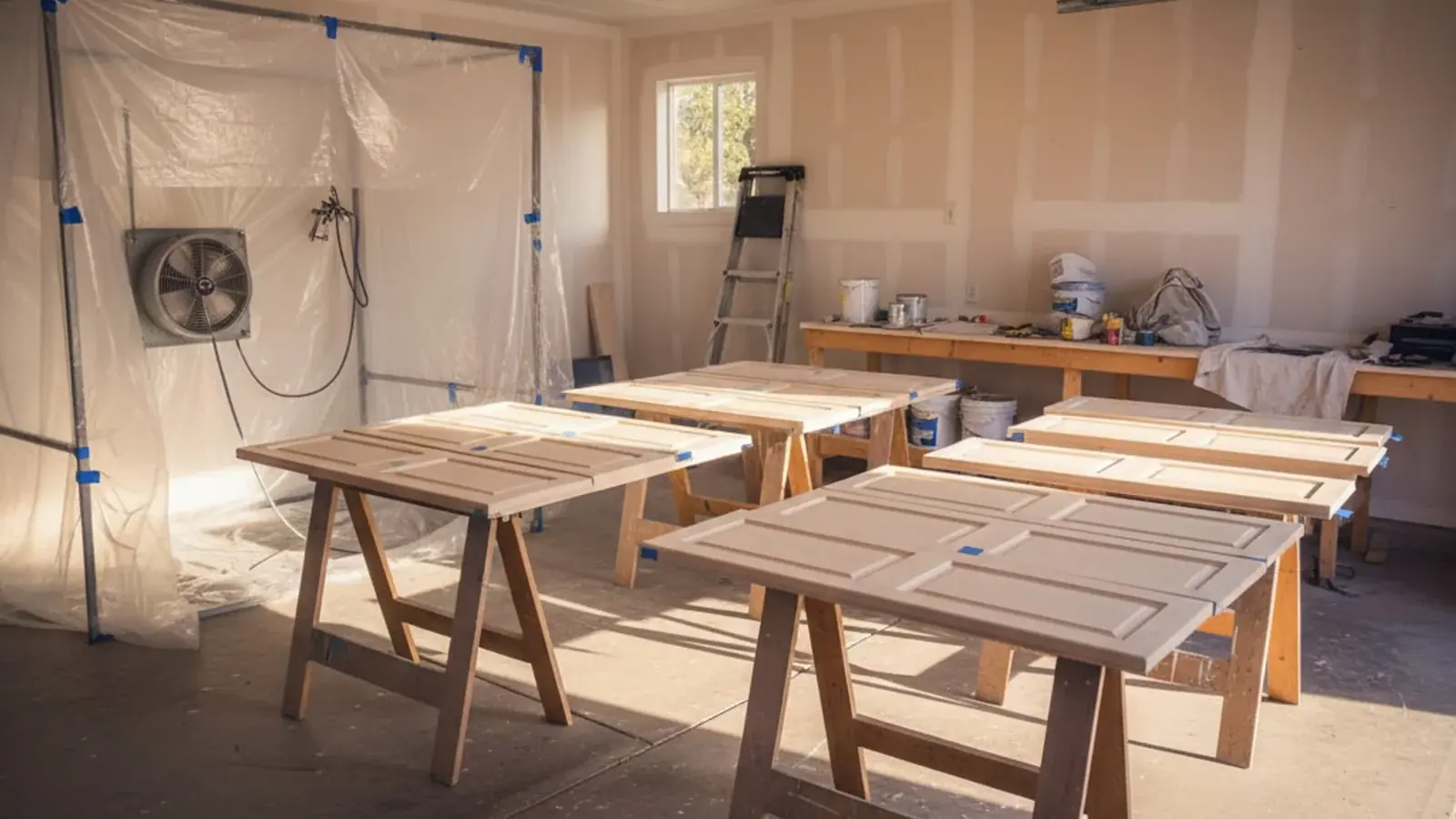
Removal, labeling, transport. Every door, drawer front, and shelf comes off. Hinges, pulls, and bumpers get bagged and labeled by cabinet position (you don’t want door 14 ending up on box 22 because the hinge holes never line up perfectly between cabinets, even on factory builds). Doors and drawer fronts get loaded and driven to an off-site spray booth so the dust and solvent stays out of your house. The cabinet boxes, frames, and any built-ins that can’t come out stay in the kitchen and get masked off.
Prep and primer. This is where the job gets won or lost. Cabinets get washed with a degreaser like Krud Kutter or TSP substitute to pull grease out of the grain (kitchens in older Pacific Beach and Clairemont homes have decades of cooking oil baked into them). Surfaces get scuff-sanded with 220 to 320 grit to break the existing factory finish so primer can bite. Knots, nail holes, and grain on oak get filled with a high-build primer or grain filler. Then the first coat of bonding primer goes on. For laminate and thermofoil cabinets, that’s usually Stix by Benjamin Moore or INSL-X Cabinet Coat primer. For solid wood, BIN shellac primer or Sherwin-Williams Extreme Bond Primer.
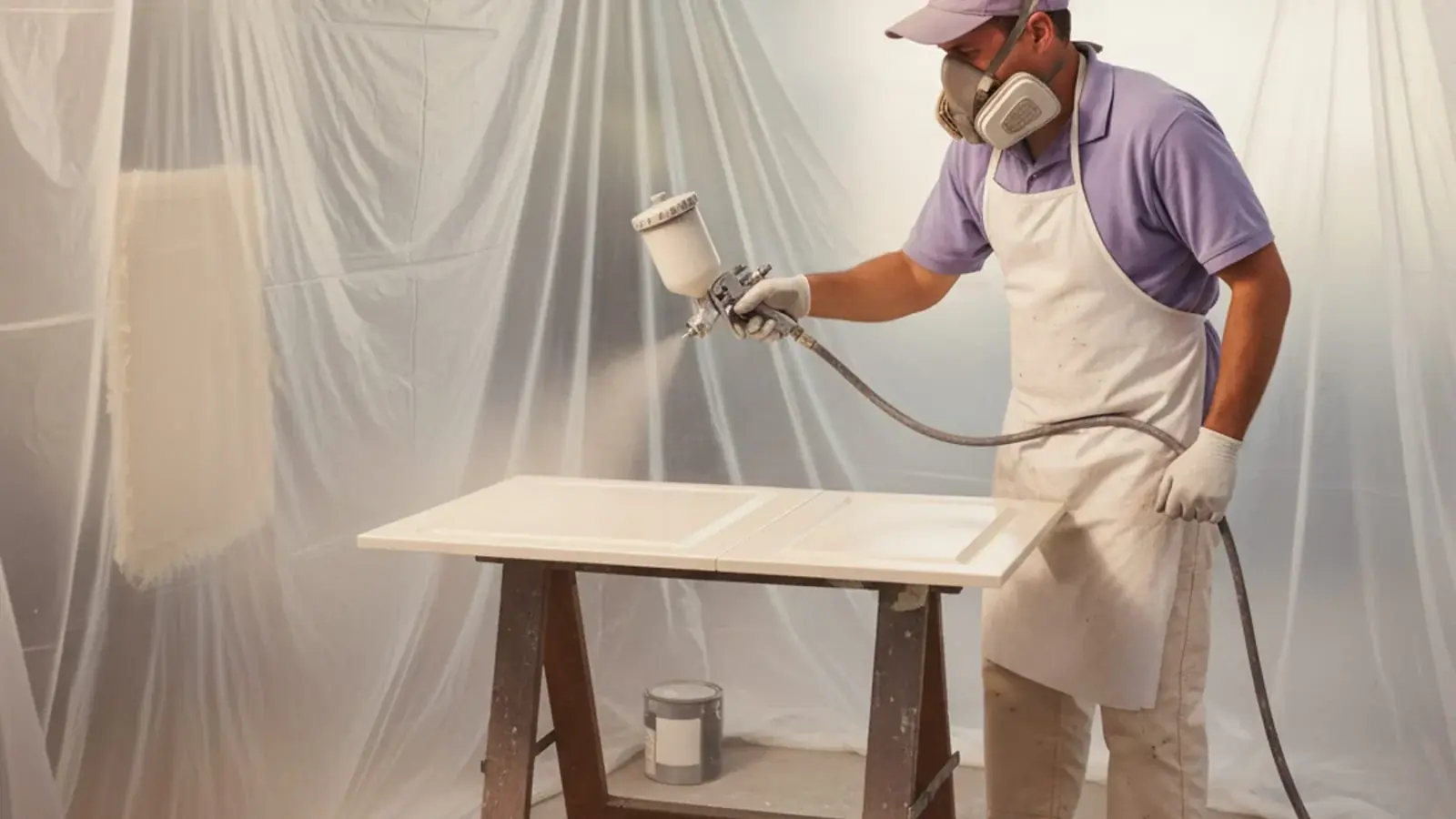
Paint coats on the boxes and doors. Two thin coats of cabinet enamel on the in-place cabinet boxes, sprayed where possible and brushed-and-rolled where masking would take longer than the painting itself. Doors and drawer fronts get sprayed in the booth, where airflow and lighting are controlled. Spec sheets call for a several-hour recoat window, but San Diego’s marine layer means many crews wait longer to be safe (see the humidity section below).
Cure and second-coat doors. Most paint manufacturers list a multi-week hard cure time for cabinet enamels. The first two days are the critical window, when the film is firm enough to handle but soft enough to dent. Doors stay flat on racks. No hardware reinstall, no stacking.
Reinstall. Doors come back, get rehung, hinges adjusted, hardware reinstalled, bumpers placed, walk-through with the homeowner. The kitchen is usable that evening for light use; full hard cure (where you can wipe with degreaser and not leave a mark) takes longer.
A few SD pros split the schedule differently. We sometimes add a stage for a third top coat on doors that get heavy use (drawers under the cooktop, the trash pull-out) because that’s where chipping starts. Worth the extra stage.
Paint types and finishes for San Diego humidity
The wrong paint on cabinets fails fast. The right paint holds up for years. San Diego’s coastal humidity, salt air on the western half of the County, and significant swings between Mission Valley and Alpine all push different paint chemistries.
Water-based alkyd enamels (latex hybrid). These are the workhorse of 2026 cabinet painting. Benjamin Moore Advance and Sherwin-Williams Emerald Urethane Trim Enamel lead the category. They flow and level like oil-based alkyds but clean up with water and stay flexible enough to handle wood movement through our humidity and temperature swings. They cure to a hard, washable shell. Most San Diego pros default to one of these two products. Material cost tracks the number of doors and how many coats the finish needs.
Acrylic urethanes and pre-catalyzed lacquers. Pre-cat lacquer (the Sherwin-Williams Kem Aqua Plus White line or M.L. Campbell Krystal) is what most factory cabinet shops spray. It cures fast, lands rock-hard, and resists kitchen abrasion as well as anything on the market. Downsides: it needs proper ventilation during application, the off-gassing window is sharper, and it usually has to be done in a real spray booth, not in your kitchen. Worth it for high-end refinishes where you want a true factory-grade finish. Most San Diego homeowners don’t need it.
Oil-based alkyds. Classic oil enamels (Benjamin Moore Satin Impervo) still produce the smoothest hand-brushed finish on the market. The catch is California Air Resources Board VOC limits, and most traditional oil cabinet paints are getting harder to source in San Diego. The ones that meet CARB rules yellow faster. Skip oil for white cabinets. It’s still defensible for darker colors where yellowing won’t show.
What to avoid: wall paint, “satin trim paint” without an enamel rating, and anything marketed as “all-in-one cabinet kit” at a big-box hardware store. The Rust-Oleum Cabinet Transformations kits in particular have a poor track record on San Diego service calls. We get peel-and-chip rescue jobs from them not long after install.
Finish sheen for SD kitchens. Satin is the default. It hides minor brush texture, wipes clean, and reads as modern. Semi-gloss is harder to keep looking new on south-facing kitchens because every fingerprint shows in the afternoon sun. Matte cabinet finishes (Benjamin Moore Aura Matte cabinet) are trending but harder to clean. Fine in a guest house, risky in a primary kitchen with kids.
San Diego color trends in 2026
The classic white shaker still leads most of our 2026 cabinet jobs. But what’s shifted is the rest of the mix. We covered this in detail in kitchen cabinet paint colors for San Diego 2026, so this is the short version.
Warm whites have replaced cool whites across SD County. Benjamin Moore White Dove (OC-17) and Sherwin-Williams Alabaster (SW 7008) are the two most-requested colors in 2026. Both read clean but warm, which keeps a coastal kitchen from feeling sterile under marine-layer light.
Greens are the second wave. Sage and olive cabinets land hard in Encinitas, Leucadia, and inland North County kitchens. Benjamin Moore Saybrook Sage and Sherwin-Williams Evergreen Fog were the two most-painted green cabinets across our 2025-2026 portfolio.
Two-tone (upper cabinets one color, lower cabinets or island a contrasting deeper tone) is no longer just a Pinterest move. It’s mainstream. Most common pairing in 2026 SD kitchens: warm white uppers with a navy, charcoal, or deep green island.
What’s fading: gray cabinets in the cool blue family, and high-contrast black-and-white kitchens. Both still rank but demand has cooled noticeably year over year.
Cabinet painting vs refacing vs replacing: the decision framework
Most San Diego homeowners don’t need new cabinets. They need to know which of the three options actually fits their kitchen. Here’s the framework:
| Option | What drives the cost | What drives the timeline | When it’s right | When it’s wrong |
|---|---|---|---|---|
| Paint | Door count, substrate condition, prep scope | Prep and cure time between coats | Boxes are solid wood, layout works, you want a color/style change | Boxes are warped, water-damaged, or particleboard with delamination |
| Reface | New door and drawer-front count, box veneer scope | Door manufacturing lead time plus install | Boxes are sound but door style is dated (raised-panel oak you hate the shape of) | Boxes are weak, layout is bad, you’d rather invest in real change |
| Replace | Cabinet count, materials, layout changes | Design, ordering, and full installation | Layout is wrong, boxes are failing, you’re renovating other systems anyway | Boxes are fine and you’re happy with the footprint |
The honest test: open three random cabinet doors. Push on the back of each box. If the box flexes, the joinery is loose, or you smell mildew, you’re past painting. If the boxes feel solid and the doors swing true on their existing hinges, painting will give you a kitchen that looks new for years at a fraction of the cost of replacement.
A second test: do you wake up at night thinking about the layout (the island in the wrong place, the appliance triangle that doesn’t work, the missing pantry)? If yes, paint is a band-aid. Save your budget for the real renovation.
For a longer comparison, see cabinet painting vs replacing in San Diego.
What to expect from a San Diego pro
A real cabinet refinishing job in San Diego has a rhythm a homeowner can predict if they know what to ask. Use this as a checklist when you’re evaluating bids.
Estimate. A pro visits in person, counts every door and drawer front (not just upper and lower banks), notes the cabinet material, photographs damaged areas, and asks about the finish you want. The quote should itemize: cabinet count, prep level, primer and paint product names, application method, color samples included, hardware swap, and timeline. If the quote is a single line with one number, it’s not detailed enough.
Color sampling. A pro orders or paints two or three actual sample doors for you to live with in your kitchen for 48 hours before you commit. Cabinet color reads completely different under SD natural light than it does in a paint store. The marine-layer morning, the harsh midday, and the warm evening will each show you a different version of the same color.
Site prep. Floor protection from the front door to the kitchen, plastic walls if doors are getting sprayed on-site, HEPA-vac after sanding, and contained drop zones for tools. A pro doesn’t track sanding dust into your bedrooms.
Communication. Daily check-ins or photos. You should know what’s happening throughout the job, especially because most of the work is happening off-site. If the crew goes silent for several days, ask.
Punch list. Before final payment, walk every cabinet with the foreman. Check for drips at the toe-kick, missed spots inside the corner cabinets, hinge alignment, door swing, and bumpers at every contact point. The punch list is where great crews separate from average ones.
Warranty. A real SD cabinet pro backs their own work with a defined workmanship warranty, get the term in writing before the job starts. Separately, the paint manufacturer warranty on Benjamin Moore Advance covers film failure not caused by surface prep or substrate; check the manufacturer’s current terms. The warranty that matters most is the contractor’s, because surface prep is what almost every cabinet failure traces back to.
Common San Diego-specific issues nobody warns you about
National cabinet-painting articles miss the things that actually cause cabinet finishes to fail in San Diego. Here’s what we see on service calls.
Marine layer humidity stretching cure time. Cabinet enamels cure faster in dry inland air than they do in coastal humidity. June and July mornings in coastal SD (especially Bird Rock, Mission Beach, Solana Beach, Cardiff) can stay humid well into late morning. That means a paint manufacturer’s labeled recoat window can roughly double in summer. Crews that don’t adjust get blocking, where doors look cured but stick together at the bumper points when the cabinets close. The painters we match schedule cabinet jobs in coastal zones for the morning-cool, afternoon-warm window and run dehumidifiers in the kitchen overnight.
Salt air on coastal kitchens. Cabinets in homes within a mile of the water (Pacific Beach, La Jolla, Del Mar, Cardiff, Oceanside, Imperial Beach) get a thin salt residue from the marine air that comes through open windows. If you wipe that residue with a damp cloth right before painting, you’re leaving a salt film under the primer. We rinse with fresh water and dry with microfiber, never just wipe. Two passes.
Hard water staining inland east of the 15. Kitchens in El Cajon, La Mesa, Lakeside, Alpine, Ramona, and most of East County deal with significantly harder tap water than coastal SD. Splash spots around the sink leave white mineral rings on dark cabinet finishes if the finish isn’t fully cured or doesn’t have a hard urethane top coat. We push homeowners in those ZIPs toward satin (which hides spotting better than semi-gloss) and we recommend a urethane finish over standard latex enamel. That handles the look. The rings themselves are mineral deposits, and if they bother you elsewhere in the house too, there are ways to deal with hard water stains that go after the cause rather than the finish.
Santa Ana heat events. A couple of times a year San Diego gets Santa Ana wind events with sharply lower humidity and much higher temperatures. Painting cabinets during a Santa Ana means the film flashes too fast and you get orange-peel or lap marks. Reputable SD crews check the forecast before starting and will push your start date if a Santa Ana is rolling in. If a contractor agrees to spray your cabinets during a hot, dry Santa Ana afternoon, that’s a red flag.
older oak grain. Most SD kitchens built decades ago have heavy red-oak cabinet doors with deep open grain. You can either fill the grain (high-build primer plus light skim with cabinet-grade grain filler) for a flat, modern finish, or you can keep the grain showing and lean into the texture. Halfway is the worst answer: a sprayed coat over open grain looks unfinished. Decide at the bid stage.
Frequently asked questions about kitchen cabinet painting in San Diego
How long does professionally painted kitchen cabinets last in San Diego?
With proper prep and a quality cabinet enamel like Benjamin Moore Advance or Sherwin-Williams Emerald Urethane, expect years of service before you’d want to refresh. High-use surfaces (the cabinet next to the trash, the drawer under the cooktop) show wear first. Occasional light touch-ups extend the look considerably.
What brand of paint is best for kitchen cabinets?
For a brush-or-spray latex hybrid: Benjamin Moore Advance or Sherwin-Williams Emerald Urethane Trim Enamel. For a factory-grade sprayed finish: pre-catalyzed lacquer (Sherwin-Williams Kem Aqua Plus or M.L. Campbell Krystal). Skip Behr cabinet paints from the big-box store for high-end SD jobs; the formula is fine for low-use bathroom cabinets but doesn’t have the abrasion resistance we want for a primary kitchen.
Can I paint my kitchen cabinets myself?
You can, but the time and tools usually surprise homeowners. A DIY cabinet job runs 60 to 100 hours over three weekends for a standard 30-door kitchen, plus material costs for degreaser, sandpaper, primer, paint, brushes, rollers, and sprayer rental. The most common DIY failures we get called to rescue: skipped degreasing (the new finish peels), wall paint used instead of cabinet enamel (chipping within months), and no real cure time before reinstall (blocking and finger marks). If you’re handy and patient, it’s doable on a small kitchen. For a large kitchen it usually pencils out to hire a pro. The Family Handyman DIY cabinet painting guide is a fair starting point if you’re going to attempt it.
Will my painted cabinets peel or chip?
Not if the prep was right. Peeling almost always traces to skipped degreasing or skipped primer; chipping traces to soft paint film (wall paint instead of enamel) or insufficient cure time before reinstall. The high-wear chip zones are the bottom edge of doors where the drawer below catches them, around the cabinet under the sink (water exposure), and the cooktop-side cabinet edges. A good pro reinforces those zones with an extra coat.
Does cabinet painting add to my home’s resale value?
Often, yes. The National Kitchen and Bath Association and major San Diego County realtors consistently rank kitchen updates as one of the highest-return cosmetic projects, and painting is usually the dominant line item in a minor kitchen remodel’s return. The Remodeling Magazine Cost vs Value report tracks this category annually if you want the current-year detail, especially when paired with new hardware and a fresh wall color.
When should I choose refacing instead of painting?
Reface when the cabinet boxes are sound but you genuinely hate the door style and no paint color will fix it. Raised-panel oak doors painted white still read as raised-panel oak doors. If you want a shaker or slab door look, paint won’t get you there. You need new doors, which is refacing. Reface when your budget supports new door and drawer fronts across the whole kitchen; below that, paint makes more sense, and above it, weigh full replacement.
Is it cheaper to paint or replace kitchen cabinets?
Painting a standard kitchen costs dramatically less than replacing the same cabinets with mid-grade semi-custom units, which adds demolition, new boxes, doors, hardware, and installation. Painting is the cheaper path if the boxes are structurally sound. Replace only when boxes are water-damaged, the layout is wrong, or you’re doing a full kitchen remodel that includes counters and floor.
Is it worth it to paint kitchen cabinets?
Yes, in almost every case where the cabinet boxes are solid. A well-executed paint job on a dated oak or honey-stained kitchen can look like a much larger update from across the room. The job that isn’t worth it: paint over particle-board boxes with delaminated edges, or over water-damaged sink-base bottoms. Fix the substrate first.
Do painted cabinets look cheap?
Not when the prep, paint, and finish are right. The cheap look comes from skipped degreasing (visible brush marks where the new finish wouldn’t level), wall paint used instead of cabinet enamel (chipped edges within a year), and a roller-applied finish instead of sprayed. Properly sprayed cabinet enamel from Benjamin Moore Advance or Sherwin-Williams Emerald Urethane reads as a factory finish, not as paint. The visual giveaway is sheen consistency: bad jobs have streaky sheen, good jobs are uniform.
What is the most popular kitchen cabinet color in 2026?
Warm whites and soft creams still lead in San Diego County by a wide margin in our 2026 cabinet jobs. Sage green and muted blue-greens are gaining fast, especially in coastal homes. Two-tone kitchens (white uppers, painted-color island or lowers) make up a meaningful share of bookings. Pure stark white dropped off in 2024 and has not recovered. For 2026 trend detail, see our kitchen cabinet paint colors guide.
How long does it take to paint kitchen cabinets?
A professional job on a standard 30-door kitchen moves through removal, prep, priming, paint, cure, and reinstall in sequence, and off-site spray queue time can add to the schedule, though the finish quality is better for it. DIY runs 60 to 100 hours spread across three weekends. The kitchen is unusable for cooking through most of the middle stages either way.
What is the difference between cabinet painting and cabinet refinishing?
Refinishing is the umbrella term and includes painting, staining, and clear-coat work. Cabinet painting specifically means a pigmented opaque coating that covers the wood entirely. Cabinet refinishing can also mean stripping back to bare wood and applying a new stain plus clear coat (keeping the wood grain visible), or a glaze treatment over existing color. In San Diego the words are used interchangeably most of the time, but if you want grain to show through, ask specifically for a “stain refinish” not a “paint job.”
Get a real San Diego cabinet painting estimate
A real bid happens in your kitchen. The painter counts every door, looks at the substrate, checks for water damage, walks you through the paint and finish options, and follows up with a detailed itemized quote.
Call (858) 400-6422 for a Paint Pros San Diego cabinet walkthrough, or visit our cabinet painting service page to see the full process and what’s included. For the deeper cost breakdown, our San Diego cabinet painting cost guide covers every pricing factor in detail. For step-by-step process detail, see professional cabinet refinishing process.
We service the full County: San Diego, La Jolla, Pacific Beach, Mission Hills, North Park, Mira Mesa, Carmel Valley, Del Mar, Solana Beach, Encinitas, Cardiff, Carlsbad, Oceanside, Vista, San Marcos, Escondido, Poway, Rancho Bernardo, Rancho Penasquitos, Tierrasanta, Clairemont, Chula Vista, National City, Bonita, La Mesa, El Cajon, Santee, Lakeside, Alpine, Ramona, and the surrounding communities.