Pull off an outlet cover or check a cut end in the garage and you’ll usually find your answer fast. The bigger question is what that material means for the repaint you’re planning, especially in a coastal San Diego house where humidity does more work on trim than most homeowners expect. Wood and MDF baseboards take primer and paint differently, hold up differently at the joints, and fail differently when moisture gets involved.
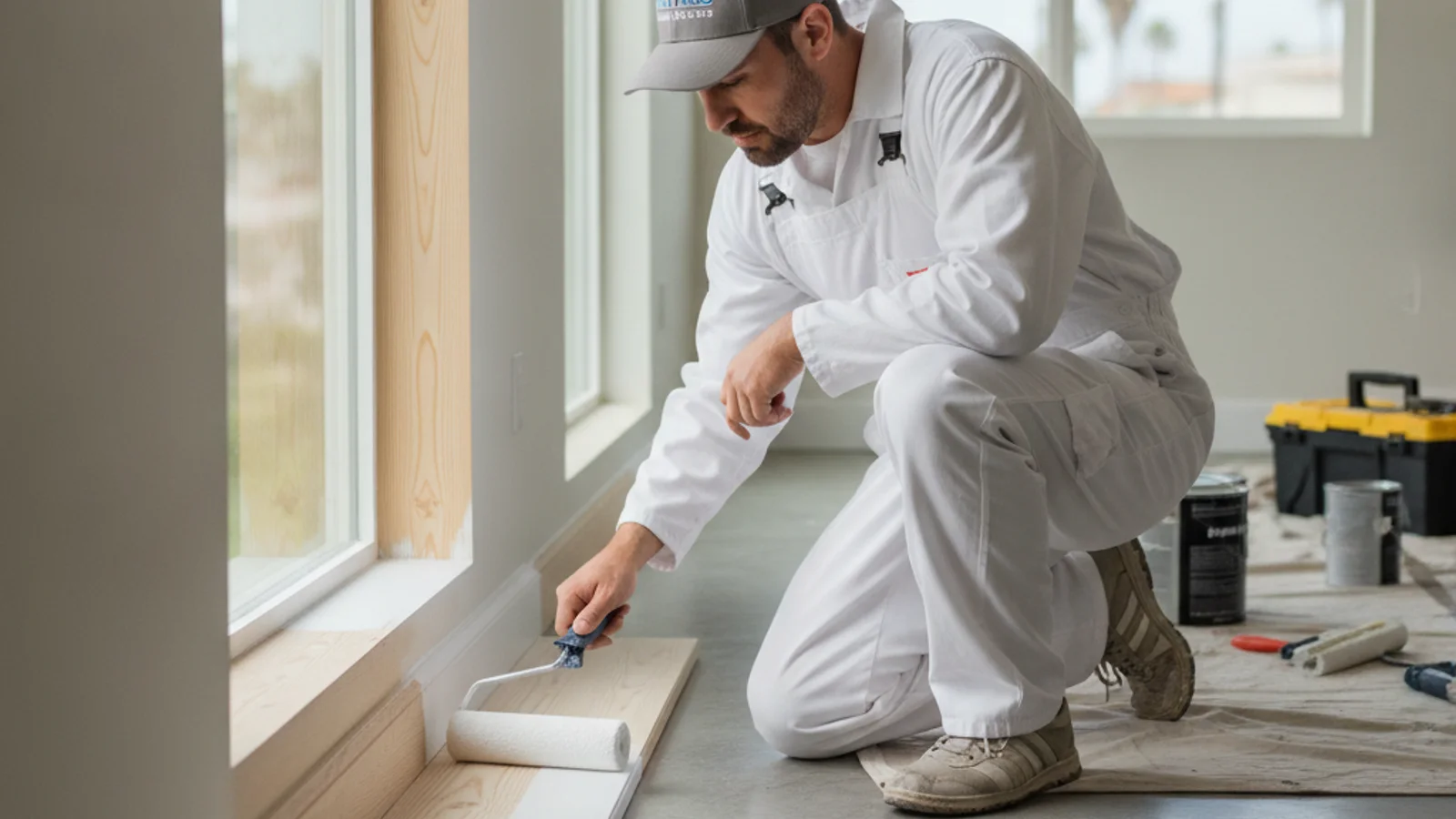
How to tell which one is already in your house
The fastest check is a cut end. Look at a spot where trim meets a doorway, an outlet box, or a mitered corner in a closet. Solid wood shows a visible grain pattern running the length of the board and, on a cut end, distinct wood fibers. MDF, short for medium-density fiberboard, is made from wood fibers pressed with resin into a dense, uniform sheet. A cut end looks smooth and slightly fuzzy, almost like compressed cardboard, with no grain at all.
Weight is another tell. MDF is noticeably heavier than solid wood of the same size because it’s denser and has no air pockets from grain structure. If you can pop off a short run of baseboard, wood flexes slightly and MDF stays rigid and can chip at a sharp edge if it’s dropped.
Age and neighborhood are not enough to identify the material, so ask the quoting painter to inspect the trim and confirm whether it is solid wood or MDF before setting the prep plan.
If you genuinely can’t tell from a cut end or weight, a painter doing prep work will usually confirm it in the first few minutes, since the two materials sand and prime so differently that the tool tells them right away. Tapping the baseboard is another quick check: solid wood gives a slightly hollow, resonant knock, while MDF sounds duller and more solid all the way through, a difference that becomes obvious once you compare a known wood sample to a known MDF one side by side.
How each takes primer and paint
Solid wood baseboard has open grain that can telegraph through paint if it isn’t sealed properly, especially with oil-based or resinous woods like fir. A stain-blocking primer such as Zinsser’s B-I-N or Cover Stain line handles that, sealing the grain and any knots before topcoat goes on. Wood also moves seasonally: it expands and contracts slightly with humidity, which is part of why joints and nail holes need attention before every repaint, not just the first one.
MDF is the opposite problem. It has no grain to seal, so it takes a smooth, even coat of paint with very little texture showing through. What MDF does have is a vulnerability to raw, unsealed edges. Factory-primed MDF baseboard comes primed on the face and top edge but the bottom edge, where it meets flooring, is sometimes left raw from the factory cut. That edge soaks up moisture like a sponge if it isn’t primed and sealed before installation or during a repaint.
Both materials benefit from a quality bonding primer before a repaint, particularly if the existing coat is glossy or the surface has any grease, wax, or silicone residue from years of cleaning products. Latex and alkyd enamel each bond differently to a primed surface, and the choice matters as much on baseboard as it does on cabinetry.
Moisture is the whole argument in coastal homes
San Diego’s coastal marine layer keeps relative humidity higher than most people assume for a place known for dry, sunny weather. That matters more for MDF than for wood, because MDF’s resin-bound fibers swell permanently once they take on water. A solid wood baseboard that gets damp from a leak or a humid bathroom will often dry out and hold its shape, maybe with some grain raising that a light sand fixes. MDF that gets wet swells at the affected spot and stays swollen. It doesn’t shrink back down the way wood does, so a water-damaged section of MDF baseboard is a replacement, not a repaint.
This is the real decision point for homes in Pacific Beach, Coronado, and other high-humidity coastal pockets, where bathroom baseboard, kitchen baseboard near a sink, or any run below a window that sweats in winter takes repeated low-level moisture exposure over years. Inland areas like El Cajon, Santee, and Escondido run drier, so the moisture argument matters less there and the choice between wood and MDF comes down more to cost and finish preference than durability.
If you’re replacing baseboard rather than just repainting it, factor in where the run sits. A hallway or bedroom baseboard away from water sources is a reasonable place for MDF anywhere in the county. A powder room, a laundry room, or any baseboard within a few feet of a shower or exterior door that lets in weather is a better candidate for solid wood, primed carefully on every face before install.
Cut ends, seams, and caulk lines
Every baseboard run has weak points, and they’re the same two materials behaving differently at the joints. Cut ends at inside corners, outside corners, and butt joints where two boards meet in a long wall expose raw material that factory priming never reached. On wood, an unsealed cut end absorbs paint unevenly and can show a slightly different sheen than the face of the board. On MDF, an unsealed cut end absorbs moisture and swells, and it’s usually the first place a repaint job starts failing.
A painter doing this work right seals every cut end with primer before caulking, not after. Caulk closes the gap between baseboard and wall or between two mitered pieces, and it needs a sealed, primed surface under it to bond and stay flexible. Ask the quoting painter how raw MDF edges will be sealed before caulking, especially in a bathroom or kitchen.
Nail holes get the same treatment on both materials: filled, sanded flush, and primed before topcoat, so they don’t flash through as small dark dots once the paint dries.
Choosing between them on a repaint or remodel
If you’re simply repainting existing baseboard, the material is already decided, and the job is about prepping it correctly for what it is: sealing wood grain and knots, or sealing MDF’s raw edges and cut ends. If you’re replacing baseboard as part of a remodel, the wood-versus-MDF choice comes down to where the room sits and how much moisture it sees.
For most interior rooms across the county, primed MDF baseboard is a practical standard that takes paint evenly and stays straight over time in a stable, climate-controlled house. For bathrooms, laundry rooms, homes with older plumbing prone to slow leaks, or any coastal property, ask the quoting painter to compare solid wood and MDF for the room.
Either material benefits from the same prep discipline: clean, sanded, primed, caulked, and inspected before the first coat goes on. That’s the work that determines whether a repaint looks sharp or starts showing seams. The trim, doors, and baseboards service page covers what that prep sequence looks like for a full room or a whole-house repaint, and the guide to trim and baseboard painting cost walks through how scope and material choice affect what a project involves.
When to call us
A baseboard repaint looks simple until you hit an unsealed cut end, a swollen section of MDF, or grain bleeding through a coat of white enamel. A local painter can identify the material, prep it correctly, and tell you honestly whether a section needs replacement instead of another coat. Call us at (858) 400-6422 and we’ll connect you with a licensed local painter.