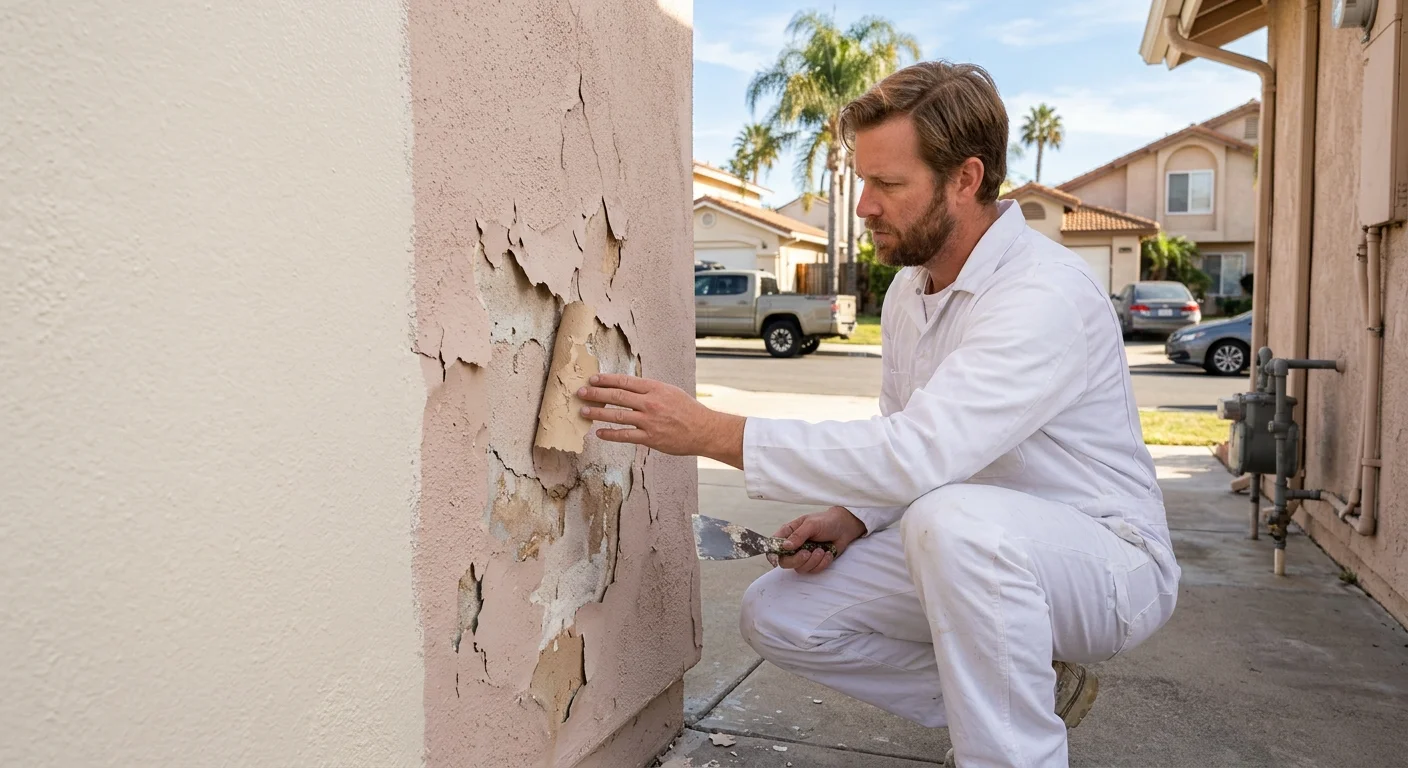
You walk the south wall and find paint hanging in sheets, with bare plaster showing through. That is peeling paint on stucco: the film has lost its bond. Another coat over those flakes will lift in the same spots, so the first move is an on-the-wall inspection by a licensed painter, not a new gallon from the shelf.
Treat peeling as a symptom that needs inspection
Peeling is the coating telling you the last system failed, or that something on the wall is still wet, dirty, or weak. It is not chalking, which leaves powder on your hand. It is not alligator cracking, which looks like dried mud in the film. And it is not a hairline crack in the plaster. Those common stucco problems show up on the same blocks, often on the same house. Mixing them up leads to the wrong repair.
A painter starts with a slow walk. South- and west-facing walls in Clairemont, Point Loma, and El Cajon take more sun. Coastal walls in Imperial Beach, Coronado, and Oceanside sit in marine layer and morning damp. Inland walls in Escondido and Poway bake harder in the afternoon. None of that, by itself, proves why your film lifted. A photo cannot confirm a leak, salt on the wall, or a failed primer. The painter has to see whether the peel is a band under a window, a sprinkler arc, or a whole elevation.
They lift a loose edge and look at the back of the flake. Clean paint on the back usually means the coat never grabbed. Stucco dust on the back can mean a weak surface. A wall that stays cool and dark after a dry morning still has moisture in play. About 49.6% of the City of San Diego’s housing units were built before 1978, so scraping an older house can also mean lead-safe work. That share runs higher in La Mesa (68.7%), Lemon Grove (69%), El Cajon (62.5%), National City (66.2%), and Imperial Beach (62%). It runs lower in newer North County cities such as San Marcos (23.8%) and Carlsbad (27.5%). The year on the house matters more than a guess from the curb.
Do not chip a whole wall yourself on a pre-1978 house. Paid work that disturbs paint in housing built before 1978 generally falls under the EPA Renovation, Repair and Painting program. Certified firms and certified renovators do that work, with limited exceptions for very small areas. Testing is not required. Without proof the paint is not lead-based, the rule still applies.
Separate coating failure from stucco damage
Two failures get called peeling. One is the paint film lifting off intact stucco. The other is the stucco itself letting go of the wall. You cannot treat them the same.
Coating failure looks like flakes, chips, or sheets of paint. The plaster under them can still be hard. The repair is removal of loose film, then primer and a masonry coating. That is stucco painting work, often bundled with a full exterior painting elevation so the wall does not read as a patch.
Stucco damage looks different. Hollow spots, crumbling brown coat, or slabs of plaster pulling off the lath are not a paint problem. Painting over that hides the failure and can trap moisture. Hairline cracks still need crack repair before painting. A painter can coat a sound, repaired surface. They should not coat loose plaster.
Planning ranges from a named local source help you budget the substrate side. Chism Brothers Painting, in a June 20, 2023 article on stucco repair cost in San Diego, put minor cracks and sprinkler damage around $200 to $300. Extensive cracking, or stucco peeling away from the wall as a multi-day job, was about $1,500 to $2,500 or more. Those are their published planning ranges, not a quote from Paint Pros San Diego. This brand does not set prices.
Who does the plaster work is a license question. CSLB describes a C-33 painting contractor’s scope as surface prep by scraping, sandblasting, or other means, plus the application of coatings. If the wall needs new stucco, ask which classification covers that repair, and check the license before you sign. California’s minor-work threshold is under $1,000 for the whole contract as of 2026. A peeling wall plus primer and finish coats is almost always above that line.
Your insurer decides whether peeling paint or stucco repair is covered under your policy. Coverage turns on the cause and the policy. Ask your carrier in writing. Do not treat a painter’s scope as an insurance decision.
Check cleaning, moisture, and old layers
Before anyone talks about color, the wall has to be clean, dry, and stripped of failed film. Dust, chalk, and irrigation scale sit on San Diego stucco all year. A coat over that peels again.
Cleaning belongs in the job, not as a weekend extra. Independent painters often wash the elevation, then wait for the wall to dry through. A numeric wash pressure is not something this page can publish as a rule. The right setting depends on the stucco, the old coating, and the tool. Too aggressive a wash can scar the finish coat. Too light leaves the chalk. Ask whether pressure washing is in the written scope.
Moisture is the other quiet cause. Eighty-five percent of San Diego’s rainfall falls from November through March. Coastal San Diego sees about 4 inches a year. Inland and mountain areas get more. The marine layer still wets coastal stucco on rainless mornings. Average relative humidity at San Diego International Airport is 79%. That does not mean an El Cajon wall is equally damp. It does mean a painter should not coat a wall that is cool, dark, or wet to the touch after June gloom in Ocean Beach or a sprinkler cycle in Santee.
Look at the pattern. Peeling in a stripe under a window can point at flashing or a leaking sill. Peeling at grade can point at soil piled against the wall. Peeling only on the sprinkler arc is often irrigation, not the paint brand. A painter can flag those patterns. They cannot certify a leak from the sidewalk, and this page will not diagnose one from a description.
Old layers matter too. Many San Diego stucco houses carry three or four coatings. When the stack gets thick and brittle, the new coat sticks to the old film, and the old film lets go of the plaster. The honest repair is to take the loose material off, not to add another skin.
Fresh patches have their own trap. Drying time for new stucco depends on the patch product and coating specifications. Painting too soon can trap moisture and lift the new film. Follow the patch product and the quoting painter. If the repair is still giving off damp, wait.
Plan removal, primer, and a new system
You cannot just paint over peeling paint. Loose film has to come off first. What stays has to be sound. A painter scrapes, sands, or otherwise removes the failed coating, then feathers the edges so the new system does not telegraph every chip.
Bare or chalky stucco usually needs a masonry primer. Stucco is alkaline and thirsty. A wall primer made for masonry evens absorption and gives the topcoat something to grab. Named systems on the local market include masonry coatings such as Sherwin-Williams Loxon and Loxon XP, and Dunn-Edwards EVERSHIELD, including elastomeric versions. Those names are examples of products sold for this substrate. They are not a ranking, a warranty, or a promise of how long a wall will last.
The topcoat has to be an exterior masonry coating, not leftover interior latex. Interior paint cannot take San Diego sun, irrigation, and marine air. Elastomeric and standard acrylic masonry paints are both used on county stucco. The right pick depends on hairline cracking, vapor movement, and how wet the wall runs. A tight, non-breathable film on damp stucco is a common way to peel the next job. Ask the painter, in writing, which primer and which topcoat they plan to use, and on which elevations.
Prep quality decides the job more than the color chip. Windows, eaves, and weep screeds need to stay able to drain. Caulk at open joints between stucco and trim belongs in the scope. If only one wall is peeling, a full-elevation recoat still often makes sense, because a patch of new film next to weathered film will read as two colors by the next summer.
On a pre-1978 house, the removal step is the lead-safe step. When the federal rule applies, certified firms isolate the work area, keep waste contained, and use HEPA attachments on sanders and grinders. Heat guns, if used on painted surfaces, stay under 1,100°F. Those are EPA work-practice standards, not a claim about any painter you have not hired yet.
Compare written repair scopes before you hire
Once the wall has been seen, hire from a written scope, not a hallway conversation. Two painters can look at the same peeling elevation and mean two different jobs.
The scope should say how loose paint comes off, how far the removal goes, and how they will treat remaining sound film. It should name the primer and the topcoat, not “paint the house.” It should split stucco patching from coating, so plaster work does not show up as a surprise extra. It should note moisture patterns they saw, and whether those have to be fixed before coating. On a pre-1978 house, it should state that the firm will follow EPA RRP practices when the rule applies.
Ask for the CSLB license number and look it up yourself. Paint Pros San Diego is a referral service. We match you with licensed, independent local painters. We do not paint, we do not repair stucco, and we do not hold a C-33. The painter you hire is the licensed party, and that painter’s contract is the one you sign.
Compare at least two written scopes on the same walls. Line up removal, primer, coats, and who owns the plaster repair. A low number that skips scraping is not a bargain. A high number that still says “paint as is” is not a thorough spec. If only a few chips are loose and the rest of the film is tight, a local repair plus a recoat of that elevation can be enough. If whole walls are shedding, plan a system replacement. Either way, put the decision on paper.
When to call us
Call when paint is peeling off stucco in sheets, when patches keep lifting, or when you cannot tell coating failure from damaged plaster. A licensed local painter should inspect the wall and write a scope before anyone recoats it. Call us at (858) 400-6422 and we’ll connect you with a local painter.