A stucco house on Coronado or in La Jolla does not live the same outdoor life as a house in El Cajon or Escondido. Two quotes can still look interchangeable until the product line shows up: Benjamin Moore Element Guard on one sheet, a Sherwin-Williams exterior on the other. The comparison that holds up in San Diego County is exposure, substrate, and the full system the painter will actually apply.
Start with the home’s exposure and substrate
San Diego County is not one climate. Coastal north county, the central city, East County, and the South Bay punish a paint film in different ways. Start there, then argue about cans.
Homes along Coronado, Imperial Beach, Oceanside, Solana Beach, and the La Jolla shoreline take marine air, fog, and salt on the windward walls. Inland homes in Escondido, El Cajon, Ramona, and Alpine take hotter afternoon sun and a drier wall. Rain still bunches up from November through March. Coastal San Diego sees about 4 inches in a typical year. Inland and higher ground get more. That split is why a product that looks fine on a north-facing courtyard can fail on a west stucco wall above I-8.
The substrate comes next. Most county exteriors are stucco. Wood siding, fascia, and doors are a different film. Fiber cement is another. A masonry-oriented coating, including systems like Sherwin-Williams Loxon or Loxon XP, is a different spec from a general exterior acrylic. Putting a wall paint on chalky, cracked, or poorly patched stucco wastes whichever brand you paid for. If the stucco itself is open, a stucco painting scope belongs in the quote before anyone debates logos.
Age of the house changes the work too. About 61.6% of Coronado’s housing units were built before 1978. El Cajon sits near 62.5%. The city of San Diego is about 49.6%. Paid work that disturbs paint in pre-1978 housing can fall under the EPA Renovation, Repair and Painting program. Testing is not required. Without documentation that the paint is not lead-based, the rule still applies. Ask the quoting painter how they contain dust, and verify their CSLB license before you sign.
Exterior house painting in this county is prep, weather windows, and the right film on the right wall. Brand is the last decision, not the first.
Compare Element Guard with Sherwin-Williams lines
Homeowners type benjamin moore element guard vs sherwin williams because one bid named a Benjamin Moore SKU and the other named a Sherwin-Williams line. That is a product question. It is not a brand religion question.
This site’s verified product names include Benjamin Moore Aura, Regal Select, ADVANCE, Ultra Spec, and Scuff-X. On the Sherwin-Williams side they include Duration, Emerald, Resilience, SuperPaint, and the Loxon family. Element Guard is the Benjamin Moore exterior name in the search that brought you here. We are not going to invent a gallon price, a warranty year, a coverage rate, or a lab score for it. Those numbers move by sheen, base, and the current technical data sheet. Read that sheet with the painter. Confirm the current retail price at the dealer. A blog that fills those blanks is guessing.
Treat each line as its own product. Aura is not Element Guard. A quote that only says “Benjamin Moore” is incomplete. A quote that only says “Sherwin-Williams” is incomplete too. Duration, Emerald, Resilience, and SuperPaint are different films. Loxon is a masonry family, not a swap for a wood siding topcoat. If one painter wrote Element Guard and the other wrote Duration, you are comparing two systems. You are not comparing two logos.
Painters often lean Sherwin-Williams for store access. Sherwin-Williams runs its own shops. Benjamin Moore sells through independent dealers. That changes who can tint a gallon at 4 p.m. and who already has the painter’s account. Preference is logistics and familiarity as often as chemistry. It is not proof that one film always wins on San Diego stucco.
Regal Select versus Element Guard is the same trap. They are different products. “Better” only means better for this wall, this sheen, this primer, and this existing coating. Ask which product, which sheen, and which primer sit in the quote. Ask why that stack fits a salt-facing Coronado elevation or a baked west wall in El Cajon. If you want the wider brand landscape, read our Benjamin Moore vs Sherwin-Williams exterior guide. This page stays on the named exterior matchup.
Labor, access, and prep still dwarf the can. Scaffolding a three-story Point Loma wall costs more than swapping one premium gallon for another. Do not pick a winner on sticker price alone. Confirm the current gallon price at the counter that will supply the job.
Check salt air, sun, and existing coatings
Salt air along the coast is real. A published percentage for how much faster it kills paint is not. No figure like that is on this site’s claims ledger, so we will not mint one. What you can see without a lab is chalking, peeling at windward corners, failed caulk at stucco-to-trim joints, and color that has drifted on the south and west faces. Those are the conditions the new film has to sit on.
Inland sun is a different load. East County and inland North County walls bake. Dark colors show heat and fade sooner than light ones. That is a reason to sample the actual hue on the actual elevation, not a reason to crown a brand. For weather-first product thinking, use our best exterior paint for San Diego weather notes alongside this comparison.
Existing coating is the third check. Many county houses already wear acrylic. Some older trim still has oil. Some stucco has been flooded with cheap masonry paint that is powdering. Adhesion testing, washing, scraping, and priming belong in the scope. A premium topcoat over chalk is still a failure waiting for the first marine-layer morning. If the wall is coastal wood or mixed siding, the La Jolla coastal exterior paint guide is the closer read for that exposure.
Sheen matters on the same wall. Flat hides stucco texture and old patches. Higher sheen on trim and doors is a different clean and a different flash. Match sheen to the surface, then keep it consistent on each elevation so touch-ups do not telegraph.
If the home is pre-1978, keep lead-safe work in the conversation while you argue Element Guard versus Duration. The film choice does not cancel containment, HEPA on power tools, or waste handling when the EPA rule applies. The painter is the one who has to run that job. Paint Pros San Diego does not.
Review samples on the actual exterior
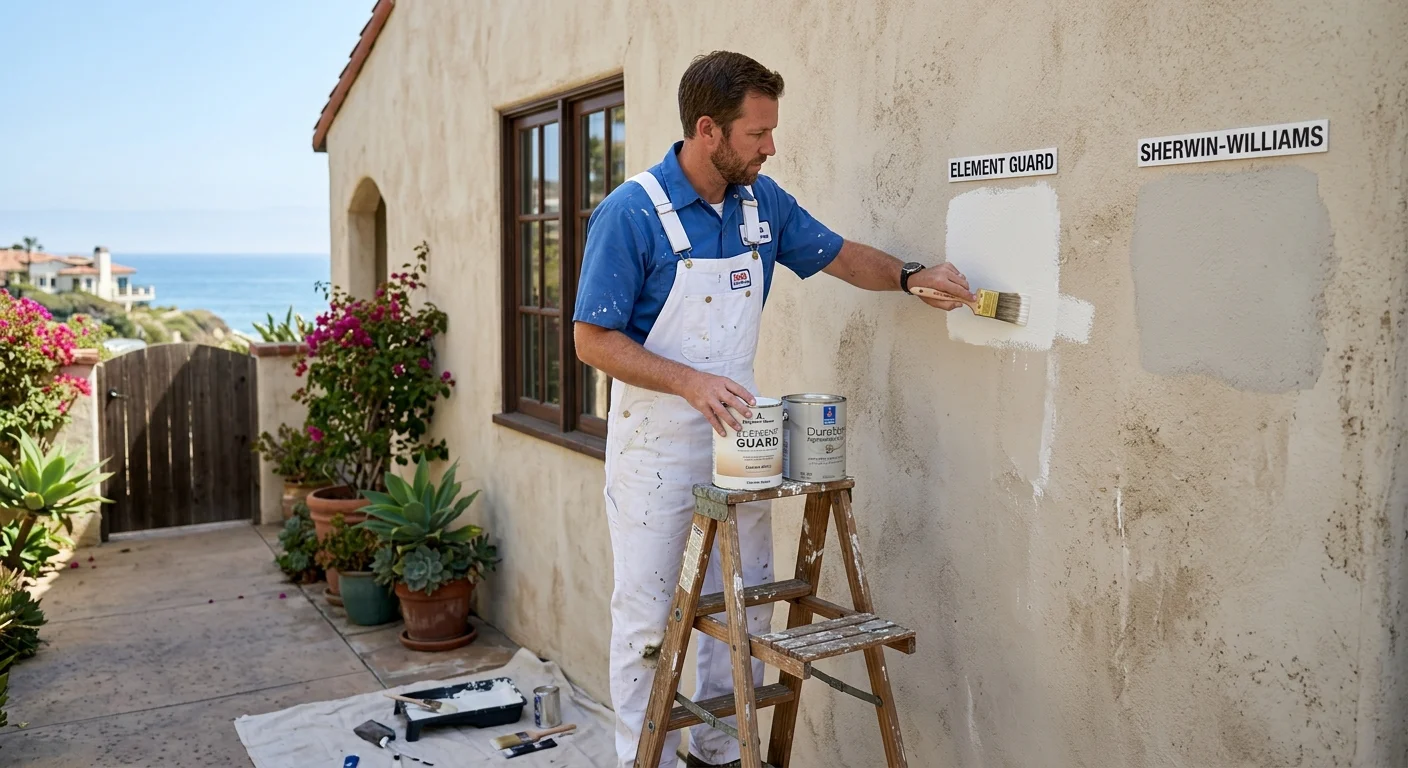
A fan deck in a Kearny Mesa shop is not your west wall at 3 p.m. Have the painter put Element Guard and the Sherwin-Williams line on sample boards or on a discreet patch of the real elevation. Use the same sheen you intend to buy. Let both dry. Look at them in morning marine layer, midday sun, and late light.
North and south faces will not read the same color. A courtyard in Encinitas stays cooler and greyer. A west stucco wall in Santee goes hard and warm. If an HOA has a locked palette, sample inside that palette. Do not approve a color from a phone photo.
Color consultation is useful when body, trim, and garage door have to work together, or when you are crossing from a Benjamin Moore chip to a Sherwin-Williams formula. Both companies publish large libraries. Benjamin Moore’s color trends and Sherwin-Williams color collections are starting points. The wall still gets the vote.
Ask for two coats on the sample if the quote is two coats. One thin pass lies about hide, especially when you are covering a dark existing body. If the painter says the new line is self-priming, ask on what substrate, over what existing film, and after what prep. Self-priming on clean, sound acrylic is a different claim from self-priming on raw stucco or burned wood.
Keep the boards. Photograph them with a note for date, elevation, and product. When a second painter arrives with a different can, you have a control instead of a memory.
Ask the painter to document the system
A good exterior quote names the system, not the brand. You want the product name, sheen, primer or spot primer, number of coats, and the surfaces each one covers. Element Guard on the body and a different enamel on doors is normal. Duration on stucco and a trim enamel on fascia is normal. “Sherwin-Williams, two coats” is not a system.
Ask them to write down what is on the house now, what failed, and what they will remove. Chalking, peeling, hairline stucco cracks, and open wood are prep items. They belong in writing. If the job disturbs paint on a pre-1978 house, ask how they will follow lead-safe work practices. That is the painter’s procedure, not a promise from this referral service.
Batch numbers, leftover labeled gallons, and a simple elevation map save you in year three when a pipe leak stains one wall. Touch-up from a different batch, or from a store-matched “close enough,” is how a patch appears at 10 a.m. and disappears at 4 p.m.
Paint Pros San Diego matches homeowners with licensed, independent local painters. We do not hold a C-33, we do not apply the film, and we do not warranty the coating. The contract and the product choice sit between you and the painter. Verify license on the CSLB site, ask for insurance documents, and keep the spec sheet with the signed scope.
If two bids still disagree, compare prep and product, not charm. The cheaper bid that skips washing, caulk, and primer is not a smarter Element Guard or Duration choice. It is a shorter job.
When to call us
Call when you have two exterior quotes that name different products, or when a coastal wall and an inland wall on the same house need different thinking. A licensed local painter should walk the elevations, name the system, and put samples on the real stucco or siding before anyone orders gallons. Call us at (858) 400-6422 and we’ll connect you with a licensed local painter.