Stucco repair in San Diego, CA covers everything from a single hairline crack to a multi-crack patch job to a full elevation re-stucco. What it costs tracks the type and extent of damage, not a flat number. Most San Diego homes 20 years or older show some stucco wear from UV exposure, marine layer humidity, and minor settling. We serve all of San Diego County, not just the city limits. Call (858) 400-6422 and we’ll connect you with a vetted local painter.
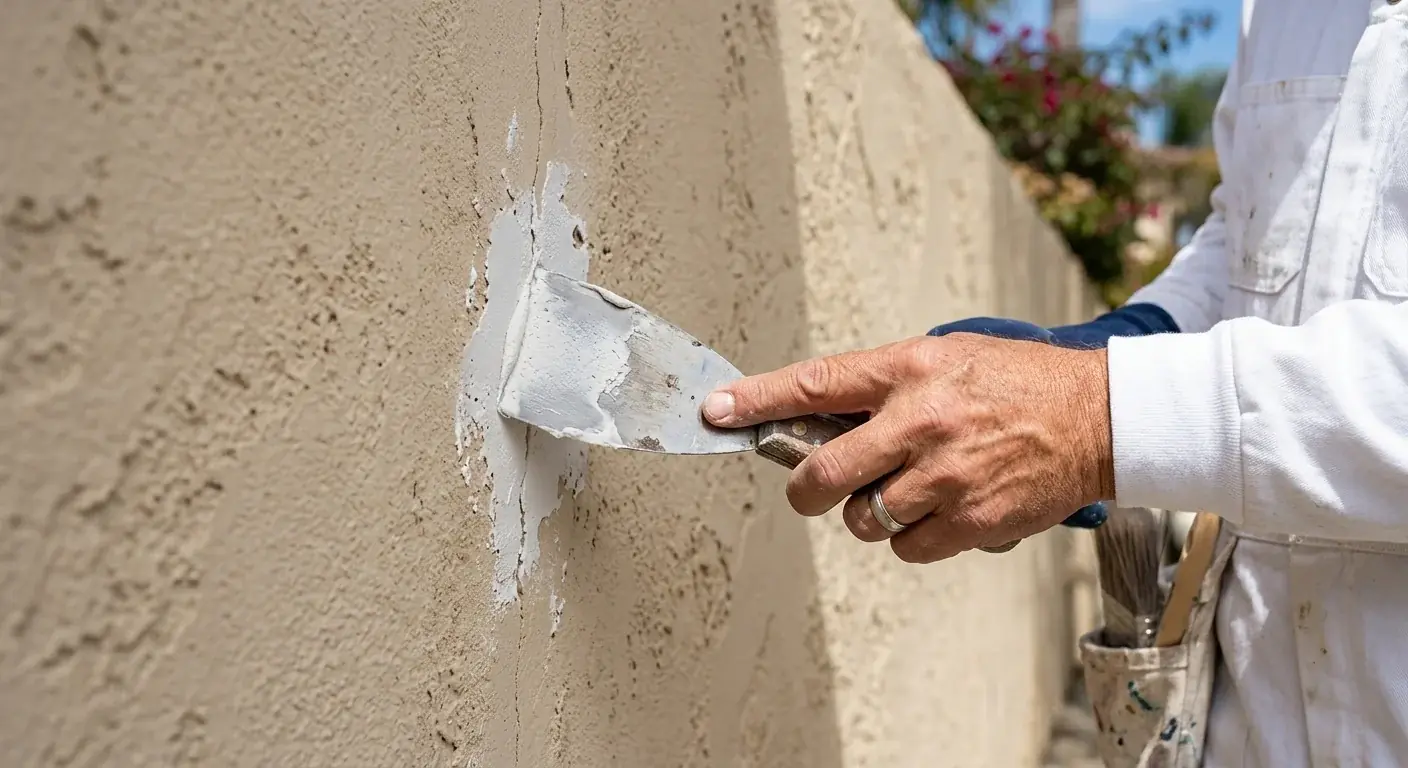
Types of stucco damage in San Diego, CA
Stucco fails in a few predictable ways. Knowing which type you’re looking at helps you understand what a repair will actually involve and whether you also need to address what’s behind the wall.
Hairline cracks are the most common issue we see. They’re thinner than a credit card edge (under 1/16 inch) and usually radiate from window corners, door frames, or run in a web pattern. The Stucco Manufacturers Association technical guides note these are typically cosmetic, caused by normal shrinkage and thermal cycling. In San Diego, the daily temperature swing between morning marine layer and afternoon sun drives a lot of these.
Stress cracks are wider (1/16 to 1/8 inch) and often run diagonally from openings or appear at floor lines on two-story homes. They mean something’s flexing more than the stucco can handle: a marginal weep screed, missing control joints per ASTM C1063 lath installation standards, or framing that’s moving. These need to be tracked, not just filled.
Structural cracks are over 1/8 inch wide, often run vertically full height or stair-step through a wall, and signal foundation movement. A licensed structural engineer should look at these before any patch goes on. According to the InterNACHI exterior inspection standards, cracks wider than 1/4 inch with offset edges are categorized as significant and require professional evaluation.
Impact damage shows as chips, gouges, or punched-through holes. Lawn equipment, ladders, hail (rare here), and kids’ baseballs are the usual suspects. The repair is straightforward but the texture match is what separates a clean job from a visible patch.
Water-intrusion delamination is when stucco pulls away from the wall in sheets or sounds hollow when you tap it. This means moisture got behind the lath and rusted it out, or rotted the sheathing. The repair scope is much larger because you have to open the wall, fix the source, and rebuild the assembly.
Efflorescence is the white powdery deposit you see on stucco after a wet winter. It’s mineral salts pushed to the surface by moisture moving through the wall. It’s not damage by itself, but it’s a sign water is getting into places it shouldn’t.
Color fade and chalking isn’t a repair issue, it’s a paint issue. We cover that in our post on how often to repaint stucco in San Diego.
Stucco crack repair vs patch repair vs full re-stucco
Three different scopes, three different cost drivers. Here’s how to figure out which one your house actually needs.
Stucco crack repair
For isolated hairline cracks under 1/16 inch, the fix is a flexible elastomeric sealant or specialty stucco patch product, applied with a putty knife and feathered to blend with the surrounding texture. A single crack run usually carries a minimum charge. Several cracks on the same elevation cost more, tracking the additional labor. We always recommend painting the repaired section (or the whole wall) afterward, because even a perfect color-matched patch will show through clear coats once UV hits it.
For a deeper look at this specific scope, read our stucco crack repair before painting guide.
Patch repair
When you’ve got localized damage larger than a crack (a busted corner, an impact hole, a small water-damaged area), you’re in patch territory. The work involves cutting back to sound stucco, replacing lath if it’s damaged, applying scratch and brown coats, finishing with a matching texture, and blending the paint.
Small patches cost less than medium patches, and cost scales with square footage from there. Anything bigger than that, you’re probably better off recoating the whole elevation for visual consistency.
Full re-stucco
A full re-stucco means new stucco over an entire elevation or the whole house, either as a recoat over sound substrate or a complete tear-off and rebuild. A recoat costs less per square foot than a full tear-off and rebuild, per ASTM C926 application standards, because a tear-off involves new lath, scratch, brown, and finish coats rather than a single skim layer.
We break the drivers down further in our stucco repair cost guide for San Diego.
Multi-family stucco repair in San Diego, CA
Property managers, HOAs, and apartment owners across San Diego County deal with stucco at scale. The repair questions are different from a single-family job.
Scope per building: Most multi-family stucco scopes are a mix of crack repair across all elevations, isolated patch work where tenants have damaged walls, and partial re-stucco on the south and west sides that see the most UV. What drives per-unit cost is the mix of crack repair, patch work, and whether a full elevation rebuild is on the table.
Scheduling around tenants: Stucco repair is loud, dusty, and ladder-heavy. Painters in our network coordinate notices per California Civil Code §1954 entry requirements, work elevation by elevation so tenants always have at least one usable patio or window, and keep the active work zone tarped at end of day. For occupied apartments, we generally avoid spraying and stay on hand-application methods to limit overspray complaints.
HOA and CC&R compliance: HOAs almost always require a color match to the approved palette and a licensed contractor carrying adequate general liability coverage. The painters we refer handle the architectural review committee submittal and supply a certificate of insurance naming the HOA as additional insured.
Per-unit vs lump-sum pricing: For smaller buildings, a lump-sum bid by elevation is usually cleaner. For larger complexes, a per-unit rate with a documented scope per unit type makes annual budgeting easier for the management company.
If you manage multi-family property in San Diego and want a walkthrough, call (858) 400-6422.
San Diego, CA climate factors in stucco damage
San Diego’s climate looks mild on paper, but the daily and seasonal patterns are what put real stress on stucco.
UV degradation. climate.gov data for San Diego shows sustained high UV index readings through the summer months. That UV breaks down the binders in elastomeric topcoats and causes paint to chalk, which then accelerates water absorption at every micro-crack. South and west elevations always wear faster than north and east.
Thermal cycling. The swing between cool marine mornings and warm inland afternoons drives hairline cracks. Stucco expands and contracts with temperature per EIMA technical bulletins, so day after day, that movement opens micro-cracks at every weak point in a wall.
Marine layer humidity. North-facing walls in coastal zones (La Jolla, Pacific Beach, Encinitas, Carlsbad) stay damp from the marine layer until late morning most of the year. Algae, mildew, and efflorescence show up here first. The fix is annual rinses and an antimicrobial primer when repainting.
Salt air corrosion. Coronado, Imperial Beach, Mission Beach, and Point Loma homes closest to the water deal with salt air that corrodes the galvanized lath behind the stucco. Once the lath rusts, the stucco can debond in sheets. Coastal homes need more aggressive sealing at all penetrations (light fixtures, vents, hose bibs) and earlier intervention on any cracking.
Wildfire smoke and ash. After a major fire event, ash bonds chemically with stucco surfaces. A pressure rinse soon after an event prevents long-term staining, especially on lighter colors.
Stucco repair and paint as one project
Most stucco repair in San Diego, CA, gets paired with painting. There are three reasons for this, and bundling the two together as one project is generally more cost-effective than doing them separately.
Visual consistency. Even a perfect texture-matched patch reads as a patch against weathered, chalked paint. New paint over the whole elevation hides every repair seam.
Primer-after-repair protection. Fresh stucco patches need real cure time, then need to be primed with a high-pH masonry primer like Sherwin-Williams Loxon or Benjamin Moore Ultra Spec Masonry Primer before topcoat. If you’re already painting, the primer step is rolled into the prep.
Mobilization cost. Setup, scaffolding, masking, and crew mobilization gets paid for once instead of twice when repair and repaint happen as one project instead of two separate visits.
For more on what kind of paint to put over repaired stucco, see our breakdowns of elastomeric vs acrylic paint for stucco and Sherwin-Williams vs Behr exterior paint for stucco.
Choosing a stucco repair contractor in San Diego, CA
Five questions that separate a real stucco contractor from someone with a bag of patch material in a truck.
1. Can you identify the stucco system on my house? Traditional three-coat cement stucco, one-coat stucco, and EIFS (synthetic foam-backed stucco) all repair differently. The wrong system match makes the patch fail. EIMA’s contractor guidance covers EIFS specifically. If they can’t tell you what’s on your wall, they shouldn’t be patching it.
2. What primer do you use after repair, and why? The right answer is a high-pH-tolerant masonry primer applied after the patch has fully cured. Painting directly over fresh stucco too soon causes peeling and discoloration almost every time.
3. How do you match texture and color? Texture is more important than people realize. Lace, dash, smooth, sand, knockdown, Spanish lace, and Santa Barbara all require different application techniques. Color match should be done with a sample patch on a hidden elevation, viewed in both morning and afternoon light, before the main job starts.
4. What’s the warranty? Ask directly, and get the answer in writing. A reputable shop backs the labor for a stated period and points you to the manufacturer’s spec for material coverage. Read the warranty before you sign. Most claims happen because of unrepaired underlying water issues, so the warranty should note that exclusions are clearly listed.
5. Can I see references for similar jobs? Hairline crack repair on a single-family home and stucco-foam (EIFS) rebuild on a four-story condo are different skill sets. Ask for references on jobs that match your scope.
The City of San Diego permit information confirms that most cosmetic stucco repair doesn’t require a permit, but structural stucco work, re-stucco involving lath replacement, and any work changing the building envelope often does. A contractor who doesn’t know which category your job falls into is one to skip.
What drives cost by job type
Here’s how the major job types compare on what drives their cost, based on jobs painters in our network have quoted and completed across the county.
| Job type | Typical scope | What drives it |
|---|---|---|
| Single hairline crack repair | 1 crack, patched and painted local | Minimum service charge; labor and small material quantity |
| Multi-crack patch | Several cracks on one elevation, patched and painted | Crack count and total linear footage |
| Small patch (under 10 sq ft) | Impact hole or corner damage, full texture match | Texture-match difficulty and prep |
| Medium patch (10 to 50 sq ft) | Water damage repair, includes lath replacement | Square footage plus lath replacement labor |
| Large patch (50+ sq ft) | Localized section rebuild with sheathing repair | Square footage plus sheathing repair scope |
| Full elevation re-stucco (recoat) | One side of house | Square footage at the recoat rate |
| Full house re-stucco (recoat) | All elevations, sound substrate | Total square footage across all elevations |
| Full house re-stucco (tear-off and rebuild) | New lath, scratch, brown, finish coats | Full rebuild labor and material, the highest-cost scope |
| Multi-family (per unit) | Moderate scope across building | Per-unit mix of crack repair and patch work |
| Multi-family (per unit, full re-stucco) | Per-unit cost on a larger building | Per-unit rebuild scope |
What you pay varies with access (two-story, scaffolding, hillside), stucco system, finish texture, color match difficulty, and whether painting is bundled in.
FAQ
How long does stucco repair last?
A properly done crack repair with elastomeric sealant and quality topcoat holds up well against re-cracking. A patch repair with full texture match and lath replacement lasts as long as the surrounding stucco typically does. A full re-stucco done to ASTM C926 standards holds up for decades if water management is right.
Can I DIY a hairline crack?
Yes, for a single isolated crack on an accessible ground-floor elevation. You’ll need an elastomeric stucco crack sealant (not regular caulk), a putty knife, a small piece of natural sponge for texture, and matching paint. Where DIY goes wrong is on map cracking (don’t fill, it’ll show every line), on stress cracks (which need to be tracked, not just patched), or on anything above a single-story reach.
Do I have to paint after a stucco repair?
For visible elevations, yes. Even with perfect color matching, a fresh patch reads slightly different than weathered stucco for a while. For backside walls behind landscaping where nobody sees them, you can sometimes skip the paint, but you still need to seal the patch.
Do you serve multi-family, HOAs, and property management companies?
Yes. We work with HOAs, apartment owners, and property managers across San Diego County. The painters we match carry general liability coverage, can name additional insureds, handle architectural review committee submittals, and schedule around tenant notice requirements.
Do you fix stucco-foam (EIFS) systems?
Yes. EIFS repair is different from traditional stucco because the foam backing has to be matched, the base coat with mesh has to be reapplied per manufacturer spec, and the finish coat has to be color-matched to the existing system. We work with Dryvit, StoTherm, and Parex systems among others.
What’s the warranty on stucco repair?
Ask your painter what workmanship warranty they offer and get it in writing. Manufacturer warranties on materials (Loxon, Evershield, and other primer and topcoat products) carry through separately per the manufacturer’s own terms. Underlying water intrusion is typically excluded unless the contractor is hired to fix the source as part of the scope.
How much does stucco repair cost in San Diego?
Hairline crack repair on a single accessible elevation costs the least. Patch repair with lath replacement costs more, scaling with size. Multi-elevation crack remediation costs more still. Full re-stucco on a single-story home costs the most before paint. Combined repair and repaint projects generally cost less than doing the two as separate jobs. Get a written quote based on a walkthrough for your specific scope.
Can stucco be repaired?
Yes, in almost every case short of full structural failure. Hairline cracks get sealed with elastomeric stucco crack sealant. Patch repairs replace damaged scratch, brown, and finish coats with full lath replacement underneath if the lath is corroded. Full re-stucco is reserved for substrates that are detached, water-damaged through the wall cavity, or have failed beyond patch tolerance. The right repair scope depends on damage type, not damage size.
Is stucco repair expensive?
Crack repair is the least expensive scope. Patch repair costs more. Full re-stucco costs the most. The total cost compounds when paint is added because color-matching a patch reliably means painting the entire elevation. Most San Diego homeowners save money by bundling repair and repaint as one project instead of doing them separately.
How long does stucco repair take?
Timeline tracks scope. A single hairline crack takes far less time than a multi-crack repair on one elevation. A single patch repair takes longer because of cure time, which is the rate-limiter, not labor. A full re-stucco takes the longest, since it needs the stucco work itself, then a full cure period before paint, then the paint work on top. Most homeowners underestimate the cure time.
Can I do stucco repair myself?
Yes, for a single isolated hairline crack on an accessible ground-floor elevation. You need elastomeric stucco crack sealant (not regular caulk), a putty knife, a natural sponge for texture matching, and matching paint. DIY goes wrong on map cracking (don’t fill, it’ll show every line), stress cracks (which need monitoring, not just patching), patches needing lath work, or anything above ground-floor reach. Above one story, hire a pro.
Why is my stucco cracking?
Five common causes in San Diego. House settlement (especially in newer homes). Foundation movement on expansive clay soils (East County, Otay Mesa). Lath corrosion in coastal salt-air zones (Imperial Beach, Coronado, Point Loma). Thermal cycling on south and west elevations (Santee, El Cajon, Lakeside). Water intrusion behind the wall (worst case, requires structural diagnosis first). Hairline cracks under 1/16 inch are usually cosmetic. Cracks over 1/16 inch, especially diagonal or stair-step patterns, warrant a structural look.
Get a stucco repair quote
If your San Diego home has cracks, patches, or paint that’s peeling off the stucco, we can take a look and tell you exactly what scope it needs. No upsell, no scare tactics. If a sealant tube and 20 minutes of your time is the right answer, we’ll tell you that too.
Call (858) 400-6422 and we’ll connect you with a vetted painter for a written San Diego stucco repair quote, or learn more about stucco painting in San Diego and full exterior painting service.
We serve all 67 cities of San Diego County, including the coastal zones (La Jolla, Pacific Beach, Coronado, Imperial Beach), North County (Carlsbad, Encinitas, Vista, Oceanside, San Marcos, Escondido), East County (El Cajon, Santee, Lakeside, Alpine), and South Bay (Chula Vista, National City, Bonita).