If you’re standing in front of your stucco wondering whether it’s time, here’s the direct answer: it depends on what’s happening on the wall, not on a number of years. Stucco homes within about three miles of the San Diego coast wear out faster because of salt-laden air and constant moisture cycling. Inland stucco homes east of I-15 hold up much longer because they trade that salt and moisture for intense but manageable UV exposure. East County homes in places like Ramona, Lakeside, and Alpine, with low humidity and larger lots that reflect less heat between walls, tend to go the longest between repaints of anywhere in the county. Warranty language on the can describes lab conditions, not what we see fail on a south-facing wall in our climate.
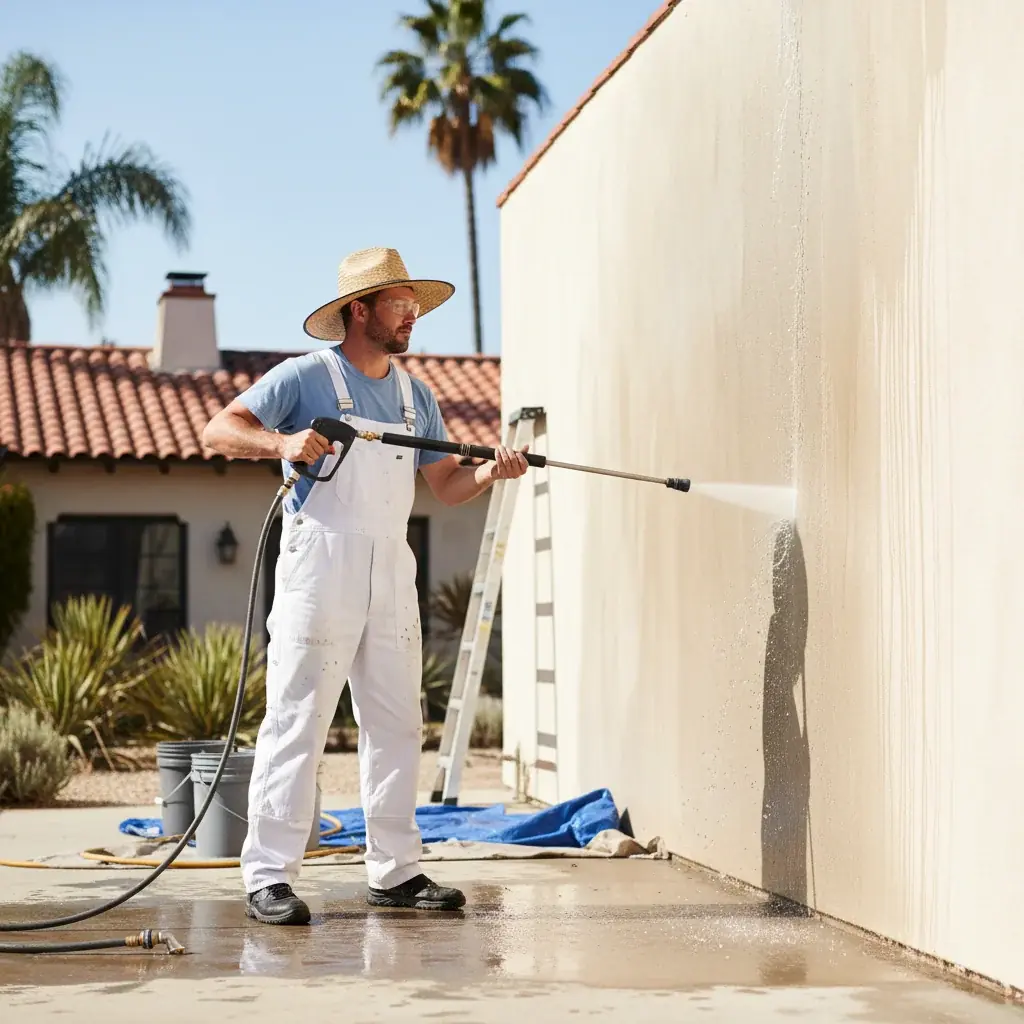
That gap between marketing warranty language (often “long-life,” “extended,” or “lifetime”) and what we actually see fail on south-facing stucco walls in Encinitas well ahead of that promise is the entire reason this guide exists. Below is how we read the signs when we assess repaints across the County, what drives wear, and how to know whether to repaint, spot-treat, or wait.
The coastal exposure: salt, moisture, and constant thermal movement
The coastal corridor runs from Oceanside down through Coronado and Imperial Beach, and every ZIP inside that band shares the same three stressors. Salt-laden marine layer settles on stucco overnight, UV bakes off the topcoat binder during the day, and the daily temperature swing forces hairline movement at every crack and control joint.
The ZIPs where we see paint show wear fastest:
- La Jolla (92037), Bird Rock, and Windansea: the bluffs catch direct ocean spray during winter storms, and south and west exposures here are the first to chalk.
- Coronado (92118) and Imperial Beach (91932): Coronado’s older Spanish stucco homes also have lime-rich substrates that pull moisture, which shortens coating life if the primer is wrong.
- Encinitas (92024), Cardiff (92007), Solana Beach (92075): the marine layer here is heavy roughly half the year. North-facing walls hold mildew; south-facing walls fade first.
- Carlsbad (92008, 92011), Oceanside (92054, 92057): a little farther from the bluff edge, slightly less corrosive air, but still a coastal wear pattern.
- Del Mar (92014), Pacific Beach (92109), Ocean Beach (92107): sea spray is the dominant driver. South walls almost always need a recoat before north walls do.
If a homeowner inside any of these ZIPs sees the paint film aging, we recommend at minimum a chalk test and a moisture read before deciding whether to wait or move ahead. National guidance like the certapro.com guidance lines up directionally with our coastal read, but tends to understate how much longer inland San Diego paint holds up.
The inland and East County exposure: UV instead of salt
Cross I-15 and the math flips. Salt drops off, humidity drops off, and the primary enemy becomes UV plus Santa Ana heat events. The good news: modern acrylic and elastomeric paints handle UV extremely well as long as the prep is clean. The bad news: when an inland repaint fails early, it’s almost always a prep failure, not a paint failure.
What we see across inland ZIPs:
- Escondido (92025, 92027, 92029), San Marcos (92069, 92078), Vista (92081, 92083, 92084): hot summers, cool nights, lower humidity. Acrylic systems perform very well here.
- Poway (92064), Rancho Bernardo (92127, 92128), Carmel Valley (92130): higher elevation reduces marine influence quickly. HOAs in these neighborhoods often dictate repaint timing before paint actually fails (more on that below).
- El Cajon (92019, 92020, 92021), La Mesa (91941, 91942), Santee (92071): inland heat is intense in summer but stucco coatings hold up well when the prep is right.
- Lakeside (92040), Alpine (91901), Ramona (92065): lower humidity year-round, very few mildew issues, and bigger lot sizes mean less reflected heat from neighboring walls.
- Chula Vista (91910, 91913, 91914, 91915): eastern Chula Vista (Otay Ranch, Eastlake) holds up longer than western Chula Vista, which still picks up some coastal moisture.
Inland clients often ask why the same product on the same home performs differently from a coastal neighbor’s. The answer is usually that the inland paint got a fair run at its full design life, while the coastal paint was fighting salt the entire time. NOAA’s San Diego coastal climate data on the San Diego forecast office page shows marine layer days and dew-point profiles drop sharply once you’re several miles inland.
Manufacturer warranties versus real San Diego performance
Warranty language on a paint can is a marketing description set under controlled lab conditions. It tells you what the manufacturer is willing to backstop, not how long the coating will look good on a south-facing Encinitas wall. Here’s the crosswalk we use, with our real-world read on each line.
Sherwin-Williams Loxon XP / Loxon Self-Cleaning (elastomeric, masonry). Marketed as a long-life elastomeric coating. Specs live on the Sherwin-Williams Loxon product page. It holds up well on a properly primed coastal wall, and noticeably longer inland. Where it fails early: thin application over chalky old paint without a binding primer.
Sherwin-Williams Emerald and Duration Exterior (high-end acrylic). Marketed as a long-life exterior line. We see solid coastal performance and stronger inland performance, with excellent UV resistance, which is why painters in our network spec it for south-facing inland walls.
Behr Premium Plus Exterior and Behr Marquee Exterior. Marquee carries a long-life consumer label. The Behr Marquee product page details the consumer warranty. Marquee is genuinely good UV-wise. Where homeowners get burned is that the long-life claim doesn’t survive moisture intrusion at parapets or chimneys, coastal or inland.
Dunn-Edwards Evershield. A San Diego favorite because Dunn-Edwards’ formulations are built for the Southwestern climate. Product details on the Dunn-Edwards Evershield page. Very strong fade resistance, which matters because our UV load runs high in summer. Climate.gov’s local UV index data (search “UV index San Diego” on climate.gov) shows why darker colors specifically degrade faster here.
Benjamin Moore Aura Exterior. A premium acrylic with very good color retention. Aura’s strong suit is depth of color and fade resistance, not elastomeric crack-bridging, so on older stucco with hairline cracks we usually pair it with a flexible patch system or move the customer to Loxon.
Kelly-Moore DuraPoxy II / Acry-Shield. A lower price point line. Fine for budget jobs on inland tract homes. We don’t recommend it on coastal exposures, where it shows wear noticeably sooner than the premium lines above.
The honest takeaway: treat the manufacturer’s warranty language as a ceiling, never a planning number, especially on a coastal wall.
HOA repaint cycles in San Diego County
Plenty of San Diego homeowners are on an HOA cycle that’s shorter than what the paint actually needs. That’s not always a bad thing. HOA-driven repaints in tract communities keep the entire street looking consistent, which protects property values. But it does mean you may be repainting before chalking or fade actually warrants it.
Common HOA patterns we see:
- Carmel Valley (92130) and Pacific Highlands Ranch: fixed-interval mandates, with color committees that approve palettes only from approved Dunn-Edwards or Sherwin-Williams cards.
- Rancho Bernardo (92128) and 4S Ranch (92127): fixed-interval cycles. Some sub-associations are stricter on trim color than body color.
- Carlsbad master-planned communities (La Costa, Aviara, Bressi Ranch): coastal exposure pushes some HOAs toward shorter cycles than an equivalent inland community.
- Otay Ranch and Eastlake in Chula Vista: often paired with required pressure-wash documentation.
- Scripps Ranch (92131): looser cycles than coastal HOAs, in line with its inland exposure.
If your HOA wants a repaint and your paint is still in good shape, you generally need to comply. There’s a formal color and contractor approval process that has its own timeline. Painters in our network walk through that in detail in our HOA paint color rules in San Diego guide and the HOA exterior paint approval process so you don’t get caught between a paint crew start date and an approval board.
8 signs it’s time to repaint your San Diego stucco
If you’re trying to decide whether you’re at the front of the window or past it, these are the signals we look for during an in-person assessment. Two or more of these together usually means the repaint is overdue.
- Chalking. Rub a clean dark cloth on the wall. If it picks up white or pigmented powder, the binder is breaking down. This is one of the most common signals we see on inland stucco as the coating ages.
- Hairline cracks across stucco fields. Some hairlines are normal in San Diego stucco because of seismic and thermal cycling. When they spread into a web pattern, the paint film is no longer bridging movement.
- Color fading on south and west walls. Compare a south wall to a north wall under the same eaves. A clear color delta means UV has broken down the topcoat pigment, and shows up sooner on coastal homes than inland ones.
- Peeling at parapets, chimneys, and roofline transitions. These edges trap water. When you see peeling here but the field is intact, you may be able to spot-treat for a while, but the repaint clock is running.
- Efflorescence (white salt deposits). Crystalline white residue on stucco means moisture is moving through the substrate and depositing salts. This is a moisture-source problem first, then a paint problem. Don’t repaint over active efflorescence.
- Mildew or algae growth. Green or black staining, especially on north walls in coastal ZIPs, signals moisture retention. A repaint with mildewcide-loaded paint solves the look. The moisture source still needs addressing.
- Color drift. When the original color no longer matches a recent touchup, the field paint has shifted. Owners usually notice this after a small patch repair makes the rest of the wall look “off.”
- Sealant failure at windows and trim. Caulking lifts, cracks, or pulls away from substrates as it ages in San Diego sun. If the caulk goes, the paint film at those joints isn’t far behind.
A combination of chalking plus hairline cracks plus south-wall fade is the canonical “you’re past due” signal we see most often in Encinitas, La Jolla, and Coronado.
Why San Diego stucco often fails before the warranty
Stucco repaint failures here usually have nothing to do with the paint can. They’re driven by four field-level realities the warranty doesn’t account for.
South and west exposure UV load. A south-facing wall in El Cajon or Escondido takes on meaningfully more annual UV energy than a north-facing wall on the same house. The same can of paint on the south wall shows wear years earlier. The painters we match rotate inspection priority accordingly.
Hairline cracks across thermally active stucco fields. Stucco moves with temperature. San Diego’s daily swing is wide enough that older homes (1960s to 1980s, especially in the 92020 El Cajon corridor) develop hairline cracks the paint film can’t bridge unless it’s elastomeric. We cover the repair side in stucco crack repair before painting.
Dirty pre-paint surface. This is the single most common failure cause we inspect when a homeowner says their fairly recent repaint is already chalking. Stucco needs proper pressure-washing and dry time before coating. National content on the Brad Stoner repaint guide skips this in detail because it’s a contractor-side issue, but it’s the dominant predictor of early failure.
Inadequate primer coat. Stucco that’s chalked or that’s seeing its first repaint after a long stretch needs a binding primer (Loxon Conditioner is the most common spec we write). Skipping the primer to save a day is the second most common cause of early failure.
When all four of these are handled correctly, San Diego stucco holds its protective qualities the longest its exposure allows. When any one of them is mishandled, expect to lose real years off the coating’s life.
Repaint, spot-treat, or wait: a decision framework
Three real scenarios the painters we match walk homeowners through every week.
Scenario A: Coastal home, light chalking on south walls, no cracks, no peeling. Recommendation: monitor for a season or two unless you’re selling, and note if chalking spreads to west walls.
Scenario B: Coastal home, chalking on three exposures, hairline cracks on the south field, peeling at one parapet. Recommendation: repaint now. Spot-treating won’t buy meaningful time and the parapet peeling indicates moisture entry. See our exterior painting cost in San Diego breakdown for what drives the price.
Scenario C: Inland home, no visible failure, HOA-mandated repaint due. Recommendation: comply with HOA timing and use the cycle to upgrade to a long-life acrylic or elastomeric. A higher-grade coat from Sherwin-Williams Emerald or Dunn-Edwards Evershield extends the next cycle further than a contractor-grade product would.
If you want a baseline on overall exterior life across siding types, our how long does exterior paint last in San Diego post covers the broader picture. The post you’re reading is the stucco-specific deep cut.
How to make your next stucco repaint last longer
The single highest-impact decision after timing is prep depth. Here’s the order of operations we use on every coastal job.
First, pressure-wash with a low-PSI rotary nozzle and let dry well before coating, longer in marine layer season. Hairline cracks get a flexible patch (we use a polymer-modified stucco patch or a high-grade urethane sealant depending on width). Chalk-bound substrates get a binding primer like Loxon Conditioner. South and west walls get the same number of coats as north walls, but we inspect those exposures first at every future maintenance walk.
Color choice also matters more than most homeowners realize. Light to mid-tone colors hold up noticeably better than dark colors under San Diego UV. A dark navy or charcoal stucco home in Escondido will show visible fading well before a beige or warm white home painted at the same time. The California Energy Commission’s data on reflective coatings (search the CEC residential cool-roofs page) explains why lighter pigments absorb less and degrade slower.
For full prep depth on stucco specifically, walk through our exterior paint prep on stucco guide and the elastomeric vs acrylic comparison at elastomeric vs acrylic paint for stucco in San Diego.
Frequently asked questions
What determines the cost to repaint stucco in San Diego?
Home size, story count, and prep condition are the biggest drivers, followed by whether the job calls for an elastomeric system versus a standard acrylic. Elastomeric systems cost more because of material thickness and additional prep. Coastal jobs typically cost more than inland jobs on the same square footage because of additional prep for salt and mildew. Full detail in our exterior painting cost in San Diego post.
Can I wait longer if my HOA approves a delay?
Sometimes. If you can show the HOA written documentation that your current paint film is intact (no chalking, no peeling, no significant fade), some boards grant a short extension. Coastal HOAs are stricter because their boards see early failures across the community and don’t want stragglers. Get the request in writing and plan the repaint within the extension window.
What’s the best time of year to repaint stucco in San Diego?
Late September through mid-November and April through early June tend to work best. You want low humidity, dry surfaces, and mild overnight temperatures. We avoid the heart of marine-layer “June gloom” for coastal jobs because the wall stays damp longer than crews expect. Inland summer is technically paintable but the stucco surface temperatures get high enough to flash off the paint solvents too fast, which can affect adhesion. See best time to paint exterior in San Diego for the full month-by-month breakdown.
Do I need to power wash before repainting?
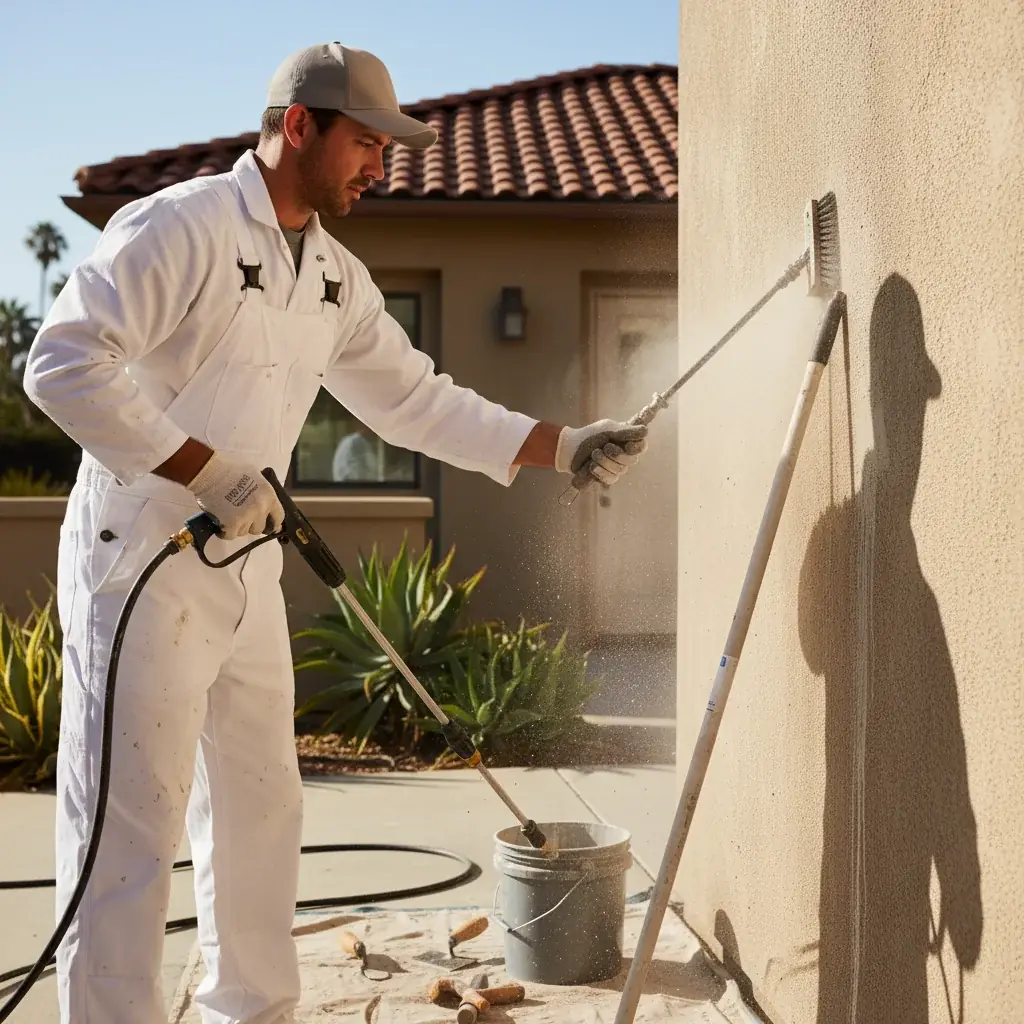
Yes. Stucco repaint failures we trace back to a single root cause almost always end at “the wall was dirty when it was coated.” Pressure washing at the right PSI for stucco and giving it real dry time is non-negotiable. Our pressure washing before painting in San Diego post details the full spec.
Elastomeric or acrylic for San Diego stucco?
If your stucco has visible hairline cracks across the field, elastomeric is the right call. It bridges movement and creates a thicker, more waterproof film. If your stucco is in excellent condition with no cracks, a premium acrylic like Sherwin-Williams Emerald, Dunn-Edwards Evershield, or Benjamin Moore Aura will be cleaner, breathe better, and cost less. Full side-by-side comparison at elastomeric vs acrylic paint for stucco in San Diego.
Can I change colors at repaint, or does the HOA limit me?
You can change colors. In HOA communities you’ll need approval through the architectural review committee, which takes time. Communities with strict palettes (Carmel Valley, Aviara, 4S Ranch) limit you to approved swatches. Outside HOAs, you’re free to choose, though we always recommend lighter to mid-tone colors for longer-lasting performance in San Diego sun. Color planning is covered in our paint color consultation guide.
How often should you repaint stucco?
It depends on exposure more than any fixed number. Coastal homes within a few miles of the Pacific need to watch their paint closely because of salt air and constant humidity cycling. Inland and East County homes go much longer between repaints because of high UV but lower humidity stress. Stucco itself can last decades; the paint film is what wears out. Chalking, fading, and hairline cracks are the three signals it’s time, not a date on the calendar.
Is it better to paint or restucco?
Paint if the stucco substrate is sound. Restucco if the substrate is failing (delamination, large detached sections, water intrusion behind the wall). Restuccoing intact stucco is almost never a good investment; it’s a fix for a structural problem, not a refresh, and costs considerably more than a repaint.
How do you know when stucco needs repainting?
Eight signs in San Diego: chalking (white powder on your hand when you rub the wall), fading on south and west elevations, hairline crack network expanding, mildew streaks on north walls, peeling around window and door trim, exposed lath through cracks, color mismatch against newer additions, and a paint film that’s visibly past its prime for its exposure, sooner in coastal zones, later inland. Any two of those at the same time means start getting quotes.
Can you paint over old stucco paint?
Yes, in almost every case, if the existing paint is sound (not peeling, not blistering, not heavily chalking). Pressure wash at the right PSI for stucco, let it dry fully, spot-prime any bare patches, then apply two finish coats. If the existing paint is chalking heavily or peeling in sheets, you’ll need a full-house masonry conditioner primer first to lock down the substrate before the new finish goes on.
How long does fresh paint last on stucco?
It depends heavily on exposure and product. Coastal stucco within a few hundred feet of the ocean wears the fastest, regardless of product grade. Elastomeric systems generally outlast standard acrylic in the same location because they bridge movement better. Cheap single-coat work cuts the coating’s protective life substantially. The variable that matters most is prep quality, not the product line on the can.
Does stucco need to be sealed before painting?
Yes on bare new stucco (apply a masonry conditioner like Loxon Conditioner after the manufacturer’s recommended cure window). Yes on old chalky paint (a binding primer locks down the chalk so the new finish has something stable to bond to). Not on a sound, well-bonded existing paint film that’s still holding up well, coastal or inland. Sealing well-bonded paint is wasted money. Skipping the seal on bare or chalky stucco cuts your repaint’s life significantly.
Ready to plan your stucco repaint
Stucco repaint timing isn’t a guess. It’s a function of your ZIP code, your last paint spec, your home’s exposure, and your HOA cycle. For an in-person assessment, call (858) 400-6422) and we’ll match you with a vetted San Diego stucco painter who can chalk-test the walls, read moisture content, and give you an honest answer on whether to repaint now or wait. See our page on stucco painting in San Diego for the full scope of what matched contractors handle.