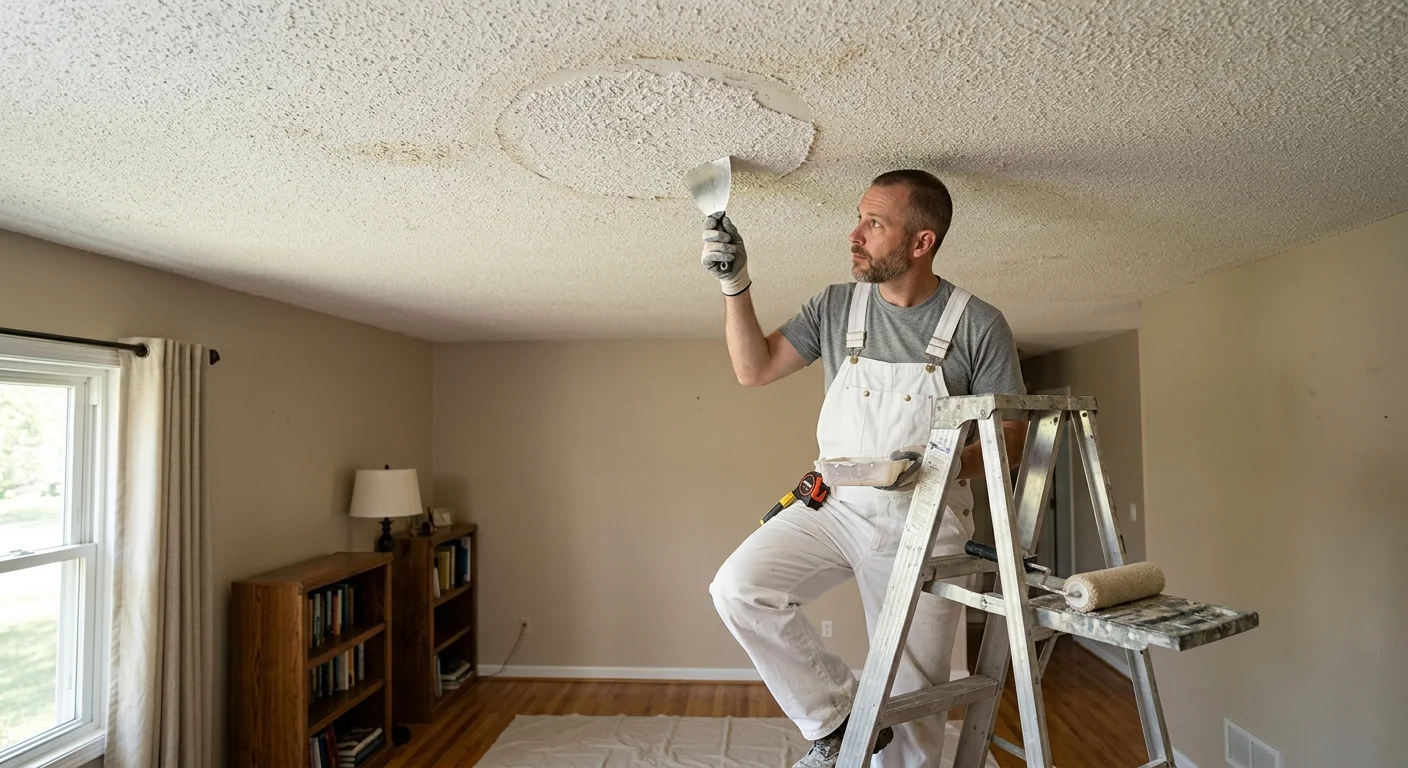
The circle over the old can light is a different ceiling from the rest of the room. The original acoustic spray still has its peaks. The popcorn ceiling patch is flatter, shinier, or a slightly different white. Independent ceiling and drywall professionals see that mismatch every week in San Diego County tract homes, and the next move is inspection, not another coat of white.
Identify the existing ceiling texture
Popcorn is not one look. In this county it shows up as coarse acoustic spray, a finer cottage-cheese stipple, or a later knockdown that someone still calls popcorn. Before anyone adds more material, the existing pattern has to be named. That means flake size, how the peaks sit, and how many times the original texture has already been painted.
Housing age is the local clue. About 62.5% of El Cajon’s units, 68.7% of La Mesa’s, and 69% of Lemon Grove’s were built before the 1978 federal lead-paint cutoff. City of San Diego sits near 49.6%. Chula Vista is newer, about 40.8%. A popcorn ceiling patch in an East County ranch is often sitting on original spray that has already been sealed with paint. A patch in a 2000s South Bay tract is a different stack of materials.
A painter who does drywall repair and texture match starts with a close look, not a can. They read a small area in raking light from a window or a hallway. Ceiling texture types in San Diego run from orange peel to knockdown to true acoustic popcorn. If the room is actually knockdown, spraying “popcorn” on the hole will never sit right.
Do not assume the original mix is still on a shelf. Many older acoustic textures used a vermiculite or polystyrene aggregate that today’s bagged products do not copy. That is why a store spray can land on a ceiling in El Cajon or National City and still read as a pancake. The pro is matching particle size and sheen, not a brand name on a lid.
If the house was built before 1978, paid work that disturbs paint can fall under the EPA Renovation, Repair and Painting program. Testing is not required by that rule. Without documentation that the affected paint is not lead-based, the applicable requirements stay in play for covered work. Visual look also does not tell you whether the texture contains asbestos. EPA advises a trained, accredited professional take samples, and advises against taking samples yourself. A build year does not prove what is in that particular ceiling.
Check the patch edges and surrounding coating
Most failed popcorn ceiling patches fail at the rim, not the center. The new texture stops in a hard line. The old texture was crushed by a knife. Paint on the original field is a different sheen than the patch. Afternoon light from a west window, or a skylight inland, makes that ring obvious.
A pro checks four things. First, whether the board under the patch is flush. A proud drywall plug or a sunken hole will show through any spray. Second, whether the surrounding popcorn was feathered back, or just smeared. Third, whether the existing coating is flat ceiling paint or a later eggshell rolled across the whole room. Fourth, whether the patch compound is still a different color because it was never primed.
Sherwin-Williams ceiling paint is typically a flat finish formulated to resist drip. Benjamin Moore Waterborne Ceiling Paint is a dead-flat interior ceiling paint. Insl-X Color-Changing Ceiling Paint goes on pink and dries white flat. Those are spec examples, not a prescription. A patch painted with leftover wall eggshell will flash against a flat acoustic field. Paint will not hide a different aggregate.
Spackle over popcorn is a common shortcut. Spackle fills a hole. It does not recreate sprayed aggregate. Joint compound can level a board seam. It still leaves a smooth island unless texture goes on after. That is why a “fixed” hole still reads as a scar once the sun hits it.
If the surrounding ceiling was already painted, the old texture is locked. New wet texture sits on a sealed film instead of raw gypsum. It beads, clogs, or lands too fine. The painter may need to dull the sheen or work a wider zone so the new material has something to grab. None of that is a promise of an invisible repair. It is the inspection that decides whether a popcorn ceiling patch can even be attempted on that plane.
Compare spot repair with a wider texture area
A nickel-sized screw hole and a two-foot water stain are not the same job. Spot repair tries to hide one defect. A wider texture area accepts that the eye reads a field, not a dot. On popcorn, the field usually wins.
Independent ceiling and drywall professionals often test a sample on a board, or in a closet, before they commit to the main room. They vary spray distance, material wetness, and aggregate until the test is close. Then they look at it dry, under the same lighting as the room. Coastal houses from Imperial Beach to Oceanside live with damper air. National Weather Service climatology for San Diego International Airport puts average relative humidity near 79%, highest before dawn and lower in the afternoon. Inland rooms in Escondido and El Cajon sit in drier air. There is no single countywide dry time for a popcorn ceiling patch. Product labels and job conditions set that. Confirm the current instructions with the painter before anyone recoats.
When the test still reads as a patch, the honest move is to enlarge the work, not to pile another coat on the same island. That can mean texturing from a corner to a beam, or from a bulkhead to the wall. It can mean matching one whole living-room plane instead of a circle over the old fixture. The extra square footage is not padding. It is how you keep the blend line out of the middle of the ceiling.
Compare that choice with whether to repair or remove a popcorn ceiling in the first place. A mismatched popcorn ceiling patch is often the moment that decision becomes real. If the rest of the ceiling is stained, sagging, or already a mix of three DIY sprays, a wider repair still leaves a quilt.
California’s C-33 painting classification covers surface prep and the application of textures that adhere by evaporation. For work at or above $1,000 as of 2026, homeowners should verify the contractor’s CSLB license before signing. Paint Pros San Diego is a referral service. We match you with licensed independent local painters. We do not perform the work, own no crews, and hold no trade license of our own.
Plan primer and paint after texture approval
Texture first. Approval second. Primer and paint last. Painting a still-wrong popcorn ceiling patch only freezes the mismatch in a nicer white.
Benjamin Moore’s published how-to is to paint the ceiling before the walls, and that most previously painted, undamaged ceilings do not need primer. A repair is not an undamaged ceiling. New compound and new texture are porous and often a different color. They flash if you skip primer. A stain-blocking primer such as Zinsser Cover Stain or Zinsser B-I-N is a spec example when water marks or smoke are in play, not a claim that every patch needs oil or shellac.
The painter should wait until the texture is fully set per the product in use. Then they check the match in daylight and in the room’s night lighting. Only then does primer go on the repair, and often on a wider field so the sheen is even. Flat ceiling paint hides small texture differences better than eggshell. It will not hide a hard edge or a different particle size.
If the plan is to recast the whole ceiling in one color, the pro still needs the texture approved first. Paint will not save a pancake patch. It can even make the patch louder, because a fresh flat film shows raking light more cleanly than the old, slightly soiled white around it.
Keep furniture, rugs, and floors protected. If the home is pre-1978 and paid work disturbs painted surfaces beyond the EPA’s minor-repair exception, a certified firm and certified renovator are required. That interior exception is six square feet or less per room. Window replacement and demolition are covered regardless of size. When the rule applies, signs go up, the work area is contained so dust does not leave it, and sanders or grinders on painted surfaces need a HEPA vacuum attachment. Ask the quoting painter how they handle that, and check their credentials. Do not treat a visual “it looks like popcorn” as a materials test.
Know when full removal deserves consideration
Some patches should not be chased. If the mismatch sits in the center of an open living-dining room, every guest will find it. If the ceiling has been painted so many times that new texture will not key, a blend is theater. If one room already has three texture generations, stop adding a fourth.
Popcorn ceiling removal is the other path. Independent pros scrape or wet-scrape, repair the board, and often skim to a new plane. After that, the room can go smooth or take a knockdown. That is a different project from a popcorn ceiling patch. It is also the project people want when the patch already failed.
Asbestos and lead still sit in front of that decision. EPA is clear: you generally cannot tell asbestos by looking, and a building year does not establish a particular ceiling’s contents. Sampling belongs to a trained, accredited professional. If lab results show asbestos-containing material, California requires Cal/OSHA registration for contractors and employers removing material with fiber content over 0.1% and 100 square feet or more of surface area. That is a threshold, not a DIY go-ahead. Confirm current rules with the testing lab and the contractor.
Lead is a paint issue, not a texture brand. Pre-1978 housing in Coronado (about 61.6% of units), National City (about 66.2%), and Imperial Beach (about 62%) is old enough that painted popcorn should be treated as a regulated disturbance until testing or documentation says otherwise. Newer tracts in San Marcos (about 23.8% pre-1978) still need a check of that specific house, because infill and additions mix eras on one block.
Full removal also makes sense when you are already opening the ceiling for insulation, a fan, or a lighting change. Patching around a new can light is how a lot of these scars start. If the rest of the acoustic texture is tired, spend the disruption once and finish the plane as one ceiling.
When to call us
Call when a popcorn ceiling patch already shows, when a hole needs texture match, or when you are weighing a blend against full removal. Paint Pros San Diego connects San Diego County homeowners with licensed, independent local painters. We don’t scrape, spray, or paint the ceiling ourselves. Call us at (858) 400-6422 and we’ll connect you with a licensed local painter.