If you’re an Escondido homeowner looking for a painting contractor, here’s the short answer. Paint Pros SD matches homeowners with vetted contractors for interior, exterior, cabinet, and stucco repair-and-paint work across all of Escondido, from the older tract neighborhoods near downtown to the custom hill homes off Del Dios Highway. Cost tracks home size and scope first. Painters in our network also cover San Marcos, Valley Center, and Hidden Meadows. Call (858) 400-6422 and we’ll connect you with a vetted local painter.
Escondido home eras and what they need
Escondido is the 5th largest city in San Diego County (~150,000 residents) and one of the most architecturally mixed. You can drive five minutes from an older ranch tract to a 2010s gated custom home in the hills. Each era needs a different paint strategy.
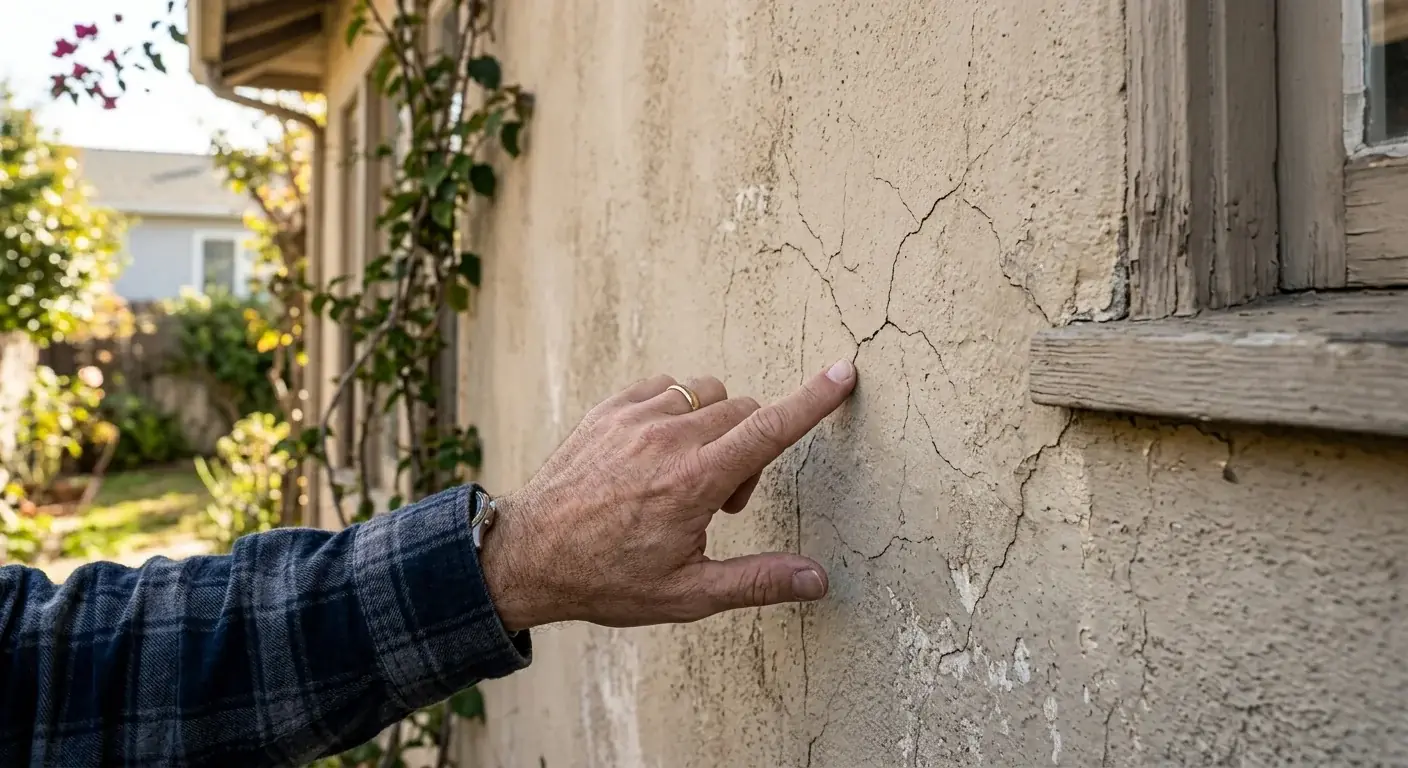
The oldest common housing stock is the older ranch tracts in central and west Escondido, including pockets near Grand Avenue, Westwood, and the streets south of Felicita Park. Single-story, 1,200 to 1,700 square feet, sand-finish stucco, wood fascia, aluminum-frame windows. Most are on their third or fourth repaint. The stucco shows hairline cracks, and original wood trim is often weathered or partly rotted at the fascia ends. Prep is the whole game here. Jobs that should have lasted ten years fail in three because a prior contractor skipped the bonding primer over chalky stucco.
The older tract homes dominate north and east Escondido, stretching toward San Marcos and off El Norte Parkway. Two-story, 1,800 to 2,500 square feet, heavier knockdown or lace stucco, more wood siding on gable ends, and sometimes T1-11 plywood on detached structures. T1-11 is the trouble spot. The vertical grooves trap water, and bottom panels rot at the foundation line if drainage is poor. A real exterior repaint replaces rotted panels before painting, not over them.
The newer custom homes sit mostly in the hill neighborhoods (Hidden Meadows-edge, Lake Hodges-adjacent, Country Club, Eureka Springs, and the gated developments north of Lake Wohlford). Larger, 2,800 to 4,500+ square feet, smooth-troweled stucco, stone veneer accents, heavier wood beams, often clay tile roofs. Stucco’s in better shape than the older tracts, but there’s more exposed wood to prep, and the height plus hill access drives labor up.
A contractor who quotes your Escondido home without walking the whole property and identifying which era you’re in is guessing. Push back if you get a flat number off a phone call.
Escondido climate and the paint cycle
Escondido’s climate is harder on paint than coastal San Diego, and any contractor working out here should be specifying for it.
Summer surface temperatures run consistently hot inland (the NOAA climate data for inland San Diego County tracks the pattern for Escondido), and dark stucco in direct sun runs far hotter than the air temperature by afternoon. Painting in that heat ruins jobs. The paint skins over before it can bond, you get lap marks, and the finish blisters within months. Escondido exterior work should start at dawn and shift around the house with the sun, wrapping south- and west-facing walls before midday and finishing shade-side work in the afternoon.
Humidity is low. That sounds like good paint weather, with one caveat: dry air pulls solvents out of fresh paint too fast on the hottest days. The fix is timing and product selection. Hot-weather acrylics (Sherwin-Williams Duration, Dunn-Edwards Evershield, Behr Marquee) with retarder additives are the right spec when needed.
UV damage in Escondido is significant. Inland sun plus elevation in the hill neighborhoods means south and west walls fade fast, chalking well ahead of the rest of the house. Higher-grade acrylic or elastomeric belongs on hot-side walls. Both Sherwin-Williams and Dunn-Edwards publish inland climate specs that match the pattern.
Santa Ana wind events (typically October through January) drive dust and debris into fresh paint, so exterior finish coats shouldn’t be scheduled during a Santa Ana week. The late-summer monsoonal moisture (occasional afternoon thunderstorms from July into September) is the other timing concern. Stucco needs to be fully dry before paint goes on. A morning thundershower can push the schedule back.
Practical takeaway: cool-side elevations in Escondido hold their paint noticeably longer than hot-side walls, with proper prep and the right product. A contractor who promises a specific number of years on an inland Escondido exterior is selling you something.
Cost ranges by Escondido home size
Here’s what drives Escondido painting cost in 2026. These assume full-prep, two-coat work using mid-grade or better paint. Cheaper bids out here almost always cut prep, not labor.
Interior, per room (walls only, mid-grade paint), what drives it:
- Bedroom (10x12): baseline wall area
- Master bedroom (14x16): more wall area, often higher ceilings
- Living room (16x22): largest single-room wall area in the house
- Kitchen (walls, around cabinets): cut-in time around cabinetry
- Bathroom: small footprint, more cut-in per square foot
- Two-story stairwell and entry: ladder or lift access for high walls
- Ceilings: priced separately from walls, added scope
- Trim and doors: priced per door and per linear foot of baseboard
Full interior (whole house, walls only, mid-grade paint):
| Home size | Typical Escondido example | What drives it |
|---|---|---|
| 1,500 sqft | older single-story tract | Baseline wall area, single-story access |
| 1,800 sqft | older tract with bonus room | Added room count |
| 2,200 sqft | 1990s two-story | Second-story access, more total wall area |
| 2,800 sqft | older custom or larger remodel | Larger footprint, more trim |
| 3,500+ sqft | Hill-neighborhood custom home | Full-house scope, higher finish standard |
Exterior, by home size (stucco and wood trim, full prep, two coats):
| Home size | Typical Escondido example | What drives it |
|---|---|---|
| 1,500 sqft | older tract, single-story | Baseline stucco prep, single-story access |
| 1,800 sqft | older tract two-story | Second-story access |
| 2,200 sqft | older tract, north Esco | Heavier stucco texture, more trim |
| 2,800 sqft | older custom, hill access | Hill access, longer hose runs |
| 3,500+ sqft | Larger custom with stone and wood | Stone veneer detail, heavier wood-beam prep |
For more on what drives these numbers, see our exterior painting cost guide for San Diego and the interior painting cost guide.
What pushes an Escondido estimate higher: heavy stucco patching, T1-11 panel replacement, wood rot at fascia or window frames, two or three stories, hill access (sometimes we need a longer hose run or a lift), elastomeric coatings on hot-side walls, and detailed HOA color matching where required.
What can bring it down: a home that’s been repainted within the last five years, single-story access, no detached structures, and choosing a color that doesn’t need a third coat for coverage.
Escondido neighborhoods and paint particulars
Different parts of Escondido have different paint stories. Here’s the breakdown by neighborhood.
Felicita and South Escondido. Mostly older ranch tracts. Sand-finish stucco, wood fascia, single-story. Lots of hairline cracking and chalky surfaces. A bonding primer before topcoat is standard practice here.
Downtown and Grand Avenue historic district. Older homes, wood siding, original-era trim. Lead paint disclosure rules apply on pre-1978 homes; confirm your painter holds a current EPA RRP certification for these.
Country Club and Lake Hodges-adjacent. Larger older homes, often two-story with view lots and steeper lots. South and west walls take a beating from the sun. Elastomeric or premium acrylic is the right call on hot-side elevations here, and estimates run higher because of access and material volume.
Hidden Meadows-edge (the rural-feel pocket north of the city limits). Estate-style ranches, often on well water (which matters for the rinse step before painting, since hard water leaves mineral residue that paint won’t bond to without a clean-water rinse). Generator access matters on some of these properties.
Eureka Springs and Champagne Village. Newer master-planned developments with HOA color review. Approved palettes only, formal submission process, painter has to be insured to spec.
North and east tracts (off El Norte Parkway and toward San Marcos). older tract homes, heavier stucco textures, T1-11 on some detached structures.
HOAs and the color approval process
A meaningful share of Escondido homes are inside an HOA or master-planned community, and the color approval process varies a lot.
Champagne Village (the senior community off East Mission Road) has a defined approved-palette list and a written submission form. Expect a two- to four-week review.
The Eureka Springs and Hidden Meadows-edge developments use a similar approach: pick from the master palette, submit through the management company, wait for written approval. Painting before approval risks a violation and a forced repaint at your cost.
The older tracts near Felicita and central Escondido generally aren’t governed by HOAs. You have full freedom on color, subject to the city’s general nuisance standards.
The standard process for HOA homes: a painter pulls your community’s approved palette before quoting, color-matches against your current scheme, gives you printed swatches to submit, and only schedules the job after you have written approval in hand. If your HOA documents are missing, the City of Escondido building department can point you to the right management contact.
For more on this process, see our HOA paint color rules guide for San Diego.
One code note: lead paint disclosure. Homes built before 1978 (which covers most of central and west Escondido and all of the Grand Avenue historic district) are subject to federal lead-safe work practices. A legitimate contractor will be EPA RRP certified for those homes. If your painter doesn’t bring this up, that’s a red flag. The EPA’s lead-safe work guidance is the source on this.
Services for Escondido homes
Paint Pros SD connects Escondido homeowners with vetted contractors for the full scope of residential painting work, including:
Interior painting. Walls, ceilings, trim, doors, closets. A painter moves and protects your furniture, masks floors, and finishes each room before moving on. Most single-story Escondido interiors take three to five days; larger custom homes take seven to ten.
Exterior painting. Stucco, wood siding, fascia, eaves, trim, doors, garage doors. Pressure wash, scrape, sand, patch, prime, caulk, two finish coats. A typical 1,800-square-foot Escondido exterior takes four to seven days depending on weather and prep depth.
Cabinet refinishing. Kitchen and bath cabinets. Strip hardware, sand to bare wood or scuff existing finish, prime with a bonding primer, spray two coats of cabinet-grade acrylic or alkyd. Cost tracks door-and-drawer count first. For homes near the rural edge, see our Hidden Meadows cabinet refinishing guide.
Stucco repair and paint. Patching hairline cracks, blowouts, and full sections. A painter color-matches the existing texture, primes, and finishes with a fresh paint coat. Critical on older Escondido homes where stucco failure is common. For more on this, see our stucco painting guide.
Fence, gate, and garage floor. Wood fences, wrought iron gates, security doors, and epoxy or polyaspartic garage floor coatings. Common ask in older Escondido tracts where original 1970s fencing is on its last coat, and in the hill custom homes where the garage matters to the overall property impression.
How to choose a painter in Escondido (5 questions)
A reasonable contractor will answer these without dodging.
1. Do you have bilingual estimators or crew?
Escondido is about half Latino, and a lot of homeowners do better walk-throughs in Spanish. Painters in our network staff bilingual estimators and crew leads. Baseline expectation in this market.
2. How do you handle hot-day painting?
A good answer mentions starting at dawn, chasing shade, using hot-weather products with retarders, and refusing to paint a wall once it’s run too hot in direct sun. A bad answer is “we just paint.”
3. Do you have hill access equipment?
For homes off Del Dios Highway, Lake Wohlford Road, or Hidden Meadows-edge, longer sprayer hose runs, lifts, or scaffolding are sometimes needed. Ask how they handle steep driveways.
4. Do you know about well-water rinse on rural-edge homes?
For homes running on well water, the rinse step matters. Hard water leaves mineral residue paint won’t bond to. Painters in our network bring filtered water for the final rinse.
5. Do you carry a generator?
Some rural-edge homes don’t have convenient exterior power for sprayers and compressors. Painters in our network bring their own quiet inverter generators. A contractor without one runs cords across your living space or skips equipment they should be using.
License, insurance, and references are non-negotiable on top of all of this. Check any California painter through the Contractors State License Board and look up complaints through the BBB San Diego chapter. For broader vetting questions, our how to hire a painter in San Diego guide walks through the full checklist.
FAQ
How much does it cost to paint a home in Escondido?
Both interior and exterior cost track home size first, with prep depth as the biggest variable on top of that. See the tables above for what drives cost by square footage.
Do you have Spanish-speaking estimators?
Yes. Painters in our network staff bilingual estimators and bilingual crew leads. About half of Escondido walk-throughs are conducted in Spanish.
Do you serve neighboring cities like San Marcos, Valley Center, and Hidden Meadows?
Yes. Painters in our network cover all of inland north county. San Marcos, Valley Center, Hidden Meadows, Rancho Bernardo, and Vista are all part of our regular service area. Booking from any of those zips is no different than booking from inside Escondido.
When’s the best time to paint in Escondido given the summer heat?
April through early June and late September through November are the easiest windows. Work still happens mid-summer, starting at dawn, chasing shade around the house, and stopping painting on any wall that’s run too hot in direct sun. Late summer monsoonal moisture (mid-July through early September) can occasionally push the schedule back.
My home is in an HOA. What’s the approval process?
For Champagne Village, Eureka Springs, and the Hidden Meadows-edge developments, pick from your community’s approved palette, submit a written form through the management company, and wait two to four weeks for approval. A painter pulls the palette, color-matches your current scheme, provides swatches for your submission, and only schedules once you have written approval. See our HOA paint color rules guide for more.
How do painters in your network quote an Escondido project?
Painters in our network walk the property across all of Escondido, San Marcos, Valley Center, and Hidden Meadows, and quote the job directly in writing.
Ready to start
Whether you’re in an older Felicita ranch, an older tract off El Norte, or a custom home in the hills, a real paint job starts with an honest walk-through. Painters in our network cover all of Escondido and inland north county, with bilingual crews and products spec’d for hot inland climate. Our San Diego County painters hub has every city we cover, and our Escondido painting service page has the full service list. Book directly through interior painting or exterior painting.
Call (858) 400-6422 and we’ll connect you with a vetted local painter.