TL;DR
- A single interior room’s cost tracks its size, ceiling height, and how much prep the walls need for a proper two-coat finish.
- A full-interior 3-bedroom repaint scales with square footage across walls, ceilings, and trim.
- Prep is the single biggest variable. Walls with scuffs, nail holes, and settling cracks cost the same as smooth walls to paint, but more to prep.
- Flat-rate quotes beat square-foot quotes. Square-foot pricing hides scope and usually ends with surprise line items.
- Cheaper isn’t better if the paint fails early. Premium paint plus real prep is the math that holds up.
Interior painting cost in San Diego depends on room count and square footage first, then prep depth and paint grade, for a full repaint including walls, ceilings, and trim with two coats of premium paint. The same house can price very differently depending on who’s quoting and what’s actually included. This post walks through where the cost goes, what separates a low quote from a high one, and what to ask before you sign.
What drives interior painting cost in San Diego?
Here’s the driver breakdown for typical scopes:
| Scope | What drives it | What’s usually included |
|---|---|---|
| Single bedroom | Baseline room size, light patching | Walls two coats, light patching, cut-in, basic prep |
| Single bathroom | Small footprint, mildew-resistant paint required | Walls (mildew-resistant), ceiling, trim touch-up |
| Kitchen (walls + ceiling) | Grease film needs degreasing before priming | Degrease, prime, two coats; does NOT include cabinets |
| Living room / great room | Largest common room; vaulted ceiling adds labor | Walls, ceiling, trim, vaulted ceiling premium possible |
| Hallway + stairwell | Tall walls need scaffolding or extension-pole access | Tall walls add scaffolding or extension-pole labor |
| Full 3-bedroom interior | Whole-house wall area plus trim and doors | Walls + ceilings + trim + doors + baseboards |
| Full 4–5 bedroom interior | Same scope, scaled to added square footage | Same, scaled up |
| Trim and doors only | Door count and linear feet of baseboard and casing | Crisp enamel on all trim, doors, baseboards |
| Ceilings only (whole home) | Total ceiling square footage plus any patching | Flat ceiling paint after any patching |
Figures assume two coats of premium paint (Sherwin-Williams Emerald or Benjamin Moore Regal), standard-height walls (8–9 feet), and normal prep. Vaulted ceilings, heavy repair work, and color-change jobs over dark-to-light add cost.
What’s included in a proper interior paint job?
A complete interior repaint should cover, at minimum:
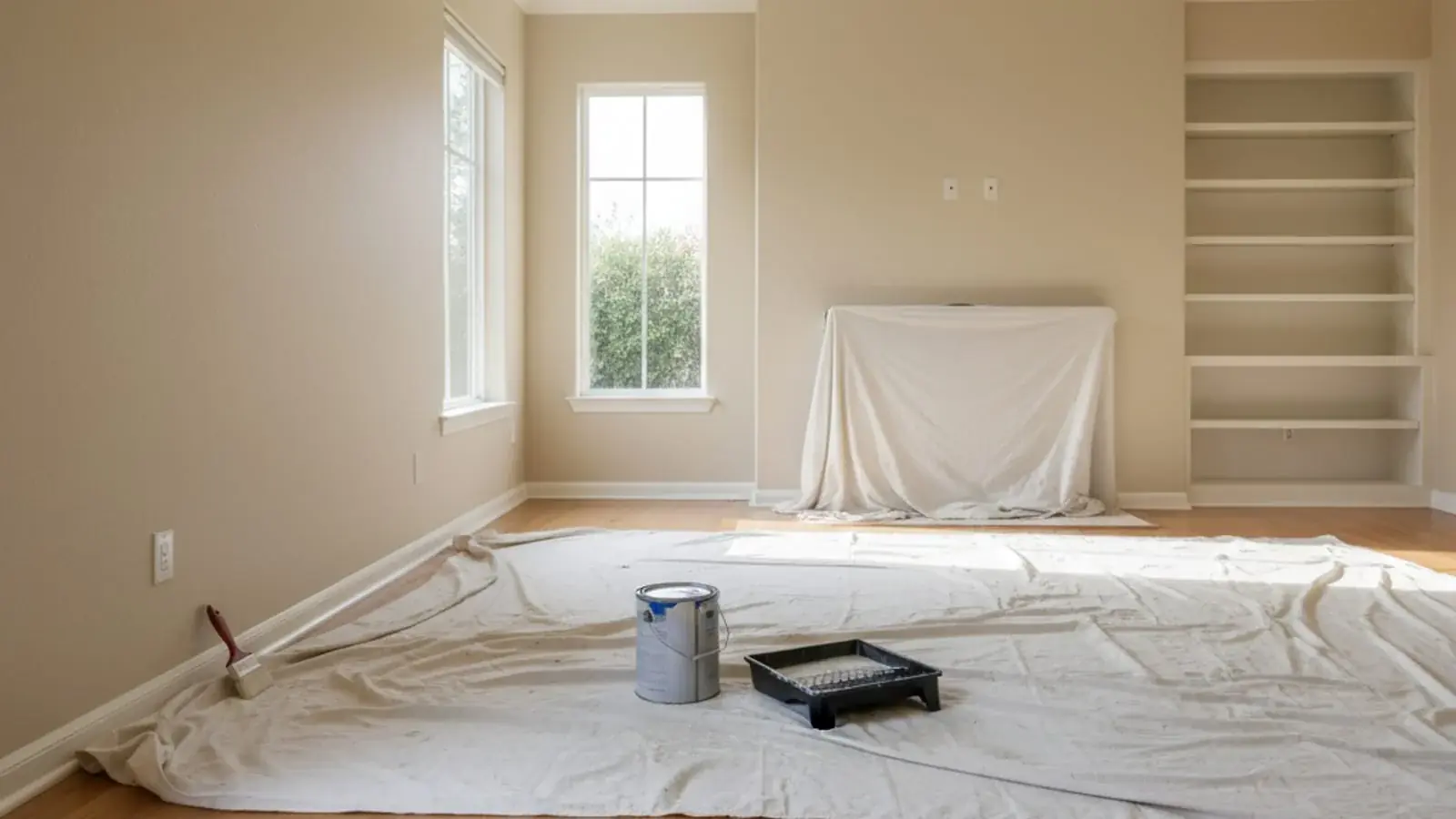
- Room-by-room prep. Move furniture to the center, lay canvas drop cloths on floors, mask adjacent surfaces with painter’s tape and plastic sheeting where needed.
- Surface prep. Fill nail holes and small dings with lightweight spackle. Caulk open seams along baseboards and trim. Scuff-sand any glossy surfaces before priming.
- Priming. Spot-prime any stained, patched, or previously-dark areas with an appropriate primer. Full prime only when substrate requires it (new drywall, major color change, old oil-based trim).
- Two coats of premium paint. Pole-rolled for even film on walls. Brushed and rolled cut lines. Ceilings with a long-nap roller. Trim with waterborne alkyd enamel.
- Clean-up daily. Drop cloths folded, paint cans sealed, trash removed, floors swept or vacuumed before the crew leaves.
If a quote doesn’t include all five, that’s usually where a cheap price comes from, typically no patching beyond nail holes, no caulk refresh, one coat instead of two, and “prep” that means “wipe the wall with a rag.”
Why is prep the biggest cost variable?
Painting a wall takes roughly the same amount of time whether the wall is smooth or dinged up. Prepping a wall is where the hours go.
Here’s the order of operations on a typical living-room repaint, roughly fastest to slowest step:
- Masking and drop cloths
- Patching nail holes and small dings
- Caulking open seams
- Sanding patched areas, glossy trim, and previously-painted surfaces
- Spot-priming patches and stains
- Painting (two coats, walls + ceiling + trim), the largest single block of time on the job
- Tidy down and move furniture back
Prep is a meaningful share of the labor on a typical room. On a rough room with lots of patching, drywall cracks, or old oil-based trim to convert, prep can become the majority of the labor.

Flat-rate vs. square-foot pricing: what’s the difference?
Ask any painter to quote and you’ll get one of three answers:
- “So much per square foot.” Sounds simple, but it hides everything. A 12×15 room has a set wall area including a ceiling, but is it rough? Are there nail holes? Is the trim oil-based? The square foot number doesn’t care.
- “So much per hour plus materials.” Rare on residential, common on handyman-adjacent painters. Means the clock runs whether they’re actually painting or standing around. Skip.
- “A flat rate for this defined scope.” The painter walks the house, measures, assesses prep, quotes the actual project in writing. This is what you want. You agree on a price for a defined result.
A real flat-rate quote names the rooms, the scope per room (walls, ceiling, trim, doors), the paint line (Sherwin-Williams Emerald, for example), the color scheme, and the timeline. Nothing is “extra” unless you change the scope.
What drives a quote up?
If two painters walk the same house and come back with very different numbers, the difference is almost always in one of these places:
- Paint quality. Premium low-VOC lines (SW Emerald, BM Regal) cost meaningfully more per gallon than builder-grade paint. On a whole-house job, that adds up across the number of gallons the scope needs.
- Coats. One coat vs. two coats is significantly more labor and materials. Single-coat quotes are cheap for a reason.
- Trim scope. A quote that paints only walls is cheaper than one that paints walls + trim + doors + baseboards. Trim is detail-intensive.
- Prep depth. Surface-level prep (“we’ll spackle any nail holes”) is quick. Real prep (“we’ll sand, caulk, fill, and prime as needed”) takes real hours.
- Color change direction. Going from dark to light almost always needs a third coat. From light to dark may need a tinted primer underneath.
- Ceiling condition. Popcorn ceilings, water stains, or previously-damaged ceilings often need repair before painting, which adds to the scope.
How should I read a painting quote?
Look for these specifics:
- Paint product and line (e.g., “Sherwin-Williams Emerald Interior Matte, two coats”)
- Defined scope (“Living room: walls + ceiling + baseboards. Kitchen: walls + ceiling. Master bedroom: walls only.”)
- Prep included (“Fill nail holes, caulk seams, scuff-sand glossy trim, spot-prime patches”)
- Timeline stated as start and completion dates, not a vague window
- Payment schedule (a deposit at booking, balance on completion)
- Written warranty on workmanship, with terms spelled out
A quote that just says “paint interior, 3 bed 2 bath” with a single number is incomplete. Get the specifics.
Can I save money without cutting quality?
A few legitimate ways:
- Move furniture yourself. Saves the crew real setup time.
- Do your own minor patching. If you want to spackle and sand the nail holes yourself, tell the painter. Reduces prep time.
- Bundle rooms. Painting several rooms at once is cheaper per room than doing them sequentially, since the same setup and cleanup covers all of them.
- Stick with the existing color. A “color refresh” (repainting walls the existing color after years of wear) avoids the dark-to-light transition cost.
- Accept two-tone simplicity. Whole-home walls in one color, trim in one color. Multi-color custom schemes add complexity and labor.
What doesn’t save money long-term: builder-grade paint. The savings on paint buys less durability, and a thinner finish tends to need a repaint sooner than a premium one.
What about DIY?
DIY interior painting can work great on a single bedroom with solid walls and an experienced hand. It falls apart fast on:
- Ceilings. Getting a drip-free, even ceiling finish is much harder than it looks.
- Trim. Crisp lines along carpet, around fixtures, and at cut-in points require practice.
- Color-change jobs. Two or three coats of paint pushes DIY project timelines out considerably.
- Old oil-based trim. Requires adhesion primer and real prep, get any step wrong and the paint peels.
Budget DIY for materials per room (paint, primer, rollers, brushes, tape, drop cloths) and plan on multiple weekends for a typical 3-bedroom interior.
When should I hire a pro?
If any of these apply, the pro quote is worth it:
- You’re selling and need it done on a tight turnaround
- You have old oil-based trim to convert
- You have ceilings over 10 feet or vaulted spaces
- Your drywall has patching, water stains, or settling cracks
- You have cabinets included in the scope
- You simply don’t want to spend several weekends painting
Most San Diego homeowners the painters we match quote land on hiring because the time cost alone outweighs the savings of DIY.
Frequently asked questions
What determines the cost to paint the interior of a house in San Diego?
Room count and square footage set the baseline for a full 3-bedroom repaint covering walls, ceilings, trim, doors, and baseboards. A single room prices lower, and larger 4 to 5 bedroom homes price higher, all scaling with the same drivers: prep depth, paint grade, and trim scope.
What determines the cost to paint the inside of a 2,000 sq ft house in San Diego?
Painting the interior of a 2,000 square foot San Diego home tracks square footage first, then ceiling height, trim scope, and how much patching the walls need, for a full repaint with two coats of premium paint and real prep.
What do painters charge to paint a single room in San Diego?
A single room’s price tracks its size and prep needs for a proper two-coat finish. Bathrooms sit at the lower end given their small footprint. Large living rooms with vaulted ceilings sit at the higher end.
How do painters charge for labor in San Diego?
Most San Diego painters price labor into a flat rate for a defined scope rather than charging hourly. Flat-rate pricing protects you from a clock that runs while the crew sets up. See our painter cost per hour in San Diego breakdown for detail.
How long does it take to paint a house interior in San Diego?
A full 3-bedroom interior repaint takes several working days for a professional crew. A single room is usually a day. Heavy prep, dark-to-light color changes, and old oil-based trim all add time.
Ready for a real number?
The only way to know what your specific home will cost is an in-home walkthrough. Painters in our network walk the house, measure, look at prep, and give you a written flat-rate quote. No pressure to book, no hidden scope.
Browse our interior painting scope to see exactly what’s included, or go deeper with our complete interior painting guide for San Diego, our step-by-step on how to paint a house interior in San Diego, and our broader house painting cost guide. Or give us a call.