If you’re an El Cajon homeowner searching for a painting contractor, here’s the short answer. Most homes here are older tract houses (1,200 to 2,200 square feet) with stucco walls and wood trim, plus Fletcher Hills mid-century homes and newer Crest hillside builds. A standard exterior repaint’s cost tracks prep scope and square footage first. Painters in our network also cover La Mesa, Santee, and Lakeside. Call us at (858) 400-6422 and we’ll connect you with a vetted local painter.
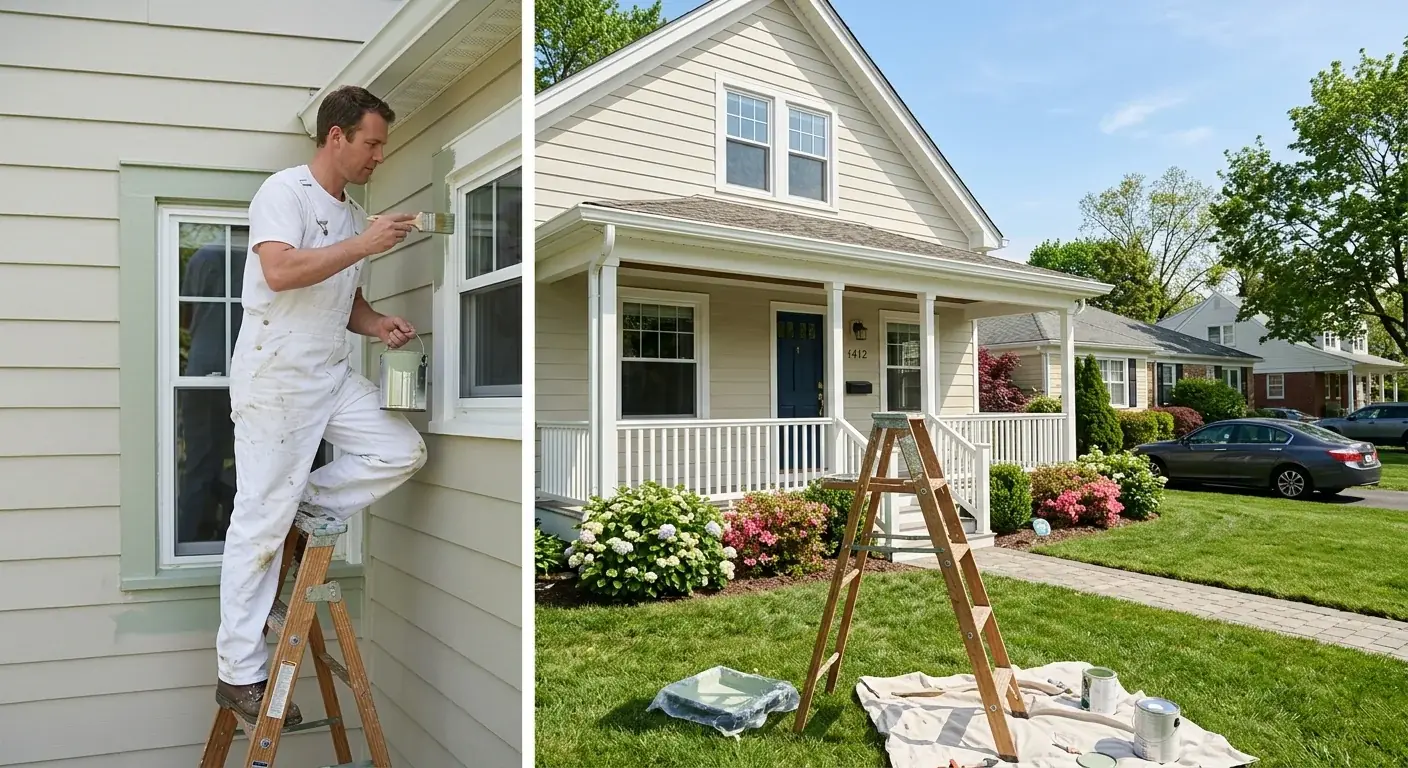
El Cajon neighborhoods and what they need
El Cajon sits in an inland valley about 17 miles east of downtown San Diego, with roughly 105,000 residents and one of the most varied housing inventories in the county. Every part of town hits paint differently, so the right scope depends on which neighborhood you’re in.
Central El Cajon and Bostonia are dominated by older single-story tract homes. These are typically 1,100 to 1,500 square feet, with sand-finish or light-dash stucco walls, wood fascia, and wood-trimmed eaves. By 2026 most of these homes have been repainted three or four times, and the substrate shows it. Hairline cracks, chalky surfaces, and hollow spots where prior coats have lifted are the norm. Lead paint is an active issue on anything built before 1978, which covers the vast majority of the central housing stock.
Fletcher Hills has a different character. The homes are mostly older mid-century ranch and split-levels on larger lots, often with view exposure to the west. These are typically 1,500 to 2,000 square feet, with mixed stucco and wood siding, sometimes T1-11 plywood on additions. Wood trim packages are heavier here, so prep takes longer.
Granite Hills and Mt. Helix-adjacent streets have higher-end homes, often 2,000 to 3,000+ square feet, on hillside lots with significant elevation change. Two-story exterior work here means more setup, more ladder time, and sometimes lift rental.
Downtown El Cajon historic district has a smaller pocket of pre-1940 bungalows and craftsman homes. These are wood-sided, with original double-hung windows and detailed trim. Prep is the whole job. A painter strips down to bare wood where the prior paint has failed, primes with oil-based primer, and finishes with two coats of premium acrylic.
Crest hillside sits above El Cajon proper, in the unincorporated stretch east of town. The homes are newer, larger (often 2,200 to 3,500 square feet), and exposed to brutal afternoon sun and high wind. Paint fails fast here if you cut corners on UV-stable product.
A real El Cajon estimate factors all of this in. A contractor who walks your property in ten minutes and quotes a flat number is missing the prep that determines whether the job lasts.
El Cajon climate and how it punishes paint
El Cajon’s climate is the harshest in the county for exterior paint, and most homeowners don’t realize it until the job starts failing early. You’re inland enough that the marine layer rarely makes it this far east, so you lose the coastal humidity buffer. Summer afternoons run hot, and surface temperatures on south and west-facing stucco walls run well above the air temperature under direct sun. Winters are mild and dry. UV exposure is constant. Reference: NOAA climate data for inland San Diego County.
Three climate factors dominate paint selection in El Cajon:
Extreme inland heat. Standard mid-tier acrylic paint carries a manufacturer-rated surface-temperature application window, and a hot summer stucco wall runs well past the top of it. Apply paint outside that window and the solvents flash off before the coating can level and bond. The result is a film that looks fine on day one but chalks, fades, and lifts early. From May through October, exterior work should be scheduled for early-morning starts, with wall-facing application stopped well before midday on the south and west elevations. A painter who knows El Cajon follows the sun around the house.
UV-driven color drift. Even with the right application window, El Cajon’s UV load fades pigment faster than coastal zones. Reds, deep blues, and dark grays drift first. Premium UV-stable acrylic (Sherwin-Williams Emerald or Dunn-Edwards Evershield) is the baseline spec worth insisting on, rather than mid-tier products. It costs more up front, but it holds color and resists chalking far longer on a sun-blasted El Cajon wall.
Temperature cycling on stucco. El Cajon’s summer days swing from hot afternoons to much cooler overnight lows, and that daily swing is wider than at the coast. Stucco expands and contracts with that swing, and hairline cracks that look minor in April are visibly wider by October. A flexible, breathable acrylic handles this better than a rigid latex. For walls with established crack patterns, the right move is a full elastomeric coating system.
Cost ranges by El Cajon home size
Here’s what drives El Cajon painting cost in 2026. These assume full-prep, two-coat work using premium-tier paint. El Cajon pricing skews lower than coastal SD because the homes are smaller, the lots are flatter (in central El Cajon), and the market is more price-sensitive than La Jolla or Coronado.
Exterior repaint drivers (premium acrylic, full prep, single-story unless noted):
- 1,200 sq ft (small central El Cajon tract home): baseline prep, single-story access
- 1,500 sq ft (typical Bostonia or central tract): more wall area, same access
- 1,800 sq ft (Fletcher Hills mid-century): heavier wood-trim package
- 2,200 sq ft (Granite Hills or larger Fletcher Hills): larger trim volume, some elevation change
- 2,800+ sq ft two-story (Mt. Helix-adjacent or Crest): second-story access, more setup time
Add-ons that raise the price:
- Elastomeric upgrade for cracked stucco
- Pre-1978 lead-safe protocol on full exterior
- Heavy wood trim prep (downtown historic)
- Detached garage or outbuilding
Interior, per room (walls only, mid-grade paint), what drives it:
- Bedroom (10x12): baseline wall area
- Living room (15x20): more wall area, typically higher ceilings
- Kitchen (walls, around cabinets): cut-in time around cabinetry
- Bathroom: small footprint, more cut-in per square foot
- Full single-story interior (3 bed, 2 bath, walls only): total wall area across the house
- Ceilings: added scope, priced separately from walls
Cheaper bids almost always cut prep. If a quote comes in well below the rest, the painter is either skipping the pressure wash, skipping the primer on patched areas, or applying one finish coat instead of two. Ask what’s included in writing.
Common El Cajon paint problems
These are the four issues that show up most often on El Cajon homes, in rough order of frequency.
Sun-blasted west walls. On older tract homes with original or single-repaint exteriors, the west and south walls show paint failure well ahead of the rest of the house. The film is chalky, the color has drifted, and the sheen is gone. Sometimes the substrate underneath is fine; sometimes it’s lifting. A painter pressure-washes with a mildewcide, scrapes and feathers any lifted areas, primes with a bonding primer, and applies two finish coats of premium UV-stable acrylic. If the wall is more than 50 percent failed paint, the right call is to strip rather than overcoat.
Hairline-crack stucco from thermal cycling. Decades of wide daily temperature swings leave visible hairline cracks on most older El Cajon stucco. Sanded acrylic caulk handles cracks up to about 1/16 inch wide. Wider cracks need elastomeric coating or full stucco repair before paint. The most common mistake is painters spot-caulking cracks and skipping the high-build primer on the patched areas, which leads to visible flashing through the finish coat.
Pre-1978 lead paint. Any home in central El Cajon built before 1978 (which is most of them) is presumed to have lead-based paint somewhere in the system, usually on original trim, window frames, or older interior walls. EPA RRP (Renovation, Repair, and Painting) certification is federally required for any contractor disturbing more than six square feet of interior or twenty square feet of exterior paint on a pre-1978 home. Confirm your painter holds a current EPA RRP certification before any sanding or scraping starts. The rule covers the disclosure paperwork, containment, dust control, HEPA vacuum cleanup, and waste disposal as standard scope on older homes. The EPA RRP rule is the federal standard. If a painter doesn’t mention lead-safe practices on a pre-1978 El Cajon home, that’s a hard pass.
T1-11 plywood rot. A surprising number of El Cajon homes have T1-11 plywood siding on additions, detached garages, or the original construction on certain older tract runs. The grooves trap water, and the bottom edges of the panels rot when they sit too close to dirt or planter beds. A painter replaces rotted sections (or coordinates with a carpenter), primes with oil-based primer, and finishes with two coats of solid-color stain or premium acrylic.
Services for El Cajon homes
Here’s the standard scope for El Cajon painting jobs.
Exterior painting. Full pressure wash, crack repair, primer on patched and bare areas, two finish coats spray-and-back-rolled. Trim, fascia, doors, and shutters all included as part of the exterior scope unless otherwise specified.
Interior painting. Walls, ceilings, doors, trim, and closets. A painter moves and protects furniture, masks floors and fixtures, fills nail holes and minor drywall damage, and finishes with low-VOC paint. Standard scope is two coats over a tinted primer.
Cabinet painting. Frequent on older El Cajon kitchens where homeowners want to update older cabinets without a full gut remodel. Box-and-door spray finish, hardware removal and reinstallation, optional new pulls and hinges. Cost tracks door-and-drawer count first.
Stucco repair and paint. Patch-and-match on damaged sections, elastomeric coating on heavily cracked walls, full re-stucco coordination when patches won’t hold, working with local stucco subs in East County.
Fence and gate. Stain or paint on wood fences, oil-based primer plus enamel on wrought iron gates and railings. Frequent add-on for Fletcher Hills and Granite Hills homes.
Choosing a painter in El Cajon
Most painting complaints in El Cajon come down to five questions homeowners didn’t ask before signing. Use these.
1. Do you have bilingual estimators (Spanish and Arabic)? El Cajon has one of the largest Chaldean and Middle Eastern communities in the country, plus a substantial Hispanic population. If grandma owns the house and English isn’t her first language, your painter needs to be able to walk her through the scope in her language. Painters in our network include Spanish-speaking estimators, and Arabic-speaking translation for Chaldean clients can be arranged when needed.
2. How do you schedule exterior work in summer? The right answer is early-morning starts (6:00 to 6:30 AM), stopping wall-facing application by 11:00 AM on south and west walls from May through October, and rotating around the house to follow shade. The wrong answer is “we work eight to four every day.” Painting hot stucco voids most paint warranties.
3. Are you EPA RRP certified for pre-1978 lead paint? Required by federal law on any pre-1978 home. If the painter doesn’t have the certification number on file, that’s an automatic disqualification. The certification is verifiable through the EPA’s RRP firm lookup.
4. Do you have generator capability for power-outage zones? East County is on SDG&E’s Public Safety Power Shutoff map. Crest and the hillside neighborhoods east of El Cajon lose power during high-wind events most fall and winter. If your job is mid-spray during a shutoff, the painter needs a portable generator to run sprayer compressors and finish the day. Painters in our network run generators on every Crest job from October through March.
5. Is the quote a flat written number or an hourly estimate? Flat written. Always. Hourly opens the door to scope creep. Painters in our network typically quote flat-rate after an in-home walk-through, broken out by paint product, prep scope, coat count, and trim handling line by line.
For broader vetting questions, see our guide to painters in San Diego County. For El Cajon-specific service pages, our El Cajon painting service page goes deeper on neighborhood scope and pricing.
Frequently asked questions
How much does it cost to paint a house in El Cajon?
Cost tracks prep scope, paint selection, and color complexity first, then square footage. A typical single-story El Cajon home costs less than a two-story home of the same size because of access alone. Older tract homes needing substantial crack repair and trim refinishing land at the higher end. El Cajon pricing generally runs lower than coastal SD because the homes are smaller and the market is more price-sensitive. For a deeper cost breakdown see our exterior painting cost guide for San Diego.
Do you offer bilingual service in El Cajon?
Yes. Painters in our network include Spanish-speaking estimators, and Arabic-speaking translation for Chaldean clients can be arranged when needed. El Cajon has one of the largest Middle Eastern communities in the country, plus a substantial Hispanic population. Communication shouldn’t be a barrier to getting a fair estimate.
Do you serve La Mesa, Santee, and Lakeside?
Yes. Painters in our network who cover El Cajon also serve La Mesa to the west, Santee to the north, Lakeside to the northeast, and Harbison Canyon to the east. Pricing is essentially the same across these areas; the only adjustment is travel time on the Lakeside and Harbison Canyon hillside lots.
When is the best time to paint an exterior in El Cajon?
April through early June is the sweet spot. The rainy season is over, but the deep summer heat hasn’t kicked in yet. October and November also work well. From mid-June through September exterior work still happens, but it starts early and chases shade around the house. See our best time to paint exterior in San Diego guide for the full seasonal breakdown.
Do you test for lead paint on pre-1978 El Cajon homes?
Confirm your painter holds a current EPA RRP certification before any sanding or scraping starts. Lead-safe work practices apply on any pre-1978 home, which covers most of the central El Cajon housing stock. That means EPA-recognized swab testing on suspect surfaces, full containment, dust control, HEPA vacuum cleanup, and proper waste disposal, plus the required federal disclosure documentation as part of project paperwork. The added scope adds real cost that tracks home size. The EPA RRP rule is the federal standard.
How do painters in your network quote an El Cajon project?
Painters in our network typically provide in-home walk-throughs across El Cajon, Fletcher Hills, Granite Hills, Bostonia, Crest, and all neighboring East County communities, with flat-rate written quotes that break out paint product, prep scope, coat count, and trim handling line by line. Call (858) 400-6422 and we’ll connect you with a vetted local painter.
Why El Cajon homeowners pick The Paint Pros San Diego
Paint Pros San Diego matches East County homeowners with vetted, licensed, insured painting contractors who carry verified CSLB licenses. The contractors in our network include Spanish-speaking crews, teams equipped with generators for PSPS shutoff seasons, and EPA RRP-certified painters for the older central El Cajon housing stock. Matched contractors schedule exterior work for early-morning starts in summer and won’t paint a hot wall. See the City of El Cajon for permit and noise-ordinance requirements on multi-day projects.
For related guides, see our breakdowns on interior painting cost in San Diego, how often to repaint stucco in San Diego, our companion neighborhood guide for painting contractors in La Presa, and stucco painting in Harbison Canyon for the East County backcountry just north of El Cajon. For service-specific pages see exterior painting and interior painting.
Call (858) 400-6422 and we’ll connect you with a vetted local painter.