National City’s housing stock skews older than almost anywhere else in the South Bay, and that’s good news if you’re tired of your kitchen. Most of the oak and laminate cabinet boxes installed here between the 1950s and 1980s are still structurally solid. That means refinishing, not replacing, is usually the right call. A typical National City kitchen refinish costs far less than tearing everything out and starting over, and the gap tracks door count and how much prep the old finish needs.

Why National City kitchens are good refinishing candidates
National City’s homes were mostly built before 1980, concentrated in Old Town, Granger, Olivewood, and the Sweetwater Heights corridor. Kitchens from that era were fitted with real hardwood face frames and solid wood or thick veneer doors, oak being the most common, with a smaller share of the earlier older stock running painted maple or birch. That construction is exactly what refinishing depends on: the boxes and doors need to be structurally sound so a new primer and enamel coat has something solid to bond to.
Compare that to cabinets built in the last 15 years, where thin MDF doors and particleboard boxes are far more common at the entry price point. Those don’t always refinish as cleanly. National City’s older stock, ironically, is often a better refinishing candidate than a much newer tract-built kitchen.
Kitchen size here also runs smaller than the North County norm. Most National City kitchens have 14 to 26 doors and drawer fronts, occasionally with a small peninsula. That keeps refinishing costs on the lower end of the county range even before you account for the value of the work.
What drives cabinet refinishing cost in National City
Cost tracks door count and finish type.
| Kitchen size | Doors and drawer fronts | Painted enamel: what drives it | Stain or glaze: what drives it |
|---|---|---|---|
| Small galley | 14 to 20 | Fewer pieces, standard prep | Lighter prep, no grain-fill needed |
| Medium L-shape | 20 to 28 | More surface area, added masking | Color match adds time on the front end |
| Larger, with peninsula | 28 to 36 | Peninsula adds pieces and access planning | More surfaces to match and blend |
| Bathroom vanity (single) | n/a | Small footprint, priced on its own | n/a |
Painted finishes cost more than stain refreshes because oak grain telegraphs through paint unless it’s grain-filled first, and most National City kitchens are oak. A grain-fill pass adds to a painted quote. Going from a dark stain to white or a soft gray also needs an extra stain-blocking primer coat so tannins don’t bleed through.
For county-wide context on how these numbers compare, see our cabinet painting cost guide for San Diego and the broader refinishing versus replacing breakdown.
Refinish, reface, or replace: the National City math
Three paths exist for a tired National City kitchen, and the price gap is the whole story.
Refinish keeps the boxes, doors, and layout, and changes only the surface. This is the right call for roughly three out of four National City kitchens we look at, since most of the original boxes are still sound.
Reface keeps the boxes but swaps the doors and drawer fronts for new ones, then veneers the visible box faces to match. Worth considering if you want a different door style (shaker instead of a raised panel, for instance) but the boxes themselves are fine. Cost in National City tracks door count and veneer scope.
Replace tears out everything. Only worth it if the boxes are water-damaged, warped, or built from failing particleboard, or if you’re doing a full layout change as part of a bigger remodel. In National City that’s a major expense even for a modest kitchen, once demolition, new cabinetry, and installation labor are all in.
The trap to avoid: a neighbor’s full remodel isn’t a reason to assume your kitchen needs the same thing. If the layout works and the boxes are solid oak, refinishing gets you most of the visual change for a fraction of the cost.
The refinishing process
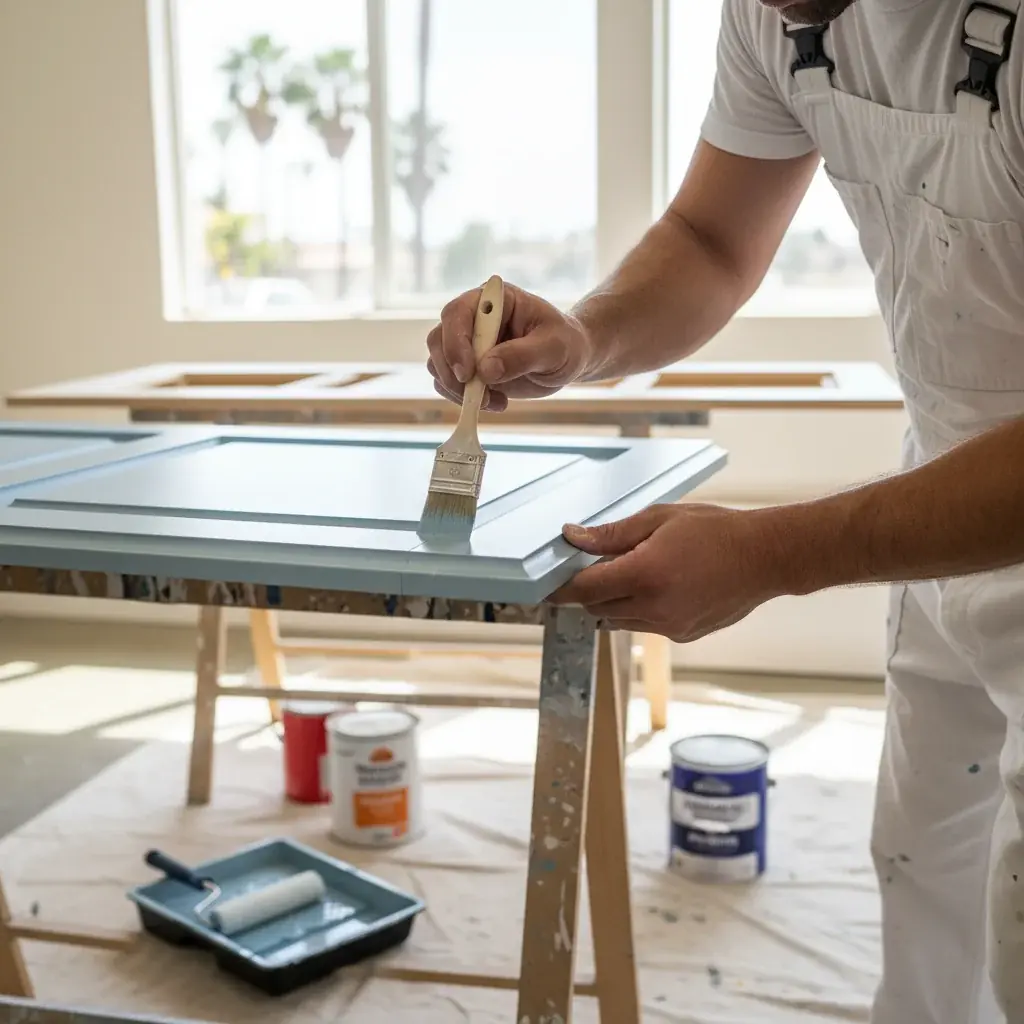
A National City refinishing project runs four to six working days for a typical kitchen. Doors and drawer fronts get labeled, pulled, and either refinished off-site in a controlled spray booth or masked and sprayed on-site depending on garage or patio space. Every surface gets degreased first, since kitchen cabinets carry years of cooking oil residue that will reject new paint if it’s not fully stripped.
After degreasing, surfaces are sanded or chemically de-glossed, dents and chips get filled, and a bonding primer goes down tinted toward the final color. Two to three coats of a cabinet-grade waterborne enamel follow, sprayed rather than brushed for a smooth, factory-style finish. Boxes and face frames get done in place with careful masking of countertops and floors. Hardware and doors go back on once the finish has fully cured, which for a waterborne enamel usually means a few days of light-use caution even after it feels dry to the touch.
Colors trending in National City kitchens right now
The requests we’re hearing most in this part of the South Bay in 2026:
Warm white and off-white on the perimeter, moving away from the honey-oak or golden-stain look that most older National City kitchens started with. This is the single most requested change.
Two-tone kitchens, where the perimeter goes white or a soft greige and a peninsula or small island gets a deeper navy or sage. Works well in the smaller National City layouts because it adds visual interest without needing a big kitchen to pull it off.
Warm gray and greige for homeowners who want a break from stark white but still a clean, modern look against original tile or laminate counters that aren’t being replaced yet.
Frequently asked questions
How much does cabinet refinishing cost in National City?
Cost tracks door count and finish choice. A small galley kitchen with 14 to 20 doors lands at the lower end. Bathroom vanities are priced on their own smaller scope.
Is refinishing a good option for older oak cabinets?
Yes, often better than newer construction. National City’s pre-1980 kitchens typically have solid wood face frames and doors, which refinish more reliably than the thinner MDF doors common in budget cabinets built in the last 15 years.
How long does the project take?
Timeline scales with door count and finish choice, from prep through coats, cure time, and reinstall. Larger kitchens with 30-plus doors take longer. Your painter maps out the schedule once the scope is set.
Can I change from a dark stain to white?
Yes. It’s one of the most common requests in this area. It needs a stain-blocking primer coat to keep old tannins from bleeding through the new finish, which adds a bit of time but is standard practice.
Do you serve Chula Vista and Bonita too?
Yes. The same crews that handle National City cabinet work also cover Chula Vista, Bonita, and the rest of the South Bay. See our painting contractor guide for National City for the broader service area.
Ready for a fresh kitchen without the remodel
If your National City kitchen has solid oak boxes and a layout you still like, refinishing gets you most of the visual upgrade of a full remodel for a fraction of the cost. Call Paint Pros San Diego at (858) 400-6422 for an in-home walkthrough. We’ll count your doors, check the boxes, and quote the project in writing.