Every hardware store sells a box labeled “epoxy floor paint” next to the paint rollers, and every flooring showroom sells a “professional epoxy coating system” for a noticeably higher price. Homeowners assume one is a cheaper version of the other. It’s not that simple: the two products are chemically different, prepped differently, and fail differently on a San Diego garage slab.
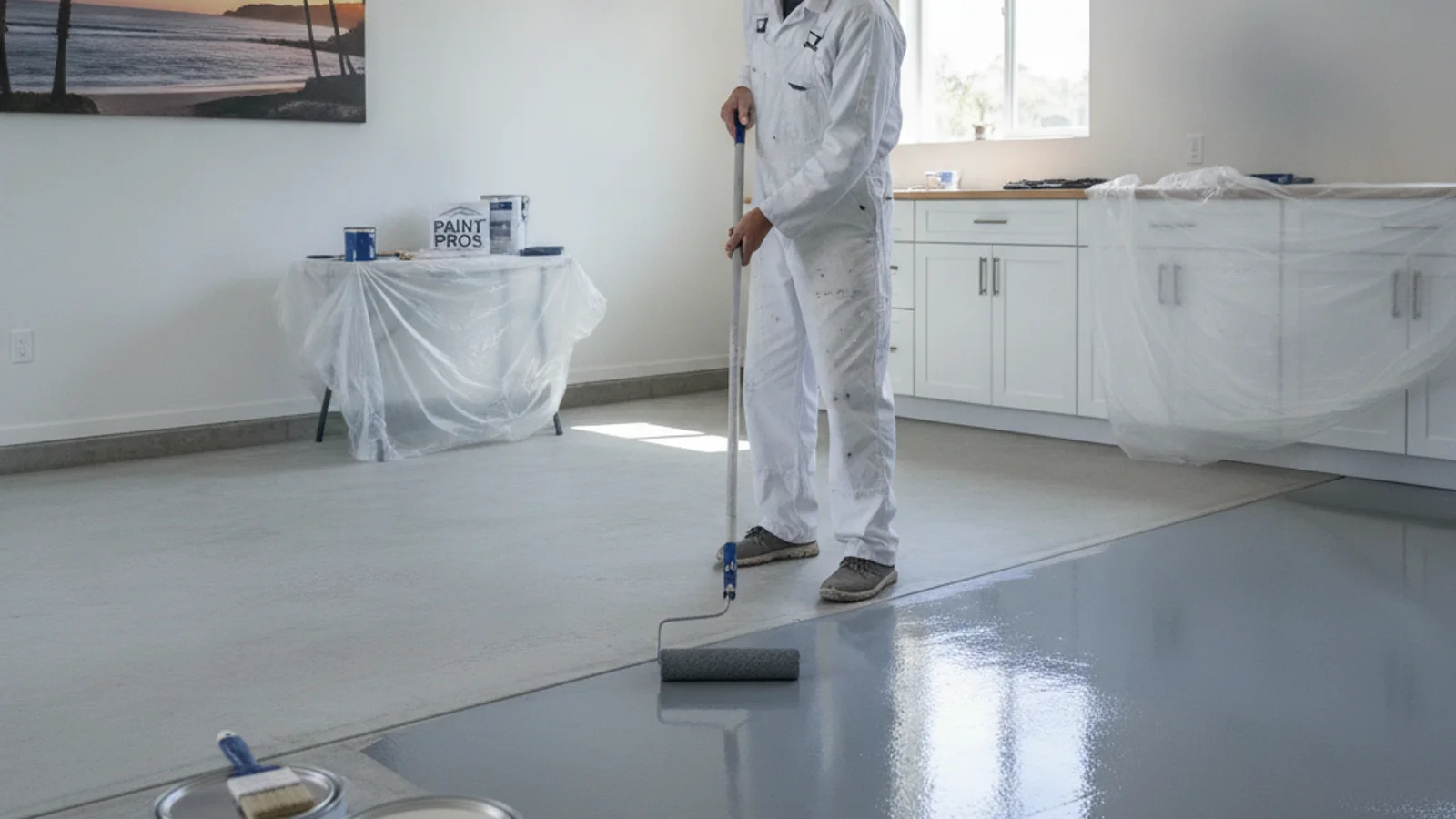
What big-box epoxy floor paint actually is
The kits sold at home improvement stores are mostly a water-based acrylic or a thin one-part epoxy blended into a paint base. Some include a small hardener packet that gets mixed in right before application, which makes the product a true two-part epoxy for a short window, but the film that results is still thin compared to what a coating contractor sprays or trowels down.
These kits are made for a homeowner to roll on without contractor equipment. Instructions typically call for a light degrease and rinse, maybe a quick acid-etch step with a bottle that comes in the box, then a thin application with a paint roller. There’s no mechanical grinding of the slab, no moisture test, and no vapor barrier consideration built into the process. The kit assumes the concrete underneath is in reasonably good shape and dry enough to bond, and the label is the authority on how many coats and how much dry time it actually calls for.
For a low-traffic space, a workshop floor that never sees a car, or a homeowner who wants color and a bit of shine without a large project, that thin film can be a reasonable choice. The tradeoff is durability under real garage use: hot tires, dropped tools, a jack stand dragged across the surface. A one-part or lightly catalyzed kit wears through those stresses faster than a true multi-coat system, and it shows peeling and hot-tire lift sooner when the slab underneath was not properly prepped.
Color and flake options in a retail kit are also more limited than what a coating contractor works with. Most kits come with a small bag of decorative chips meant to be broadcast by hand into wet paint, which gives a speckled look but rarely the dense, even coverage a professionally applied flake floor achieves. That’s not a flaw in the kit, it’s simply a different scale of product aimed at a different kind of project.
What a professional coating system adds
A professionally installed system usually starts with mechanically grinding the slab with a diamond grinder rather than an acid etch. Grinding opens the concrete’s pore structure so the coating actually bonds to bare concrete instead of sitting on a thin etched layer, and it removes any old sealer, oil staining, or curing compound left behind from the original pour.
After grinding, a full system typically layers a true two-part epoxy base coat, often broadcast with color flakes or an aggregate for texture and slip resistance, then finishes with a polyaspartic or urethane topcoat for UV stability and abrasion resistance. Each layer has a job: the base coat bonds to the concrete and builds film thickness, the flake or aggregate adds texture and hides minor slab imperfections, and the topcoat protects the whole system from hot tires, chemicals, and sun exposure coming through an open garage door.
This is spec-level material, not a claim about how long any specific job lasts. Product families like Sherwin-Williams’ Loxon line or a polyaspartic topcoat are examples of what a coating contractor might specify, not a promise about years of service. No lifespan or warranty figure travels with a product name here, because that number depends entirely on the slab, the prep, and how the garage gets used.
A contractor also chooses coating chemistry based on the slab’s exposure. A garage that sees direct sun through an open door for part of the day, common in many South Bay and East County layouts where the garage faces west, needs a topcoat with better UV stability than a north-facing garage that stays shaded most of the year. That decision is made on site, after looking at the specific garage, not from a generic spec sheet.
Where San Diego garage slabs fail first
San Diego’s marine layer and coastal humidity matter more to a garage floor than most homeowners expect, especially in slabs poured directly on grade without a vapor barrier underneath, which was common in older construction across the county. Moisture that migrates up through the slab from the soil below can push a coating off the concrete from underneath, a failure called moisture-vapor emission that shows up as bubbling or peeling months after a job looked perfect.
This risk is not uniform across the county. A slab in a coastal community with a naturally higher water table behaves differently than a slab in an inland canyon home on well-drained soil, and an older slab poured before modern vapor-barrier practice carries more risk than a newer build. There’s no verified figure for how often San Diego garage slabs specifically fail this way, so treat any specific percentage you see elsewhere as unconfirmed and ask a coating contractor to test your slab directly rather than assume based on the neighborhood.
Moisture, grinding, and why prep decides the outcome
The single biggest predictor of whether a garage floor coating holds is not which product goes down, it’s what happens to the slab before anything goes down. A calcium chloride test or an in-situ relative humidity probe measures how much moisture is moving through the concrete, and a contractor uses that reading to decide whether a standard epoxy system will bond or whether the job needs a moisture-mitigating primer first.
Oil stains, old sealers, and efflorescence (the white mineral residue that forms when moisture wicks salts to the surface) all block adhesion if they’re not fully removed. This is where the acid-etch kit and the ground slab diverge most: an etch softens the very top of the concrete but does very little to a deep oil stain or existing sealer, while grinding physically removes the contaminated layer.
A slab that’s been previously coated adds another wrinkle. Removing an old, failing coating usually takes more than an etch, since the new material has to bond either to bare concrete or to a sound existing coating, never to a peeling one. A contractor evaluates what’s already on the floor before deciding whether it needs to come off entirely or can be scuffed and coated over, and that decision changes the scope and the approach more than the product choice does.
Before any coating work starts, the slab typically needs a thorough clean. Pressure washing removes loose debris, tracked-in dirt, and surface grime that would otherwise get trapped under a new coating, and it’s a reasonable first step whether the plan is a retail kit or a full system.
How to tell which one your slab needs
Start with how the garage gets used. A floor that only holds seasonal storage and light foot traffic can often get by on a well-applied retail kit over a clean, dry, sound slab. A floor that parks a daily-driver car, sees a workbench with dropped tools, or doubles as a home gym is asking more of the coating than a thin kit is built to handle.
Next, look at the slab itself. Cracks, previous peeling coatings, visible dampness, or a slab that’s never been tested for moisture are all reasons to bring in a professional before choosing a product off a shelf. The epoxy garage floor coating guide for San Diego and the cost breakdown for a garage epoxy floor both go deeper on what a full installation involves. If a polyaspartic topcoat is also on the table against a straight epoxy system, the polyaspartic vs epoxy comparison breaks down that specific choice.
When to call us
A slab with any history of moisture, cracking, or a previous coating that failed needs professional testing before another product goes down, and a garage that sees daily vehicle traffic deserves a system built for it rather than a kit built for a weekend project. Call us at (858) 400-6422 and we’ll connect you with a licensed local painter.