Technically yes, you can use exterior paint indoors, but it is not the right call for a living space. Exterior paint carries higher VOC levels and mildewcides built to survive rain and sun, not to off-gas in a closed room, and it can take days longer to cure fully without wind and direct sun to help it along. The reverse is worse: interior paint has no UV inhibitors or flexible outdoor binders, so it chalks, fades, and cracks fast in the weather, often within a year of San Diego sun.
This is the practical version of that answer, written by a painting company that gets asked this on almost every estimate where a can is already sitting in the garage.
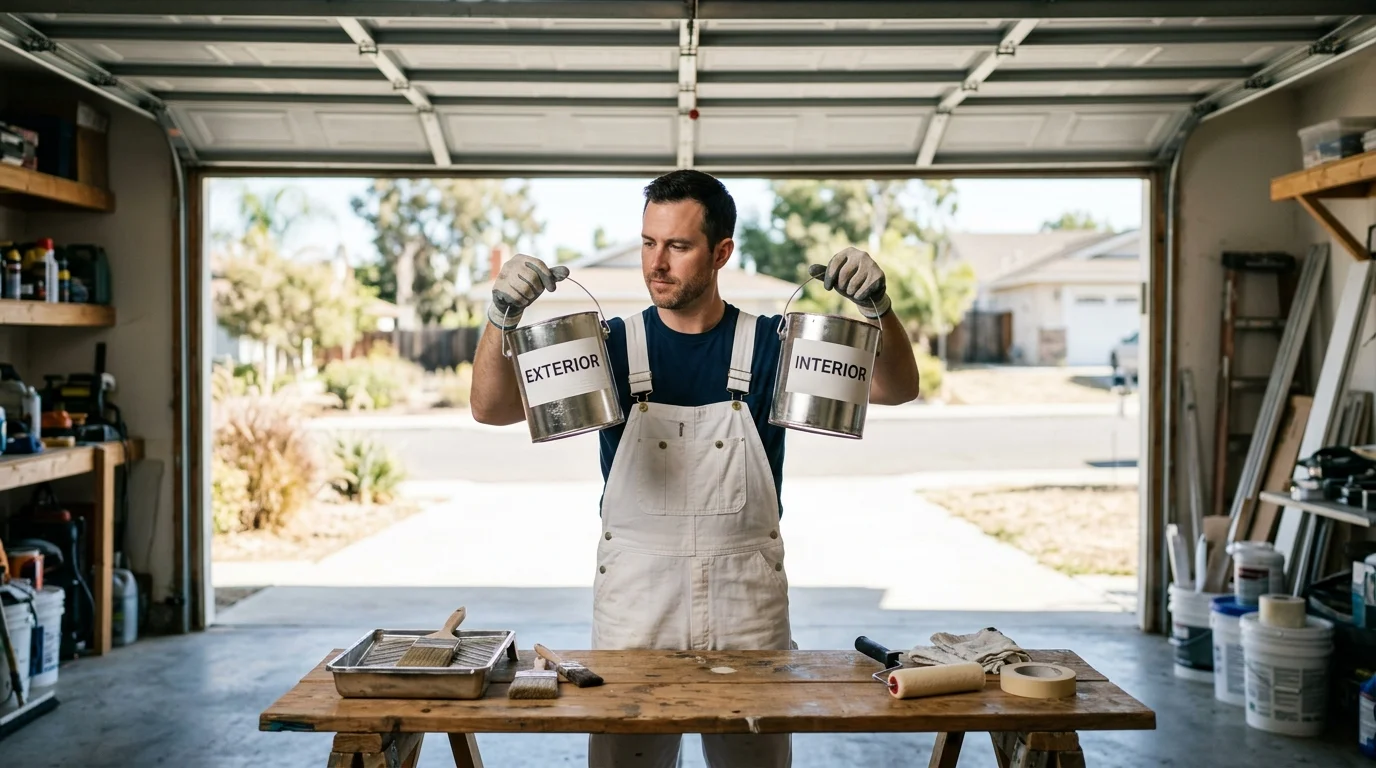
Can you use exterior paint indoors?
Yes, exterior paint physically bonds to interior drywall, plaster, or trim the same way an interior product does. Adhesion isn’t the issue. The issue is what the product was formulated to do once it’s on the wall. Exterior paint carries more of everything meant to survive weather: solvents and VOCs that help it cure through rain and temperature swings, biocides and mildewcides to stop mold and algae outdoors, and UV-blocking pigments that add cost but do nothing for you inside. Indoors, all of that becomes a liability instead of a feature. The VOCs off-gas into a closed room for days or weeks longer than a low-VOC interior product would, and the mildewcides formulated for open-air exposure aren’t the ones tested and rated for enclosed indoor air quality.
Can you use interior paint outside?
No, not for anything meant to last. Interior paint skips the UV-resistant pigments and flexible acrylic binders that let exterior paint expand and contract with San Diego’s daily temperature swings without cracking. Painted outside, an interior product chalks and fades within months of direct sun exposure, and without mildewcide protection it picks up mold and algae fast anywhere it stays damp, which around San Diego usually means north-facing walls, fence lines under trees, and anything near sprinkler overspray. Expect visible failure, cracking, peeling, or a chalky residue that rubs off on your hand, well inside a year outdoors, far short of how long a real exterior product holds up here.
Why the two products aren’t interchangeable
| Interior paint | Exterior paint | |
|---|---|---|
| Binder | Rigid acrylic or vinyl, built for a stable indoor temperature | Flexible 100% acrylic, built to expand and contract with weather |
| UV protection | None or minimal | UV-stable pigments and additives |
| Mildew and algae resistance | Light, or none | Built-in biocides for damp, shaded outdoor surfaces |
| VOC level | Lower, made for enclosed air | Higher, made to cure in open air |
| Typical lifespan in its intended spot | Holds up longer indoors, out of sun and weather | Shorter outdoors, and shortest on sun-exposed south and west walls |
The one place exterior paint indoors actually makes sense
Garages, workshops, and covered but unconditioned spaces like a breezeway or laundry room open to outside air. Most San Diego garages aren’t insulated or climate controlled, so they see bigger temperature swings than the rest of the house, on top of vehicle exhaust, chemical exposure, and humidity from an open door. That’s closer to an outdoor environment than a living room, and exterior-grade paint’s flexible binder and stronger stain resistance actually earn their keep there. Ventilation is rarely a concern in a garage the way it is in a bedroom, since the door usually stays open during the job and well after. If you’re repainting a garage door specifically rather than the walls, our guide to painting a garage door in San Diego covers the door itself in more depth.
San Diego specifics
California sets some of the strictest VOC limits on architectural paint in the country, so most interior products sold here are already low-VOC or zero-VOC, which narrows the practical gap between the two products, but doesn’t close it. Exterior formulas still run higher. San Diego’s mild year-round climate also means people often paint an interior room with a window cracked instead of running a full ventilation cycle, which is fine with a low-VOC interior product and a much bigger deal with an exterior one in the same room. On the outdoor side, coastal homes in La Jolla, Coronado, and Pacific Beach add salt air into the mix, which interior paint has zero defense against, while inland neighborhoods like El Cajon and Santee see harsher direct sun that fades an interior product even faster.
Frequently asked questions
Is it OK to use exterior paint on interior walls just once?
A small one-off job, like a mudroom or a laundry room with the door propped open, is unlikely to cause a real air quality problem. A bedroom, nursery, or any room where you’ll be sleeping isn’t worth the risk from the extra VOCs and mildewcides. Use an interior product rated for that room instead.
Can you paint over exterior paint with interior paint, or the other way around?
Yes, once the existing coat is clean, dry, and lightly sanded for grip, either product can go over the other with the right primer. What matters going forward is which product you finish with, since that’s the coat doing the actual job of protecting the surface.
Does exterior paint dry the same way indoors as it does outside?
No. Exterior paint is formulated to cure with help from sun, wind, and open-air airflow, so it dries slower and stays tacky longer indoors where none of that exists. Give it noticeably more time between coats than the can’s label suggests if you use it in an enclosed room.
What happens if you paint a fence or exterior wall with interior paint?
It looks fine for the first few months, then starts chalking, fading, and cracking well ahead of schedule, often inside a year in direct San Diego sun. There’s no fix short of stripping it back and repainting with an actual exterior product.
Is exterior paint safe to use in a garage?
Yes, garages are one of the few indoor spaces where exterior-grade paint is actually the better choice, since they run closer to outdoor temperature and humidity swings and typically have the door open for ventilation during and after the job.
Get matched with a painter
Not sure which product is right for the room or surface you’re tackling? The painter we match you with will tell you straight whether the paint sitting in your garage is the right call for that bedroom wall, or whether it needs an actual interior product. Call (858) 400-6422 to get matched with a San Diego painter. The painters we match handle both interior painting and exterior painting across San Diego, Chula Vista, Carlsbad, Encinitas, Coronado, El Cajon, and Escondido.
For more on getting the prep and products right, see our guides on primer before painting, how long paint takes to dry, and popular exterior house paint colors for San Diego.