Painting contractors in National City. We cover interior, exterior, cabinet, stucco repair-and-paint, and fence-and-gate work across the city’s older housing stock. Project cost tracks square footage first, then how much lead-safe prep the pre-1978 stock needs. We also serve adjacent Chula Vista, Bonita, and Barrio Logan. Call (858) 400-6422 and we’ll connect you with a vetted local painter.
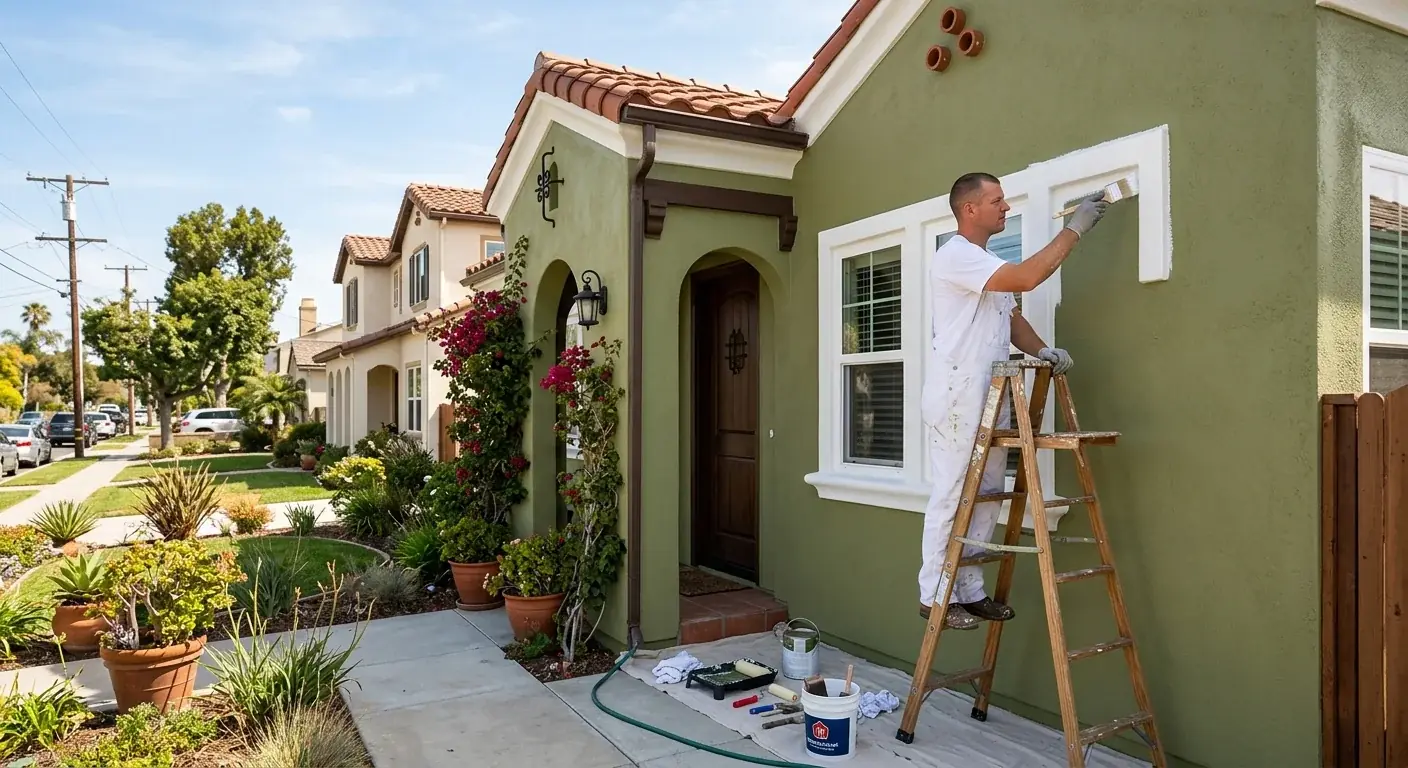
National City sits just south of downtown San Diego on I-5, between Barrio Logan to the north and Chula Vista to the south. Population is about 62,000, and the housing stock skews older than almost any other South Bay city. Lots are smaller, homes are smaller, and a real chunk of the city was built before lead paint was banned in 1978. That changes how a careful painter scopes a project here.
This guide walks through neighborhoods, the historic-home work we do most often, the moderate marine-influenced climate, real cost ranges by home size, the EPA lead-paint protocol that applies to most of the city, the services we cover, and the five questions to ask any National City painter before you book.
National City neighborhoods and paint particulars
National City is compact, roughly seven square miles, but the housing varies block to block. Here’s where the painting work actually shifts.
Old Town National City. The historic core around National City Boulevard and Heritage Square. Some of the oldest housing in San Diego County, with Victorian, Queen Anne, and older craftsman homes that pre-date the city’s industrial growth. Period-appropriate color work matters here. Many of these homes are on the local historic register, and a careful painter pulls original color photos or paint scrapings before specifying a palette.
Granger neighborhood. Older single-family homes along the Granger area west of Highland Avenue. Lots of small craftsman bungalows, Spanish colonial revival, and post-war stucco tract. Original wood siding and trim are common, which means more prep, more spot priming, and lead-safe practices on anything built before 1978.
Olivewood and Olivewood Gardens. South-central pocket near the historic Olivewood Estate. Mix of older bungalows and small ranch homes with mature landscaping. Stucco-and-wood-trim combinations are typical, and older single-pane wood windows often need full sanding and priming before paint.
Lincoln Acres. Unincorporated pocket just east of National City proper. Older tract housing on slightly larger lots, often with detached garages and wood fencing that needs its own scope on every exterior repaint cycle.
Sweetwater Heights and the Sweetwater corridor. Newer construction relative to the rest of the city, mixed in with some older infill. Stucco-dominant, hip roofs, two-car garages. The repaint cycle here is closer to a standard South Bay tract home, and lead protocol applies only on the pre-1978 sub-stock.
Bayfront and port-adjacent zones. Mostly industrial west of I-5, but the residential blocks closest to the waterfront pick up real salt air. Exterior paint specifications shift on these homes, lean toward elastomerics on stucco and high-grade 100% acrylics on wood, with extra attention to metal railings and entry doors.
ZIP codes we cover: 91950 (most of the city), 91951 (PO boxes), and the adjacent 91902 (Bonita) and 91913-91914 (East Chula Vista) for projects that bridge.
Historic-home painting in National City
A big share of National City’s housing was built before 1978, which means two things at once: original architectural character worth preserving, and lead paint somewhere in the substrate.
The architecture painters work on most often here:
older craftsman bungalows. Wood lap siding, exposed rafter tails, tapered porch columns, double-hung wood windows, and shingle accents. Period-appropriate craftsman palettes lean on earthy mid-tones with darker trim and a contrasting front door. Sherwin-Williams Historic Color collection and Dunn-Edwards Historic Colors of America are our go-to specs.
older Spanish colonial revival. Smooth stucco bodies, low-pitch clay-tile roofs, arched entry openings, wrought-iron details, and small accent windows. The classic palette is a warm off-white or cream body with terracotta accents and dark iron. Painters in our network carry the manufacturer codes for the documented period colors.
older post-war bungalows. Smaller footprints, stucco or wood siding, simple gable roofs, single-car garages. These homes have usually been repainted three or four times by now, which means substantial layer-buildup on wood trim and the occasional alligatored exterior that needs scraping back to bare wood before any new coat goes on.
When a homeowner wants to keep the period look, we sample the existing exterior in shaded eaves where original paint sometimes survives, match it to manufacturer codes, and either spec the original tone or shift it within the period-appropriate range. When a homeowner wants to modernize, we still respect the architecture, no high-contrast pure white on a craftsman, no cool gray on a Spanish revival.
National City climate and what it means for paint
National City sits in the South Bay marine zone, with a moderate, mild climate year-round. Average highs in summer are in the high 70s. Winter lows rarely drop below the high 40s. Humidity is moderate. Rainfall averages about 10 inches a year, almost all of it between November and March. See the NOAA San Diego climate normals for the full picture.
That’s an easier paint climate than inland East County (Lakeside, Alpine, Ramona) where summer surface temperatures on west-facing stucco run much hotter and paint fails faster. National City’s moderate climate is gentler on a quality acrylic than the coastal salt exposure or the inland heat load, without matching either extreme.
Two climate factors do matter:
Salt air at bayfront and port-adjacent zones. Homes within roughly half a mile of San Diego Bay pick up enough salt deposition to accelerate metal corrosion and chalking on south-facing stucco. The painters we match spec a thicker mil build on these homes (two full coats at the manufacturer’s high end), use rust-inhibitive primer on any exposed metal, and recommend a soft-wash rinse every two years between repaints.
Marine layer humidity. Summer mornings often run 80-90% relative humidity until the layer burns off. Painters in our network schedule exterior application to start after about 10 a.m. on overcast days, when surface moisture has evaporated, and we use moisture meters on stucco when we’re unsure. Painting wet stucco is the most common cause of premature failure we see on bidder repaints in this part of the County.
Cost ranges by National City home size
The headline: National City pricing tends to run lower than coastal North County and slightly below the Chula Vista master-planned tracts, because the homes are smaller, single-story is more common, and there are no HOA architectural-review fees. The trade-off is that older homes carry more prep, so the per-square-foot rate is higher even when the total project cost is lower.
Here’s what actually drives the price on a National City home, by size. Compare them to our exterior painting cost guide for San Diego and interior painting cost guide for County-wide context.
1,000 sq ft (small craftsman bungalow or post-war cottage). Interior repaint, walls and ceilings only: square footage and wall condition set the baseline. Interior plus trim, doors, and one accent wall: door count and color-change complexity add to it. Exterior repaint, body and trim, two coats: substrate condition and trim volume drive the total.
1,300 sq ft (typical 1940s-1960s single-story). Interior, walls and ceilings: room count and prep needs. Interior plus trim and doors: added door and baseboard linear footage. Exterior, two coats with standard prep: stucco condition and wood-trim repair.
1,600 sq ft (slightly larger post-war or older tract). Interior, full scope: total wall square footage. Exterior, two coats with standard prep: substrate condition and access.
2,000+ sq ft (newer Sweetwater Heights or larger custom). Interior, full scope: room count and finish detail. Exterior, two coats with standard prep: home size and trim package.
Lead-safe protocol on any pre-1978 home adds to the total, as does salt-air spec on bayfront-adjacent homes. Add a separate line item for stucco crack repair, fascia rot replacement, and cabinet refinishing when those scopes apply.
Pre-1978 lead-paint protocol (mandatory in National City)
Because so much of National City’s housing was built before lead paint was banned in 1978, EPA Renovation, Repair, and Painting Rule (RRP) compliance is not optional. It’s federal law for any contractor disturbing painted surfaces on housing built before that year.
What a compliant scope looks like on a National City pre-1978 home:
Certified firm and certified renovator on site. The contractor’s firm carries an EPA RRP certification, and at least one certified renovator supervises the lead-safe work. The painters we match carry both.
Lead testing or presumption. Before any sanding, scraping, or surface prep, we either test the existing coatings with an XRF analyzer or presume the presence of lead and work to the protocol either way.
Contained work area. Plastic sheeting on the ground at least 10 feet out from the building, doors and windows sealed, HVAC vents covered, and warning signs posted at the property boundary.
Lead-safe surface prep. No dry sanding, no open-flame burn-off, no high-temperature heat guns. We use HEPA-shrouded sanders, chemical strippers when scraping is needed, and wet-sanding methods on detail trim.
HEPA vacuum cleanup and waste disposal. Daily cleanup with HEPA-filtered vacuums, contained debris disposal, and a final cleaning verification at project close.
Documentation. We deliver the homeowner the EPA “Renovate Right” pamphlet at estimate, log the lead-safe work practices, and provide written verification at job close.
A bidder who skips this protocol on a pre-1978 home is breaking federal law and putting the homeowner at risk. The full rule, the fine schedule, and a contractor lookup tool are at the EPA Lead-Safe Certified Firm page. Verify any National City painter you’re considering is on that list before you sign.
Painting services for National City homes
Here’s the full scope we cover inside the city:
Interior painting. Walls, ceilings, trim, doors, accent walls, color consults, popcorn-ceiling smooth-overs, drywall patching. Most National City interiors painters work on are in homes built decades ago, so we deal with textured walls (sand finish, knockdown, light orange-peel), original plaster on the oldest stock, and the occasional asbestos-containing popcorn ceiling that needs an environmental scope before paint.
Exterior painting. Stucco, wood lap siding, fascia, eaves, garage doors, iron rails, and front doors. Painters in our network spec elastomerics like Dunn-Edwards Evershield and Sherwin-Williams Loxon XP on cracked stucco, 100% acrylics on wood trim, and oil-based or DTM enamels on iron and steel railings. See our popular exterior house paint colors breakdown for current National City trends.
Cabinet painting. Kitchen and bath cabinet refinishing in lacquered or waterborne urethane. Most National City kitchens painters here refinish are oak or maple boxes, being updated to white, off-white, sage, or two-tone. Pull the doors off, refinish in our shop, refinish boxes on site over two days, and reinstall.
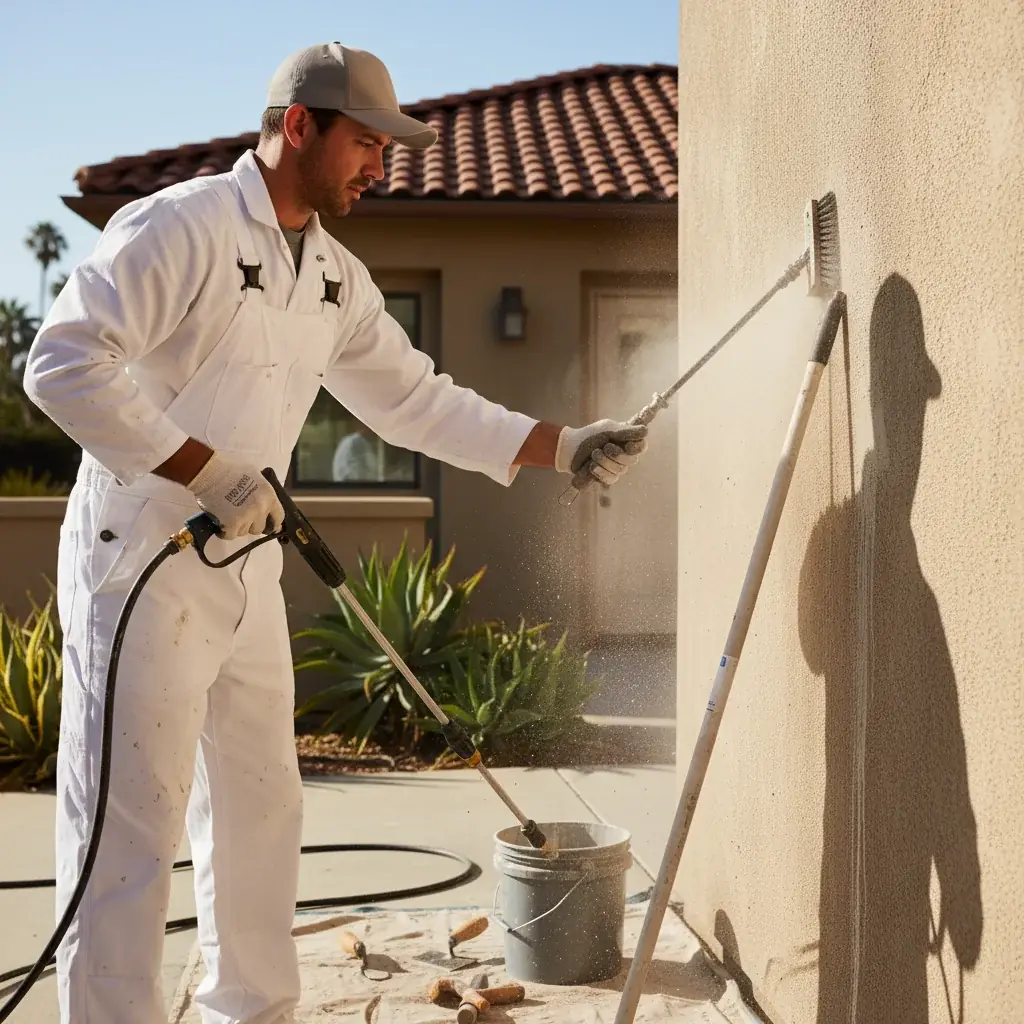
Stucco repair and paint. Patching hairline cracks, treating efflorescence, re-floating delaminated sections, and elastomeric topcoat where the substrate is still moving. National City’s older stucco has decades of settling cracks. A wash-and-paint without repair is the most common shortcut we see on cheap National City bids.
Fence and gate painting. Common scope here because the older neighborhoods carry a lot of wood fencing on the property lines. Stain or paint on cedar and redwood, rust-inhibitive primer plus oil-based topcoat on wrought-iron gates.
Choosing a painter in National City: 5 questions to ask
Most National City painting work is residential, on older homes, with prep that matters more than the topcoat color. Ask any contractor these five before you sign.
1. Are your estimators bilingual?
National City is roughly 60% Latino and a notable share of Filipino-American households. A real estimator who can walk a homeowner through scope, lead protocol, and color decisions in Spanish or Tagalog as well as English saves real friction. The painters we match staff English, Spanish, and Tagalog estimators across the South Bay.
2. Are you EPA RRP certified?
Non-negotiable on any pre-1978 home. Ask for the firm’s EPA certificate number, then verify it on the EPA Lead-Safe Certified Firm lookup. Anyone who hesitates on this question is not the right painter for a National City project.
3. Can you match historic colors?
If the home is in Old Town National City or any of the pre-1950 stock and the homeowner wants period-appropriate work, the painter should have the manufacturer historic-color binders (Sherwin-Williams Historic, Dunn-Edwards Historic Colors of America) and be willing to sample existing layers under the eaves to find what’s underneath. Generic gray-and-white modern palettes on a 1925 craftsman read as a missed opportunity.
4. How do you spec paint for bayfront salt-air homes?
For any home within half a mile of the bay or the port. The right answer mentions thicker mil build, rust-inhibitive primer on metal, manufacturer’s high-end coatings (Loxon XP, Evershield, Aura Exterior), and a recommended soft-wash rinse cycle between repaints.
5. Is your pricing transparent on the lower-cost work?
The reality of National City is that average household income is lower than coastal SD, and most homeowners are weighing real budget tradeoffs. The right painter explains what corners cannot be cut (lead protocol, prep, two coats on exterior) and where the homeowner can save money (paint product tier within the same manufacturer, scope reduction on accent walls, deferred cabinet work). Anyone giving you a single take-it-or-leave-it number on a 1940s home is not your painter.
FAQ
How much does a National City painter cost?
Home size and prep scope set the price, not a flat rate. A small interior repaint on a 1,000 sq ft home is the low end; an exterior repaint on a 1,600 sq ft home with standard prep costs more. EPA lead-safe protocol on pre-1978 homes adds to the total. See the cost-range section above for what drives price by home size.
Do you have bilingual painters and estimators?
Yes. Our South Bay estimating team speaks English, Spanish, and Tagalog. Scope walks, written estimates, and on-site daily communication can all happen in whichever language the homeowner is most comfortable in.
Do you test for lead paint before starting?
On any home built before 1978, an independent painter may XRF-test the existing coatings or presume lead is present and work to the EPA RRP protocol either way. Ask that they deliver the EPA “Renovate Right” pamphlet at estimate, contain the work area, use HEPA-shrouded prep tools, and provide written verification at project close.
Do you serve Chula Vista and Bonita?
Yes, both. National City is in our core South Bay coverage zone alongside Chula Vista, Bonita, Eastlake, Otay Ranch, Sweetwater, and the bordering parts of Barrio Logan and Imperial Beach. See our house painter Chula Vista guide for that city’s specifics.
Can you match historic colors for an Old Town National City home?
Yes. Painters in our network carry the Sherwin-Williams Historic Color collection and the Dunn-Edwards Historic Colors of America binder, and we sample existing coatings under protected eaves to find original-layer color where it survives. We can spec period-appropriate craftsman, Spanish revival, or post-war palettes, or modernize within the period-appropriate range when that’s what the homeowner wants.
What does an estimate look like?
An in-person, no-obligation walkthrough anywhere in National City and the surrounding South Bay. The painter walks the site, then follows up with written scope and pricing.
Local resources for National City homeowners
- City of National City Building Department for any permitted exterior work
- EPA Lead-Safe Certified Firm lookup to verify any painting contractor’s RRP credential
- CSLB contractor license lookup to verify any contractor’s California license before you sign
- NOAA San Diego climate normals for repaint-cycle planning
- SD County demographics for National City for housing-age and household context
- Better Business Bureau San Diego for contractor reviews and complaint history
Related reading
- Painters in San Diego County: complete guide
- House painter in Chula Vista: services, costs, and HOAs
- Exterior painting cost in San Diego
- Interior painting cost in San Diego
- Popular exterior house paint colors in San Diego
- Best time to paint exterior in San Diego
- Painting service in National City
- Exterior painting services
- Interior painting services
Ready for an estimate?
Call (858) 400-6422 and we’ll connect you with a vetted local painter. We cover the full city, ZIP 91950, plus Bonita, Chula Vista, Barrio Logan, and the rest of the South Bay. Bilingual estimators on staff. EPA RRP certified. Every painter we refer is licensed and insured. In-person, no-obligation estimates with written scope and pricing.