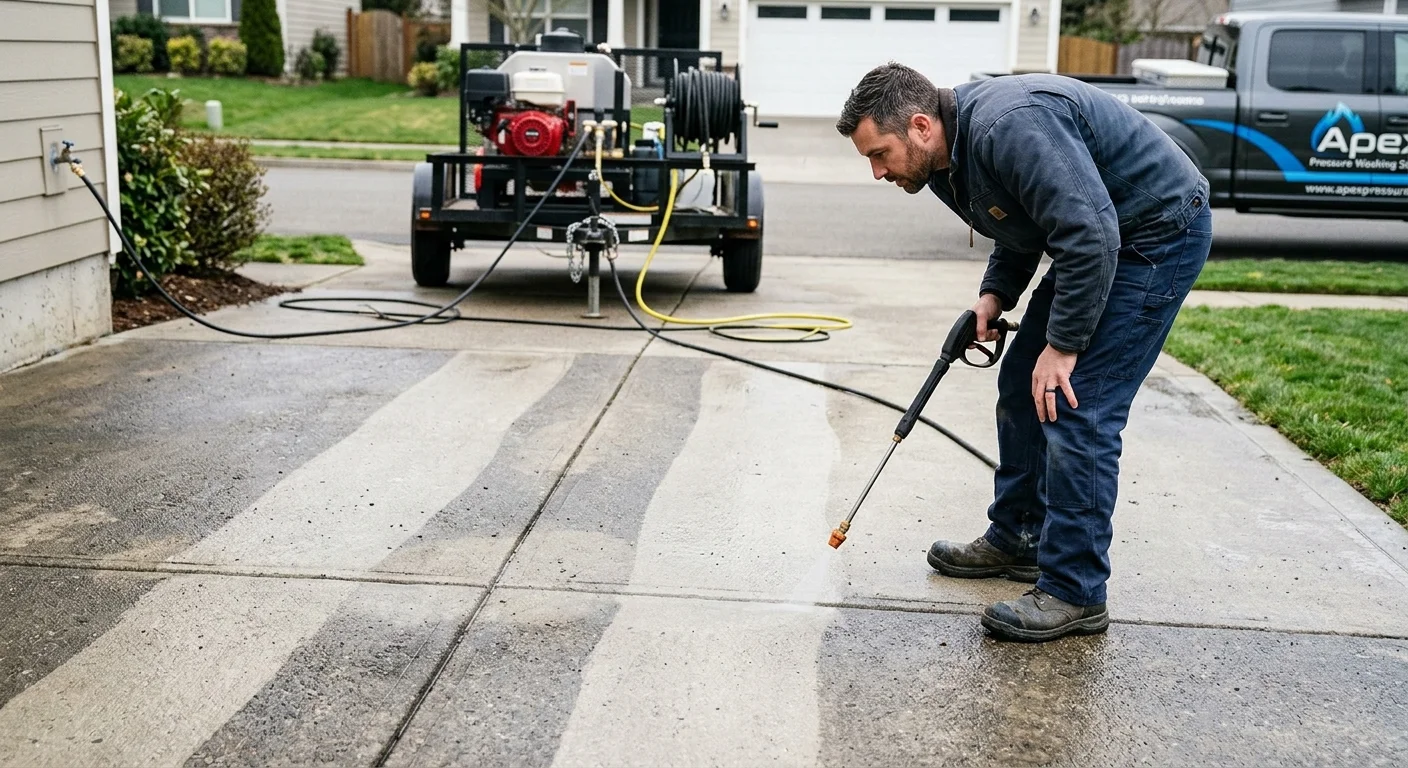
The driveway looked even while it was wet. Then it dried into pale bands next to darker concrete. San Diego slabs show this after a weekend wash, from damp Oceanside pads to El Cajon driveways that flash dry inland.
Identify stripes, wand marks, and untouched areas
People hunting pressure washing stripes on concrete are usually looking at three different patterns.
Wand marks are repeating fans or long ovals from a handheld spray. A darker lane sits where passes overlapped, and a lighter lane sits where they didn’t. Broom-finished driveways in Chula Vista, Santee, and older San Diego tracts catch those lanes in the grooves.
Zebra bands are wider and more parallel. They often mean a walk-behind cleaner skipped a strip or doubled one.
Untouched areas are soil the spray never reached. Around here that’s often the strip under a parked car, the edge against a stucco wall, the garage lip, and the joint where an older pour meets a newer extension.
Encinitas, Oceanside, Imperial Beach, and Coronado pads sit in morning marine layer, so organic film clings on the shaded north side of a house. A pass that looks even on sunny tire lanes can leave a green-gray veil in the shade. Inland, Escondido, Santee, and El Cajon bake dust into the broom finish through the dry months. Uneven pressure washing then reads as tan bands on a cleaner field.
Two concrete pours rarely match. An older apron in National City or Lemon Grove next to a later widening can dry to two tones after an even wash. Sealer worn off in the tire tracks can do the same. A surface professional reads pour lines, shade, and traffic lanes before anyone talks about a fix for striped concrete after pressure washing.
Separate uneven cleaning from concrete damage
Stripes after a wash are a look, not a diagnosis. Cleaning contrast and surface damage can share the same driveway.
Uneven cleaning often tracks the tool path. The bands follow wand swings or the width of a cleaner deck. Wet the area again and the contrast may drop, then return as it dries. That still doesn’t prove the slab is unhurt. It only says soil, film, or sealer is still in the picture.
Damage looks more like the concrete itself changed. The paste may look eaten in a stripe, or fine aggregate may stand up in one lane and stay buried next to it. Irrigation rust, leaf tannin, and oil follow a drip line, a planter, or a parking spot, not a wand. A pro separates those stains from pressure washer marks on concrete before anyone repeats the wash.
About 85% of San Diego’s rainfall occurs from November through March. Coastal San Diego sees roughly 4 inches a year, and inland and mountain areas receive more. Winter leaves mineral traces on Encinitas and Imperial Beach slabs. Inland heat in Escondido and El Cajon bakes dust into the same finish all summer.
Painted concrete is a different surface. Worn color in traffic lanes can look like stripes after a wash. On housing built before 1978, paid work that disturbs that paint falls under the EPA Renovation, Repair and Painting rule. About 49.6% of the City of San Diego’s housing units are pre-1978. Pre-1978 paint is presumed lead-based unless testing shows otherwise.
The honest step is an on-site look at the pour, the coating, and the dirt that’s still there.
Check equipment choice and cleaning pattern
Equipment and pattern leave signatures. They don’t tell you the remedy.
A handheld wand draws fans, ovals, and stop marks along stairs, walls, hose bibs, and the last pass before the sidewalk. A walk-behind surface cleaner draws broader tracks on a flat pad. When that deck lifts, stalls, or turns, you get a stripe the width of the machine. Both tools show up when a pro does pressure washing. Neither is a verdict.
Overlap that’s tight in one lane and thin in the next will dry as bands. Starting in full sun on an El Cajon or Poway slab can erase the wet edge before the next pass. Coastal work in Oceanside or Solana Beach hides skipped soil until afternoon, when contrast returns and the stripes appear.
Expansion joints, the garage lip, and the strip along a block wall need a different motion than the open field. If those zones were rushed, you’ll see a clean center and a dirty frame. That’s uneven pressure washing, not a mystery stain.
This page isn’t a setup guide. A local pressure setting, nozzle chart, or mix ratio couldn’t be confirmed from a primary source for this page. The independent pro who takes the job chooses tools on site after seeing the slab, the soil, and any coating.
Take dry-day photos from the street and the garage. Mark whether bands follow tire tracks, pour joints, shade lines, or the path of a wand.
Compare spot correction with full-area cleaning
A single pale stripe tempts a small redo. That’s not always the quieter path.
Spot correction means a pro tests a limited area and watches it dry. The test can show leftover soil still moving. It can also leave a clean rectangle as obvious as the original band. On a broom finish, a brighter patch reads from the curb. Inland light in Ramona, Lakeside, and El Cajon makes that patch louder.
Full-area cleaning evens the whole field so the eye has no clean island to lock onto. That can be the better visual choice when wand marks run across most of the pad. It still isn’t a promise the concrete will match. Oil, sprinkler rust, and old sealer may sit through another wash. Those are stain and coating problems, not just missed dirt.
Paint Pros San Diego doesn’t set prices. Scope still changes the quote: open driveway versus stairs, raw slab versus painted patio, one stain versus a full pad. Our guide to pressure washing cost in San Diego walks through how those quotes get built. You contract and pay the independent professional directly.
Hold off on unconfirmed mix ratios. Extra product on one band can leave a footprint next to untreated concrete. If the slab is prep for coating or house paint, say that up front. The goal is a uniform surface, not a weekend shine.
Know when a surface professional should inspect
Call for an inspection when the dry slab still looks striped and you can’t tell dirt from wear. The look needs a person on the concrete, not a guess from the sidewalk.
Get a pro involved before a second round if paint is on the slab, the patio, or the adjacent house. If the wash is really paint prep, read our notes on pressure washing before painting in San Diego. Paid work that disturbs paint on pre-1978 housing must follow EPA RRP work practices, including a certified firm and a certified renovator. Confirm the current rule on the EPA RRP program page.
About 41% of Chula Vista’s roughly 90,500 housing units were built before 1978, concentrated in the western half west of I-805. Granite Hills is about 76.5% pre-1978. A painted patio there isn’t the same risk as a raw slab in San Marcos, where the pre-1978 share is about 23.8%.
If the project will run $1,000 or more for labor, materials, and other items, California law requires a licensed contractor as of 2026. Check the person you hire through the CSLB license lookup before you sign. A C-33 painting classification includes surface preparation by scraping, sandblasting, or other means when the work is painting and decorating. Driveway washing on its own may sit in a different scope, so ask what license class they hold for this job. Paint Pros San Diego is a referral service. We don’t hold a trade license, and we don’t perform the work.
A pro should also inspect when bands follow aggregate, the surface feels different in the stripe, or old sealer is peeling in traffic lanes. The painter you are matched with inspects and proposes a scope. Any warranty, if one is offered, comes from that painter, not from us.
When to call us
If the slab still looks striped after it dries, or you need it even before coating nearby paint, a licensed local painter should inspect the surface in place. Paint Pros San Diego matches homeowners with independent pros who do that work under their own contract. Call us at (858) 400-6422 and we’ll connect you with a licensed local painter.