For popcorn ceiling removal in San Diego condos, get the full scope in writing before work begins. Confirm the existing ceiling, building access, protection plan, testing responsibility, drywall finish, primer, and final appearance.
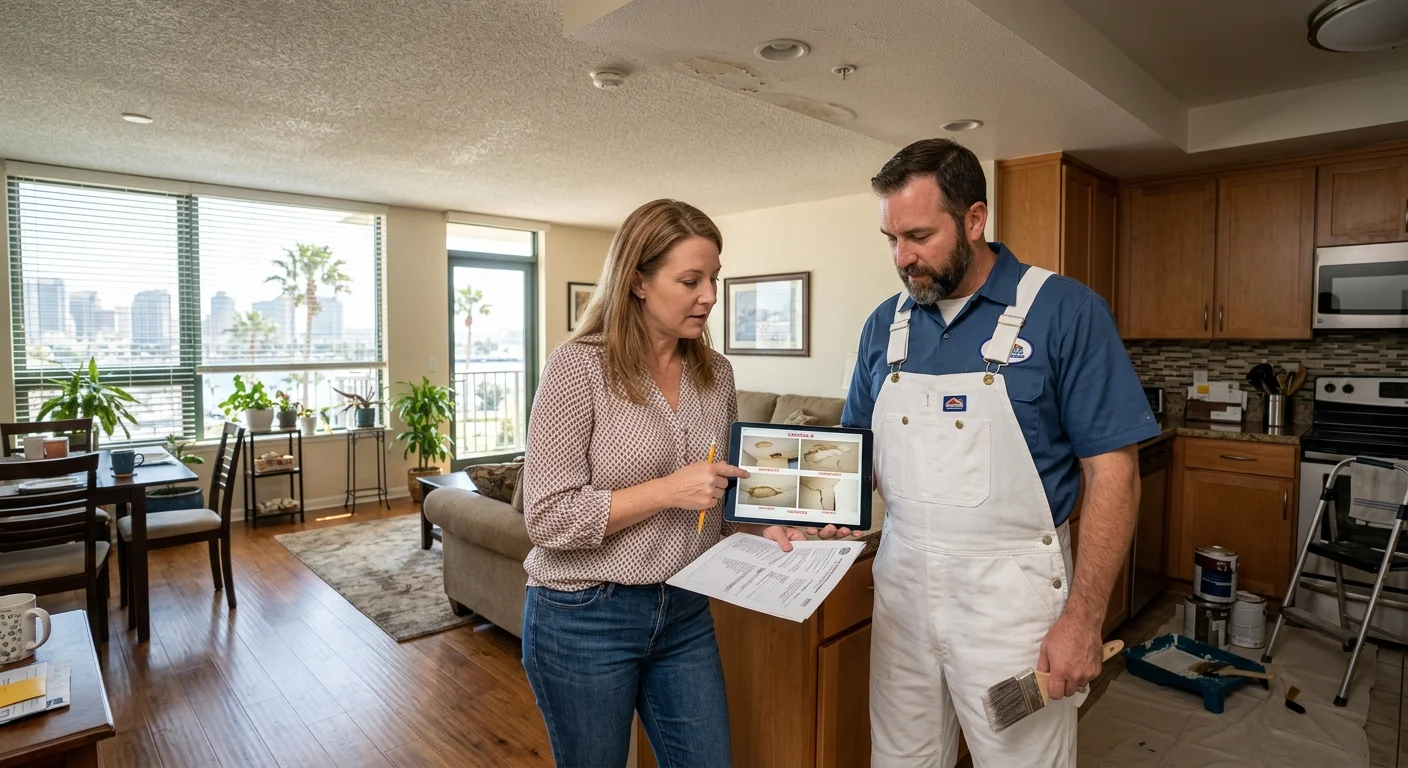
Confirm the ceiling texture and coating condition
Start with a room-by-room ceiling review. Don’t let one general description cover the entire condo.
Record where the texture appears and where it stops. Note visible paint, patches, stains, cracks, vents, lights, soffits, and ceiling transitions. These observations aren’t a material diagnosis. They give the quoting professional a clear starting point.
Ask the professional to describe the existing condition in the proposal. The description should match what you can see. If one bedroom differs from the living room, the scope should separate them.
A useful proposal answers these questions:
- Which rooms and ceiling sections are included?
- Is the existing texture visibly coated?
- Are closets, hallways, and soffits included?
- How will visible patches or damaged areas be handled?
- What condition will the ceiling be left in?
- Are primer and final paint included or excluded?
A coated ceiling deserves its own discussion. Ask whether the visible coating changes the proposed removal method or finish scope. Our guide to painted popcorn ceiling removal explains the questions to raise without assuming one method fits every ceiling.
Photos can make comparison easier. Take wide views and close views from the same rooms. Include ceiling edges, repaired areas, and places where texture meets fixtures. Give each professional the same photos and room list.
The popcorn ceiling removal service page can help you organize the referral request. Paint Pros San Diego matches homeowners with licensed, independent local professionals. The selected professional performs the work and provides the project terms.
Check building access and protection requirements
Condo access requirements come from the individual building or association. No San Diego-wide condo access rule was confirmed in the approved claims ledger. Check with the building’s responsible contact before accepting a removal proposal.
A downtown tower may present a different access plan than a low-rise Mission Valley complex. The actual requirements still come from that specific property. Don’t let either the owner or professional guess.
Ask the building contact about:
- Approved paths between the unit and exterior
- Elevator or stair access
- Loading and parking instructions
- Work-hour or noise restrictions
- Required notices or reservations
- Rules for moving tools and contained waste
- Protection expected in common areas
- Documents required from the hired professional
Then place the confirmed requirements into the work scope. If the building requires a reserved elevator or protected hallway, identify who handles each task. If no rule applies, note that answer as well.
Protection inside the condo also needs clear boundaries. List the furniture, rugs, window coverings, electronics, cabinets, fixtures, and personal property in each room. Decide what the owner will move and what the professional will protect. Don’t rely on “standard protection” without a written description.
Ask where tools and materials may be staged. Confirm how workers will enter occupied rooms and how unavailable rooms will be marked. If residents, children, or pets will remain nearby, tell the quoting professional during the first conversation.
Common areas deserve equal attention. A clean unit-level proposal can still omit the route through a lobby, corridor, garage, or elevator. Building access and interior protection should appear as connected parts of the same plan.
Separate removal from drywall finishing
Treat texture removal and drywall finishing as separate scope lines. “Remove popcorn ceiling” identifies the starting task, but it doesn’t define the completed surface.
The proposal should state what happens after the texture is removed. Ask the professional to describe repairs, surface preparation, sanding, primer, final coating, and cleanup as included or excluded items. Avoid relying on phrases like “paint ready” unless the proposal explains the expected result.
Use visible acceptance points when comparing scopes:
- Which ceiling defects are included for repair?
- Are previous patches addressed?
- Is a broad finishing pass included?
- How are ceiling edges handled?
- Does the scope include primer?
- Does it include the final ceiling coating?
- Who replaces or resets removed fixture covers?
- What cleanup marks completion?
If damaged drywall becomes visible, don’t assume its repair was included. Ask how added work will be documented and approved before it begins. This keeps removal decisions separate from later repair decisions.
Our drywall repair and texture-match service covers referrals for ceiling repair and finishing work. A condo owner can request one combined proposal or separate scopes. Either approach should identify the professional responsible for each finished surface.
Compare proposals by deliverables, not their total alone. One proposal might stop after removal. Another might include drywall finishing, primer, and final paint. Those offers aren’t equivalent, even when both use the words “popcorn ceiling removal.”
Also define the boundary between the ceiling and walls. Crown molding, ceiling trim, wall paint, vents, and fixtures may sit at that boundary. List what stays, what moves, and what receives finish work. A written boundary makes the final review much clearer.
Compare smooth and textured finish scopes
Choose the final appearance before comparing proposals. “Remove the popcorn” isn’t a complete finish decision.
For a smooth ceiling, ask the professional to describe the preparation and final coating included. Don’t assume “smooth” means the same thing to every bidder. Request a sample area, reference panel, or another written description that lets you judge the proposed appearance.
Review the sample from normal positions in the room. Look from the doorway, seating area, kitchen, and main windows. Check it with the lamps and ceiling lights you regularly use. The goal is to approve something tied to your unit, not an undefined label.
For a new textured finish, name the selected appearance in the proposal. Confirm whether the finish covers every included ceiling or only designated rooms. Record how it meets adjacent ceilings, closets, soffits, walls, and trim.
The finish scope should also answer:
- Who approves the sample?
- Where will the sample be placed?
- Does approval happen before the full ceiling is finished?
- Are primer and final paint separate line items?
- Will closets receive the same appearance?
- How will excluded ceiling sections be identified?
- What happens if the owner requests a different finish?
Don’t compare a smooth-finish proposal with a textured-finish proposal as if only the name changed. Ask each professional to quote the same room list, boundaries, protection plan, and final coating scope. That gives you a meaningful comparison.
If you haven’t chosen an appearance, pause the finish portion of the decision. Removal can expose questions that weren’t visible during the first review. The proposal should explain how any scope change gets recorded before additional work proceeds.
Confirm testing and safety responsibilities
Don’t infer ceiling contents from texture, color, or a photograph. The approved claims ledger doesn’t establish that appearance can identify asbestos or lead-based paint. Put testing responsibility in writing before anyone disturbs the ceiling.
San Diego’s citywide housing data adds useful context. An estimated 49.6% of the city’s housing units were built before 1978, based on ACS 2023 five-year data. That figure covers all housing units. It doesn’t establish the age or condition of a particular condo.
Federal rules apply when renovation, repair, or painting disturbs lead-based paint in pre-1978 housing. Covered firms must be EPA-certified and follow lead-safe work practices. The verified requirements include a certified firm and renovator, warning signs, containment, protected furnishings, controlled waste, and cleaning verification. Power sanding or grinding on painted surfaces requires a shroud or containment system with a HEPA vacuum attachment.
Review the EPA Renovation, Repair and Painting program when lead-based paint may be involved. Ask the professional which party handles the required work and documentation.
No approved claim establishes a blanket asbestos-testing rule for every San Diego popcorn ceiling. The ledger also doesn’t establish that a condo association must arrange testing. Ask the building’s responsible contact what records or requirements apply, then assign sampling, reporting, removal, and finishing responsibilities in writing.
California’s verified asbestos rules include a registration threshold. Contractors and employers removing material with asbestos fiber content over 0.1%, covering 100 square feet or more of surface area, must register with Cal/OSHA. That threshold doesn’t determine whether your ceiling contains asbestos. Testing and project-specific advice must come from qualified parties.
Our guide to popcorn ceiling asbestos testing in San Diego helps owners separate testing questions from removal scope. Before signing, verify the hired contractor through the CSLB license check.
When to call us
Call when you need a qualified local painting professional to review removal, drywall finishing, primer, and final coating scope. Call us at (858) 400-6422 and we’ll connect you with a licensed local painter.