The south wall of a Mission Hills bungalow can look two shades lighter than the north wall under the eaves. A fresh gallon mixed to the original color code will look too dark next to that faded stucco. The real choice is whether a painter matches the faded finish on a small patch, or repaints a whole elevation so the break disappears.
Confirm whether the old coating is sound
Color shift is not a diagnosis. Faded stucco can still be holding. Failed stucco can still look close to the original hue. Before anyone talks about matching, a painter needs to know if the film is sound.
Walk the house after a dry spell. Press a fingertip on a sun-baked west wall in Clairemont or Mira Mesa. If the surface powders onto your skin, you are looking at chalking, not just a lighter color. That powder is binder breaking down on the face of the coat. A formula mixed to that dusty film will sit on a weak layer. Read chalking exterior paint in San Diego before you treat the wall as a color problem only.
Look for peeling, flaking, and cracks that go through the coating into the stucco. Hairline stucco cracks show up often on inland and East County walls that heat up and cool down hard. Color matching over open cracks or loose film is wasted work. The coating has to be cleaned, scraped where it is failing, and repaired first. Independent painters do that prep. Paint Pros San Diego does not. If the field is stucco, that scope usually sits with stucco painting and repair, not with a touch-up can.
If the house was built before 1978, paid work that disturbs paint can fall under the EPA Renovation, Repair and Painting program. About 49.6% of housing units in the City of San Diego date from before that federal lead-paint cutoff. El Cajon sits higher, at about 62.5%. Carlsbad sits lower, at about 27.5%. Testing is not required by the RRP Rule. Without documentation that the paint is not lead-based, applicable requirements stay in place for covered firms. A small exterior disturbance of 20 square feet or less can be exempt, except for window replacement and demolition. Ask the quoting painter how they will handle sampling and prep on an older house. Verify their CSLB license at the CSLB license check before you sign.
A sound, faded coat is a matching problem. A failing coat is a coating problem. Do not skip that split.
Document color differences across each elevation
Fading is not even, and San Diego is not one exposure. Start on the south and west walls. Those faces take the longest stretch of sun. Then walk north and east, plus any wall tucked under deep eaves, a second-story overhang, or a patio cover. A protected patch behind a downspout is often closer to the original mix than the open field next to it.
A west wall in Encinitas or Imperial Beach also sits in marine air and a gray morning layer that inland Escondido and El Cajon do not. Coastal San Diego gets about 4 inches of rain a year, with about 85% of it from November through March. Inland and mountain areas get more. Rain is not the main fade driver. Sun and time are. Do not invent a salt-air percentage either. Coastal air is a real condition. A rate is not a published figure you can hang a match on.
Wash a small test square on each elevation and let it dry. Dust, irrigation overspray, and chalk all shift what you see. Matching dirty stucco matches dirt. Photograph the clean patches in the same hour, from the same distance, with no filter. Note the substrate: field stucco, foam pop-outs, wood or cement-board trim, a garage door, a metal railing. The same formula reads differently on a sand-finish stucco wall than on a smooth fascia.
Do not trust memory of the color you picked years ago. Do not trust a faded chip from a kitchen drawer. Document what is on the wall now, elevation by elevation. That map is what a color consultation is for. An independent consultant or painter can read those differences without guessing from a phone photo. If you still have the original can, keep it. The formula is a starting point, not the match. The wall has moved. The can has not.
Compare spot matching with a wider repaint
This is the decision the search is really about. A localized match tries to hit the faded color on a patch, a repaired crack, or a small addition. A paint-store desk can scan a chip. A big-box desk can do that too. Bring a clean sample from a hidden, less-faded spot, or a thin scrape from a place that will be recoated anyway. Phone apps that read a photo are rougher still, especially on textured stucco. They can get you into the right family. They will not settle a west-wall mismatch you will see from the sidewalk.
Spot matching works when three things are true. The surrounding film is sound. The patch is small. There is a natural break nearby: a corner, a control joint, a trim band, a material change. The painter feathers the new coat past the repair so you are not left with a postcard of fresh paint. Even then, do not promise yourself an invisible blend. Fresh paint is a different film. It will look a little fuller next to aged stucco, especially in raking afternoon light. Saturated colors show a miss faster than the light earth tones common on local stucco. A small taupe patch can still flash when the sun hits it from the side.
A wider repaint is the cleaner call when one whole elevation has drifted, when chalking is widespread, or when a patch would sit in the middle of a flat wall with no break. Painting corner to corner, or eave to stem wall, hides the shift. That is ordinary exterior house painting, not a magic formula. On a typical San Diego stucco house, one faded street face with three still-close sides is a common pattern. Recoating the hot wall and leaving the shaded walls can look honest if the corners are clean. Recoating only a two-foot square in the center of that wall usually looks like a patch.
If you like the faded look and just need a repair, match the faded wall, not the original chip. If you want the house to read as one color again, stop chasing the old mix and pick the color you want now. Popular exterior house paint colors in San Diego and exterior paint color combinations are the right next read when the job is really a reset.
Review samples beside stucco and trim
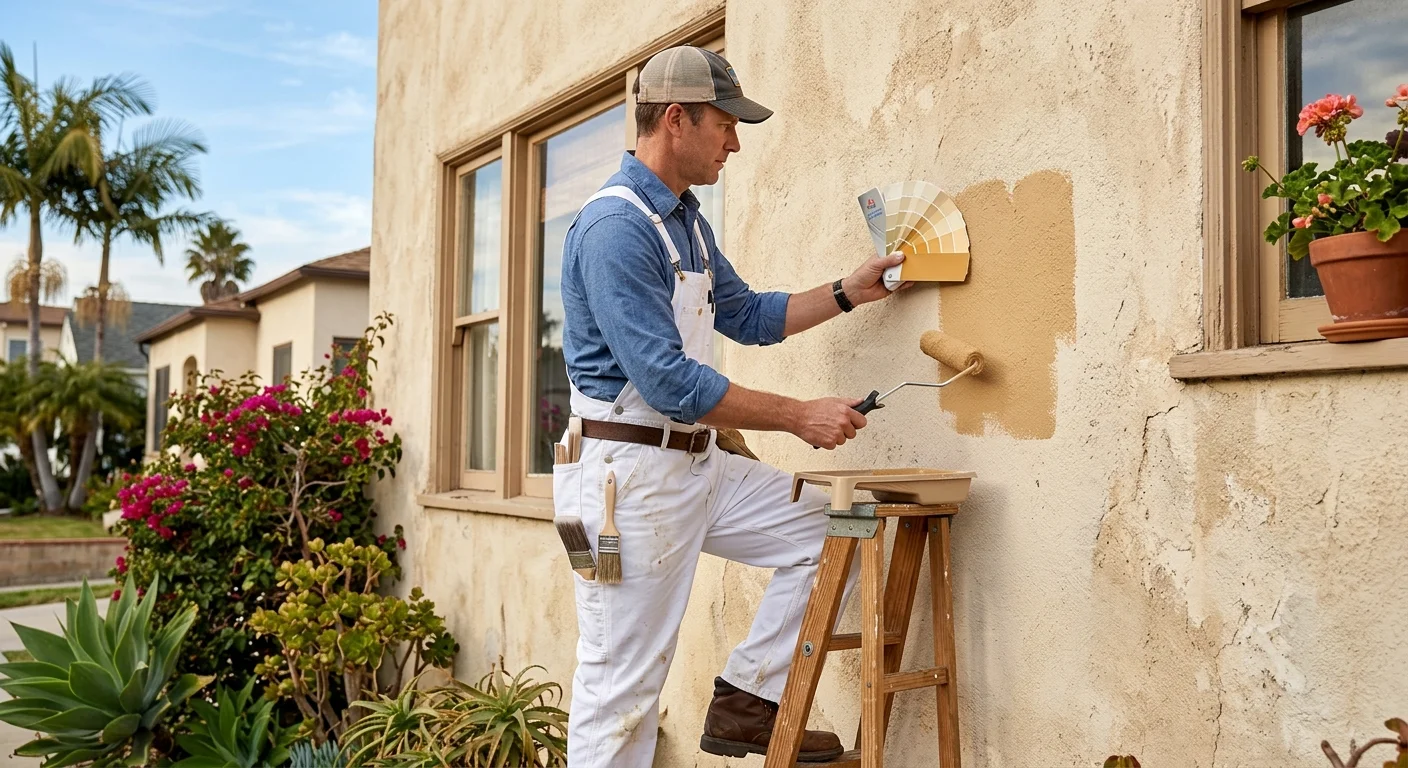
Do not approve a match from a paper fan deck in a store aisle. Have the painter or consultant brush or roll sample cards, then hold them on the actual stucco. Better: paint a small board with the same texture, or a discreet patch on the wall, in the sheen you will use.
Sheen is half the fight. A satin touch-up on a weathered flat wall will flash. Stucco field coats are often lower sheen than trim. If the fascia, window wrap, and garage door are a different formula, sample those too. Fresh caulk around a window will look brighter than aged paint until it weathers. Plan repairs as part of the color check, not after the wall is done.
Named architectural coatings you will hear on San Diego bids include Sherwin-Williams SuperPaint and Duration, Dunn-Edwards EVERSHIELD, and Benjamin Moore Aura or Regal Select. Masonry systems such as Loxon XP show up on stucco specs. Those names are examples of what is sold, not a ranking and not a lifespan claim. Ask the painter to match sheen and product type to the existing system when you are trying to blend, and to keep the same product on the whole elevation when you are not.
Hold field and trim samples together on the wall, not on a table. Trim can save a so-so field match or wreck a good one. If the house is in the Old Town San Diego Planned District, exterior repainting may be subject to city review. Elsewhere in unincorporated county, routine painting and similar finish work is generally exempt from a building permit. Individual cities can differ. Confirm with that city’s development services desk if the property is historic or in a planned district.
Approve the match under changing daylight
San Diego light moves. Approve nothing under a garage fluorescent or a phone screen.
Look at the samples in morning marine layer, when coastal neighborhoods from Ocean Beach through Solana Beach sit in a cool gray. Look again in midday sun on an inland wall in Santee or Poway. Look a third time in late-day west light, when a Point Loma or Pacific Beach elevation throws glare. The same sample can read warm at 8 a.m. and washed at 4 p.m. That is the test. If it only looks right in one hour, it is not a match.
Stand at the sidewalk and at the driveway. A mismatch that disappears at two feet often shows at twenty. If you live with an HOA color list, bring the approved chip to that walk. The faded wall may no longer match the chip. That is a separate conversation from the technical match, and it should happen before anyone opens a full gallon.
Give samples time to dry. A wet film is darker. Come back the next day. Independent painters and color consultants do this walk-through. They should not rush you into a can based on a spectrophotometer reading alone. A scanner is a tool. Daylight on your stucco is the judge. Manufacturer palettes such as Sherwin-Williams color collections help when you decide the faded color is not worth chasing. Use them after you have decided spot match versus a full elevation, not before.
When to call us
Call when you cannot tell if the coating is sound, when one wall has drifted from the others, or when a patch would sit in the middle of a stucco field. Paint Pros San Diego is a referral service. We match you with licensed, independent local painters. Call us at (858) 400-6422 and we’ll connect you with a licensed local painter.