The plumber fixed the leak and left. Now there’s a clean rectangular hole in your wall or ceiling, and you’re staring at it wondering who closes it up. That part isn’t plumbing work at all. It’s drywall finishing and paint, and it has its own decision points worth understanding before you call anyone.
Inspect the opening after the plumbing repair
Once the plumber has confirmed the leak is fixed and the area is dry, the first job is assessing what’s actually left to work with. A painter or drywall finisher looks at the size of the opening, whether the surrounding board got wet or stayed dry, and whether the cut edges are clean enough to patch against or ragged enough to need trimming back to solid material first.
Access openings vary a lot. Sometimes it’s a small hole cut to reach a shutoff valve behind a wall. Other times it’s a much larger section removed to trace a slow leak or replace a section of pipe, and that changes both the repair method and how much surrounding texture and paint has to be matched. If water did get into the surrounding drywall before the leak was found, that wet section needs to be identified now, not discovered later as a soft spot under fresh paint.
This inspection step also decides what kind of patch makes sense. A small, clean hole in an otherwise sound wall is usually a straightforward patch. A larger opening, especially one near a corner, a ceiling, or an area where multiple cuts were made to trace the pipe run, often calls for a full section of new board rather than a patchwork of smaller pieces.
Location matters too. An opening cut into a garage wall or a laundry room, where nobody scrutinizes the finish closely, has more flexibility than one cut into a kitchen or a hallway wall under everyday light. A painter walking through the space with you should ask where the opening sits and how visible it is day to day, since that affects how much texture and paint work is worth doing to make it disappear versus simply getting it solid and sealed.
Decide whether damaged board needs replacement
Not every opening gets patched with the same piece of drywall that was cut out. If the removed section got wet, soft, or damaged during the plumbing work, patching with compromised material just sets up a repeat problem. The painter or drywall finisher checks the cut edges and the surrounding board for softness, delamination, or water staining before deciding.
For a clean, dry cutout, a new piece of drywall cut to fit the opening, taped, and mudded in is usually enough. For anything larger or where the board around the opening shows damage, the repair extends past the original cut to reach solid, sound material on all sides. Trying to save a damaged edge to avoid cutting a slightly bigger hole almost always costs more time later when that edge crumbles during taping.
A local drywall repair pro handles this exact scenario: patching, taping, and finishing an opening left by another trade, sized to the actual damage rather than the minimum the plumber had to cut.
Match orange peel, knockdown, or smooth texture
Once the new board is in and the seams are taped, the texture is what makes or breaks whether the patch disappears. San Diego homes carry a mix of texture styles depending on age and builder, most commonly orange peel, knockdown, or a smooth, texture-free finish, and a patch textured the wrong way stands out no matter how well it’s painted.
Orange peel is a fine, bumpy spray texture common in newer builds and most production homes. Knockdown starts as a similar spray but gets lightly flattened with a trowel before it fully sets, leaving a mottled, more subdued pattern. Smooth walls have no texture at all, which sounds easier to match but is actually the hardest, since any unevenness in the mud finish shows immediately under paint, especially in raking light from a window or hallway fixture.
A painter matching texture typically tests the spray pattern or knockdown technique on a scrap piece or an inconspicuous section first, adjusting the mix and the tool before touching the actual repair. The ceiling texture types guide breaks down these same texture categories in more depth if you’re not sure which one your ceiling or walls already have.
Prepare the repaired area before repainting
Texture match alone doesn’t finish the job. Before any paint goes on, the patched area needs to be properly primed, and this step matters more on a repair than almost anywhere else in a paint job. New drywall compound absorbs paint differently than the surrounding wall that’s had years of paint layered on it, and skipping primer on the patch is one of the most common reasons a repair “ghosts” through as a slightly different sheen or shade once the topcoat goes on.
A stain-blocking primer, something like Cover Stain or B-I-N, is also worth considering if there was any water staining on the surrounding drywall even after it dried, since water stains can bleed through ordinary primer and paint if they aren’t sealed first. Dry times and coverage vary by product and by how much humidity is in the room, so check the manufacturer’s technical data sheet for the specific primer being used rather than guessing at a schedule.
Compare spot painting with a full-wall repaint
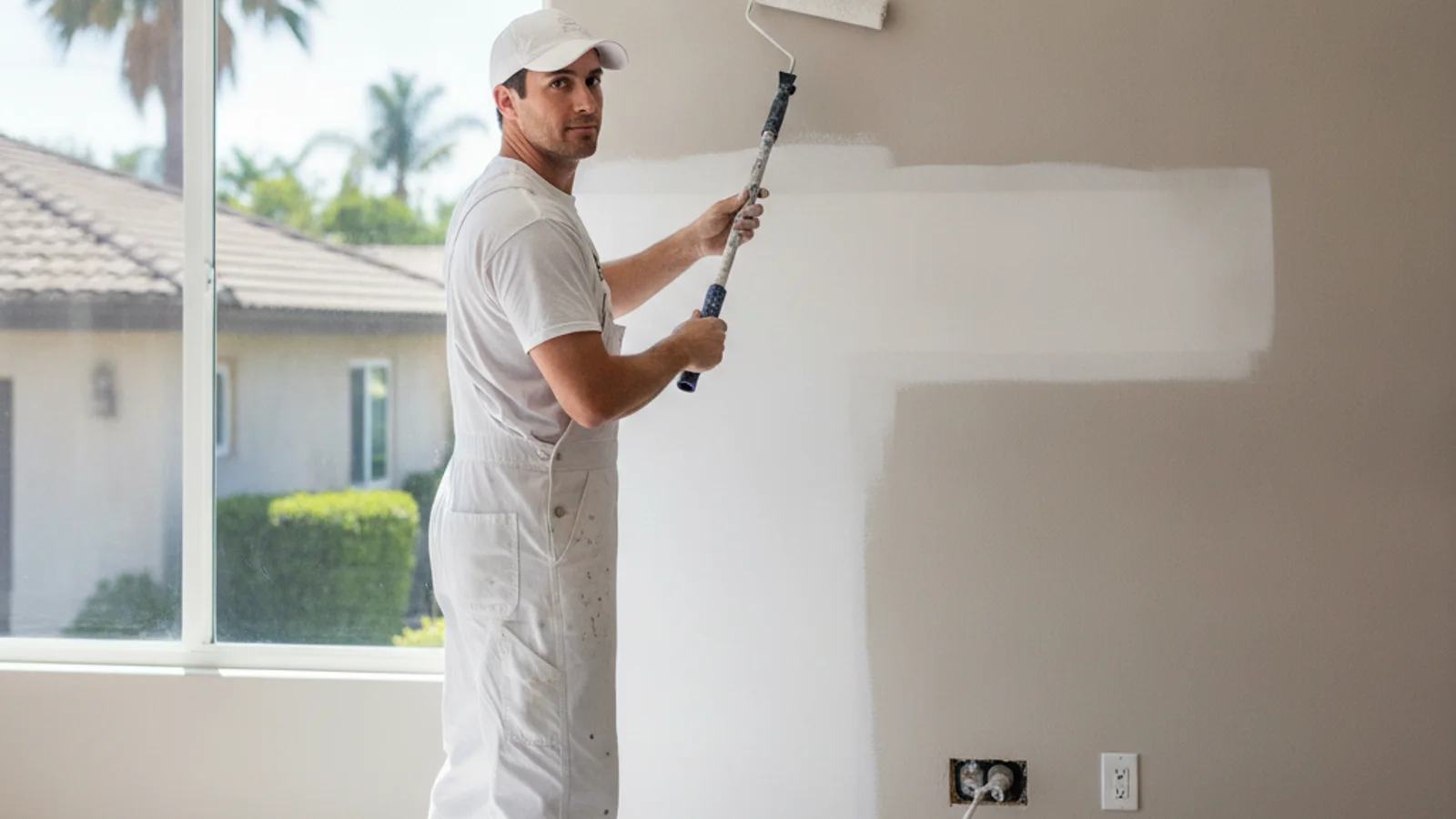
Once the patch is primed, you’ve got a real choice to make: paint just the repaired section, or repaint the full wall. Spot painting is faster and cheaper, but it comes with real risk. Paint sheen and color can shift slightly between cans, batches, and even how the paint was applied years ago versus how it’s rolled on today, and a spot repair on a wall with any wear or sun fading is more likely to show as a visible patch, even with a perfect texture match underneath.
A full-wall repaint eliminates that risk entirely, since the whole surface gets one consistent coat. It typically costs more than a spot touch-up, but on a prominent wall, near an entry, in a living room, or anywhere with strong natural light, it’s often the difference between a repair nobody notices and one that’s obvious from across the room. The interior painting service covers both approaches, and a painter walking the space with you can tell you honestly which one your specific wall and lighting call for.
The paint’s age and how it’s held up also factor into that decision. A wall painted within the last year or two in flat or matte finish is much easier to spot-match than one that’s several years old, has faded from sun through a window, or carries a satin or semi-gloss sheen that shows roller marks differently at the seam between old and new. If the surrounding paint is already due for a refresh, folding the patch into a full repaint often makes more sense than trying to make an aging wall match a brand-new touch-up.
Getting an honest read on cost matters here too. The drywall repair cost guide walks through what drives pricing for patch-and-texture work so you can gauge whether a quote for your specific opening looks reasonable.
When to call us
If a plumber left you with an access opening and you’re not sure whether it needs a patch, a texture match, or a full repaint, that’s exactly the kind of call worth making before you pick up a paintbrush yourself. Call us at (858) 400-6422 and we’ll connect you with a licensed local painter.