Commercial painting cost in San Diego comes down to square footage, surface condition, number of coats, and the coating system the space calls for. Warehouses and big-box interiors sit at the simpler, lower-cost end because the surfaces are uniform, while detailed offices, medical suites, and restaurants take more prep and run higher. Most projects run after hours or in phases so your business can stay open. This guide covers what commercial painting includes, how it’s priced, the coatings that hold up, and how to compare bids.
What commercial painting actually covers
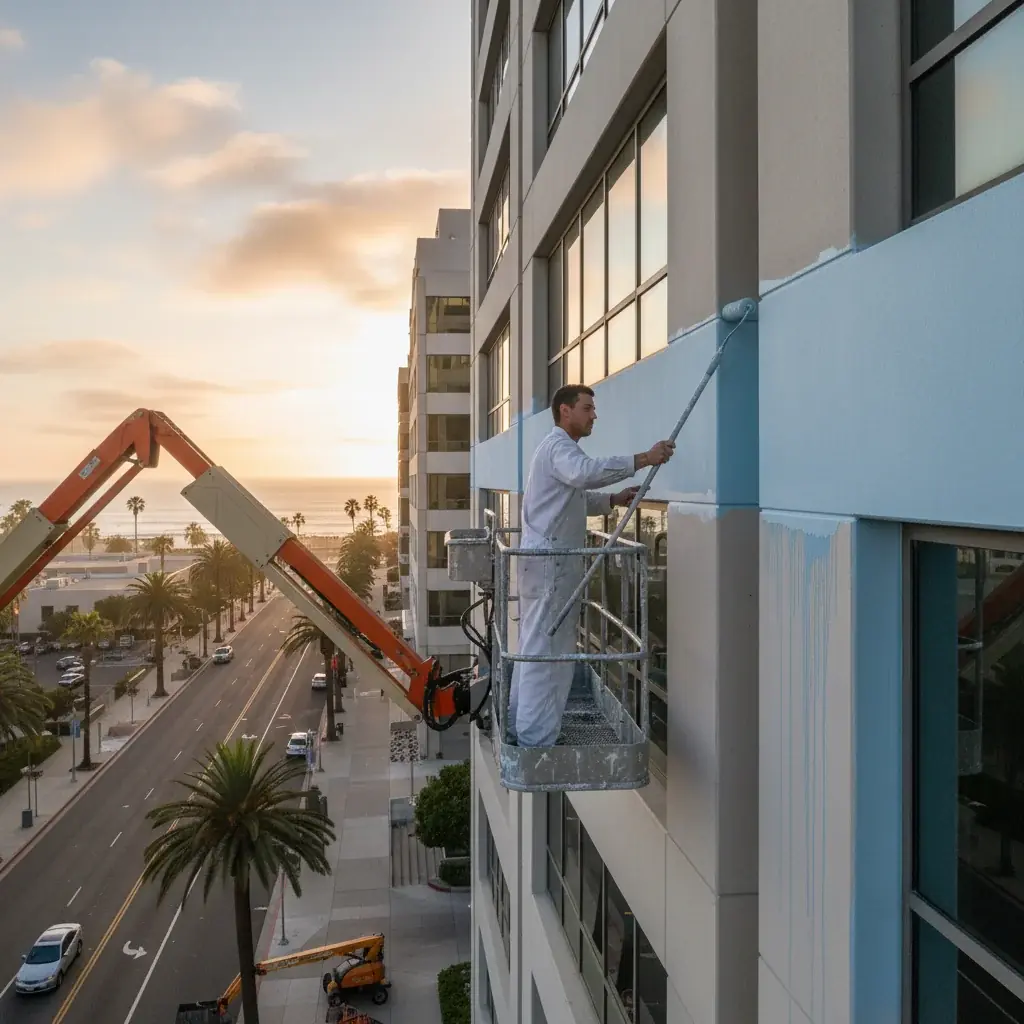
Unlike residential painting, which focuses on homes, commercial painting is a broad category designed for properties used for business. The demands are different, durability, specialized coatings, and minimal disruption are top priorities. A professional commercial painter in San Diego has the equipment, crew, and experience to handle projects of varying scale and complexity.
Here’s a look at the types of properties we typically service:
- Office Buildings: From single-tenant suites to multi-floor corporate headquarters, office painting requires careful coordination, low-odor paints for occupied spaces, and often, after-hours work. This includes common areas like lobbies, hallways, conference rooms, and individual offices.
- Retail Spaces: In retail, appearance is everything. Commercial painters handle storefronts, interiors, and showrooms to create an inviting atmosphere for customers. Projects often involve tight deadlines to align with store openings, rebrands, or seasonal updates.
- Warehouses & Industrial Facilities: These projects focus on durability and safety. Heavy-duty coatings go on concrete tilt-up walls, steel beams, and flooring. Safety markings, line striping, and chemical-resistant paints are common requirements.
- Restaurants & Hospitality: Eateries, cafes, and hotels need paint jobs that are not only attractive but also stand up to constant cleaning and high traffic. Scuff-resistant, washable, and often food-safe coatings are the standard.
- Medical & Dental Offices: Healthcare facilities demand a clinical level of cleanliness. Low-VOC or zero-VOC paints with antimicrobial properties maintain a sterile and healthy environment for patients and staff.
- HOAs & Multi-Unit Properties: Painting for Homeowners Associations involves a larger scale. It requires clear communication with property managers and residents, adherence to community color schemes, and efficient project management across multiple buildings. See our guide to HOA & multi-unit painting for the full process.
Pricing models: per square foot vs project bid
Understanding commercial painting cost is important for budgeting. While every project is unique, contractors generally use two primary pricing models. Knowing the difference helps you interpret quotes and understand what you’re paying for.
Per-Square-Foot Pricing
This model is most common for large, straightforward projects with uniform surfaces, like warehouses or the interior of a big-box retail store. The contractor measures the total paintable square footage (walls and sometimes ceilings) and multiplies it by a set rate.
For a typical interior commercial painting project in San Diego, the per-foot rate moves with a handful of specific factors.
The rate you’re quoted depends on several factors:
- Surface Condition: Walls that need extensive drywall repair, patching, or sanding will be at the higher end.
- Number of Coats: A drastic color change requires a primer and multiple top coats, increasing labor and material costs.
- Accessibility: High ceilings requiring lifts or extensive masking of fixtures will increase the price.
Per-square-foot pricing provides a clear, transparent cost basis, but it may not capture the nuances of more complex jobs.
Fixed Project Bids
For most commercial projects, like offices, retail stores, or medical facilities, a fixed project bid is more appropriate. This is a full price for the entire job, start to finish. A detailed bid will break down costs for labor, materials, prep work, and equipment rentals.
This model is better for projects with:
- Detailed work: Multiple colors, accent walls, trim, doors, and window frames.
- Complex logistics: Working around furniture, employees, or sensitive equipment.
- Variable surfaces: A mix of drywall, concrete block, metal, and wood.
A fixed bid gives you a firm, all-in price, protecting you from unexpected cost overruns as long as the scope of work doesn’t change. When you receive a project bid, make sure it clearly outlines every step, from surface preparation to the exact paint products being used.
After-hours and weekend work to avoid downtime
For most San Diego businesses, closing down for a paint job is not an option. Lost productivity and revenue are major concerns, which is why a key component of professional commercial painting is flexible scheduling. An experienced commercial painter understands that the best work happens when it doesn’t interfere with yours.
This is where after-hours and weekend scheduling becomes essential. By working when your employees and customers are gone, we can complete the project with minimal to zero disruption to your daily operations.
Here’s what that process looks like:
- Strategic Planning: A professional commercial painter works with you to create a phased project plan. For a large office, they might paint one section per night, ensuring it’s clean, dry, and ready for staff the next morning.
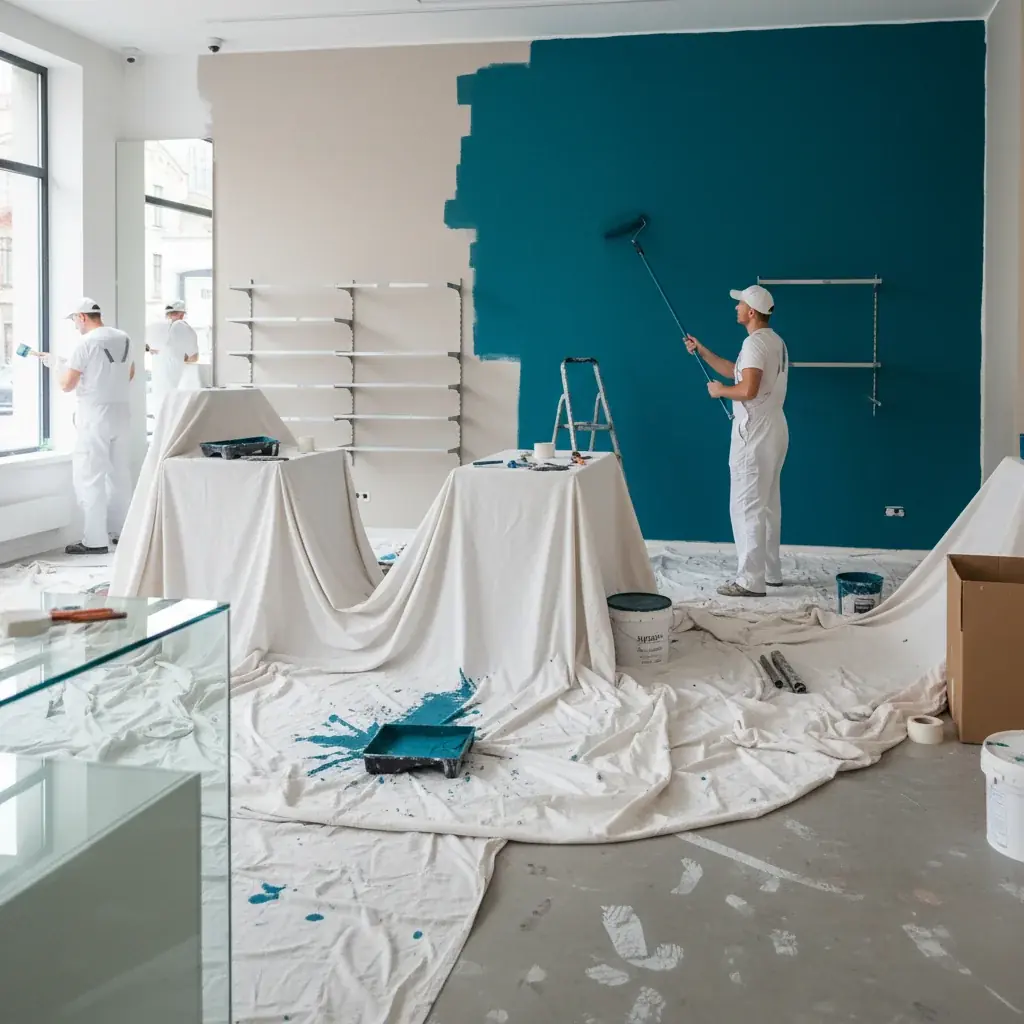
- Containment and Dust Control: Protecting your assets is paramount. Plastic sheeting creates dust barriers and thoroughly covers all furniture, equipment, and flooring. Dust extractors connected to sanders keep airborne particles to a minimum.
- Low-VOC and Zero-VOC Paints: In occupied spaces like an office building, air quality is a health and safety concern. High-quality, low-odor paints with low or zero VOCs, like Sherwin-Williams ProMar 200 Zero VOC, have minimal off-gassing so your team returns to a fresh space without lingering chemical smells.
- Efficient Execution: Professional commercial crews work efficiently in a commercial setting. They arrive after you close, complete the planned section of work, clean up thoroughly, and are gone before your first employee arrives.
This approach ensures your business continues to run smoothly while undergoing a major aesthetic and protective upgrade. It’s a standard practice for any reputable contractor specializing in office painting in San Diego.
Coatings that hold up to traffic and cleaning
The paint on your business’s walls does more than just add color, it acts as a shield. Commercial environments are tough on surfaces. Hallways see scuffs from carts, reception areas get bumped by bags, and breakroom walls need to withstand frequent wipe-downs. Using the right coating is the difference between a paint job that looks great for years and one that fails in months.
Standard residential-grade latex paint simply isn’t engineered for this level of abuse. Professional commercial painters rely on specialized industrial and commercial coatings designed for durability, chemical resistance, and washability.
Here are a few examples of high-performance products commercial painters use in San Diego:
- Sherwin-Williams ProMar 200: This is a workhorse for interior commercial spaces like offices and retail shops. It offers excellent durability and good touch-up performance. The Zero VOC version is ideal for occupied spaces, ensuring better air quality during and after painting, a key consideration under California’s strict air quality regulations.
- Sherwin-Williams Pro Industrial Pre-Catalyzed Waterbased Epoxy: For high-traffic areas like corridors, commercial kitchens, bathrooms, and locker rooms, an epoxy coating is the go-to solution. It dries to an extremely hard, chemical-resistant film that can be scrubbed aggressively without damaging the finish.
- Specialty Coatings: Different environments have unique needs. Anti-static coatings for server rooms, DTM (Direct-to-Metal) acrylics for metal doors and frames, masonry conditioners, and elastomeric coatings for exterior stucco and concrete are all common in the SD commercial context.
Choosing the correct product is a technical decision. A professional contractor will assess each area of your property and recommend a paint system that provides the best long-term value and protection for your investment.
Compliance: OSHA, insurance, and certificates
Hiring a painter for your business involves more than just evaluating their portfolio. As a business owner, you must ensure your contractor operates legally and safely to protect your company from liability. Professional commercial painters take compliance seriously and should be transparent about their credentials.
Here are the key compliance items you should verify before signing a contract:
State Licensing
In California, painting contracts above the state’s minor-work threshold require the contractor to hold a valid C-33 Painting and Decorating license from the Contractors State License Board (CSLB). This license ensures they have met experience and testing requirements. You should always verify a contractor’s license number on the CSLB’s official website.
Insurance Coverage
Insurance is non-negotiable. It protects you, your property, your employees, and the painting crew. There are two critical policies:
- General Liability Insurance: This covers accidental damage to your property or injury to a third party (like a customer or employee) caused by the contractor’s work.
- Workers’ Compensation Insurance: This covers medical expenses and lost wages for the contractor’s employees if they are injured on your job site. Without it, you could be held liable for their injuries.
Certificate of Insurance (COI)
Don’t just take a contractor’s word that they’re insured. Ask for a Certificate of Insurance (COI). This is a one-page document from their insurance provider that proves their coverage is active. Critically, you should ask to be named as an “additional insured” on their general liability policy for the duration of your project. This provides you with direct protection under their policy.
OSHA Compliance
The Occupational Safety and Health Administration (OSHA) sets safety standards for workplaces, including construction and painting sites. A professional commercial painter will have a documented safety program, provide their crew with proper personal protective equipment (PPE), and be trained in the safe operation of equipment like scaffolds and aerial lifts. This commitment to safety minimizes the risk of accidents on your property.
How do you choose commercial painting contractors in San Diego?
Start with the licence, then the schedule, then the bid. Commercial painting contractors in San Diego work on other people’s operating hours, so the ones worth hiring ask about your hours before they quote a price.
Verify the C-33 Painting and Decorating licence with the Contractors State License Board before anything else. Ask for the certificate of insurance naming your business, not a screenshot of a policy number. Then ask how they stage the work: nights for restaurants, weekends for retail, off-hours for offices, phased zones for HOAs and multifamily buildings.
Most commercial painting companies in San Diego quote one of two ways, per square foot or as a project bid, and the two are hard to compare side by side. Make every bidder price the same surfaces, the same coating, and the same number of coats, or you are comparing scope rather than price.
Paint Pros San Diego is a referral service. We do not paint and we set no prices. We match you with one vetted commercial painter who holds an active licence and current insurance, and they quote your building after walking it. If you would rather compare San Diego commercial painters yourself, the checklist below is the one we would use.
How to compare commercial painting bids
Once you’ve solicited quotes from a few commercial painters in San Diego, you’ll need to compare them. It’s tempting to just pick the lowest price, but that can be a costly mistake. A cheap bid often signals that a contractor is cutting corners on preparation, using inferior materials, or is not properly insured.
To make an informed decision, look beyond the final number and compare the proposals line by line.
Scope of Work
Does the bid clearly detail every step of the process? A professional quote will explicitly state:
- The exact areas to be painted (e.g., “all walls in 12 offices on the second floor”).
- The level of surface preparation (e.g., “scrape and sand all peeling paint, spot prime stains, patch holes up to 1 inch”).
- The number of coats of primer and paint to be applied.
- Details on protecting your property (e.g., “cover all flooring, furniture, and fixtures”).
If one bid is vague while another is highly detailed, the detailed one is from a more thorough contractor.
Materials Specified
The bid should name the exact brand and product line of paint to be used (e.g., “Sherwin-Williams ProMar 200 Zero VOC, Eggshell finish”). If a quote just says “premium paint,” ask for specifics. The cost and performance difference between a high-end commercial coating and a cheap residential paint is significant. A lower bid might be using subpar materials that won’t last.
Timeline and Logistics
A professional bid will include an estimated start date and project duration. It should also address logistical considerations, like whether the work will be done during or after business hours and who is responsible for moving furniture.
Warranty
Ask about the warranty. A reputable painter will stand behind their work with a written warranty that covers potential failures in their workmanship, such as peeling or blistering. A one-year warranty is standard, but some offer longer terms.
By comparing these elements, you’ll get a much clearer picture of the value each contractor is offering. The best bid is rarely the cheapest; it’s the one that provides a thorough, professional service with high-quality materials for a fair price.
Frequently asked questions
How much does commercial painting cost in San Diego?
Commercial painting cost in San Diego is driven by square footage, surface condition, number of coats, ceiling height, and the coating system. Warehouses and other uniform, low-prep spaces run cheaper per square foot than detailed offices or medical suites that need more coats and precision.
How much does it cost to paint an office in San Diego?
Painting a small to mid-size San Diego office is priced on square footage, surface prep needed, and whether the work runs after hours. Low-odor, zero-VOC paint for occupied spaces and phased scheduling both affect the final price.
Do commercial painters work after hours or on weekends?
Yes. Most San Diego commercial painters schedule after-hours, overnight, or weekend work so your business stays open. Crews often paint one section per night, leaving each area clean, dry, and ready before staff return the next morning.
What license does a commercial painter need in California?
California requires a C-33 Painting and Decorating license from the Contractors State License Board for painting work above the state’s minor-work threshold. Always verify the license, general liability insurance, and workers’ compensation before signing. You can check license status at cslb.ca.gov.
How do I find commercial painting contractors San Diego businesses actually use?
Ask for the C-33 licence number and check it with the CSLB, then ask for a certificate of insurance naming your business. Any commercial painting company San Diego owners recommend will hand both over without being chased. Call (858) 400-6422 and we match you with one vetted commercial painter instead of a list to work through.
Are commercial painters San Diego wide, or only in the city?
Countywide. The painters in our network cover all 67 San Diego County cities, from coastal Coronado and Encinitas through Chula Vista and National City to the inland valleys and East County. You get one local pro who already works your area, and you hire and pay that painter directly.
How long does a commercial paint job take in San Diego?
A commercial paint job ranges from a few nights for a single office suite to several weeks for a large multi-floor building or warehouse. Phased after-hours scheduling adds calendar time but keeps your business running throughout.
When to call us
When your San Diego business needs a professional touch that minimizes downtime and delivers lasting results, it’s time to call. Paint Pros SD matches commercial property owners and managers with vetted commercial painting contractors who handle the complexities so you can focus on running your business.
Call (858) 400-6422 and we’ll connect you with a vetted local painter.